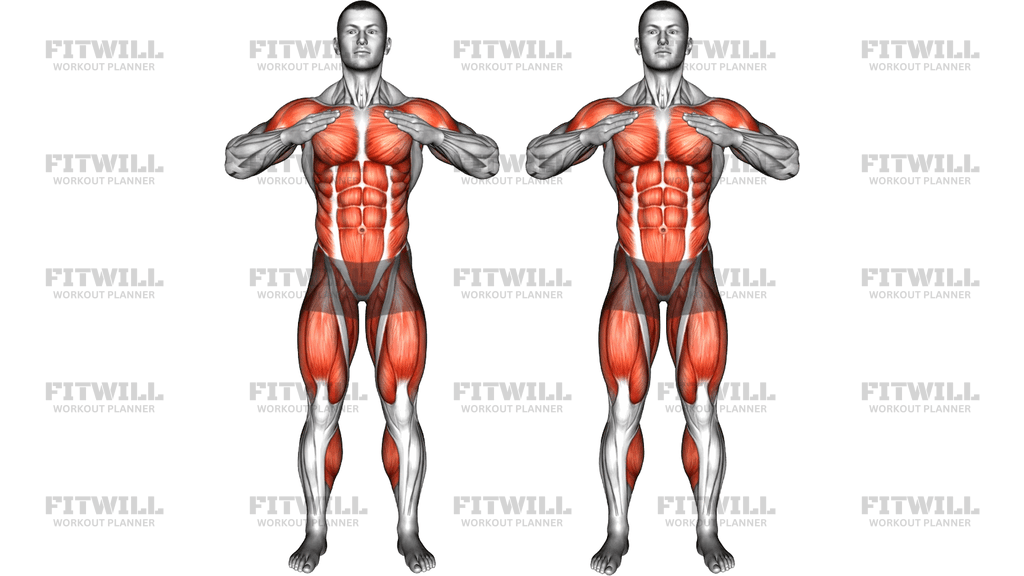
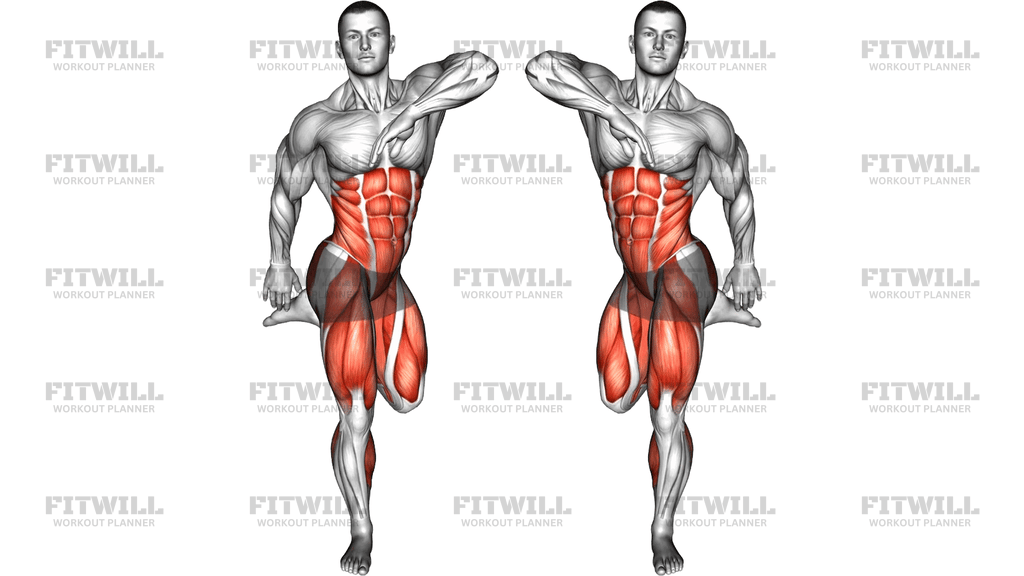
Side Leg Raise With Raised Fist In Standing Balance
Side leg raise with raised fist in standing balance is a balance exercise on one leg performed entirely with your own body weight. You stand upright on one leg with one fist raised straight above your head, then lift the other leg out to the side in a controlled arc while your torso remains upright. The combination of the raised arm and the lateral leg lift forces your obliques, outer hips, and stabilizer muscles to work together to keep you from tipping sideways — which is exactly why this movement is much harder than it looks.
The main work happens in the obliques on the side of the standing leg, which contract to keep your torso from leaning away as the leg rises. The gluteus medius and outer hip muscles of the lifting leg raise and control the leg, while the adductors on the standing leg grip to keep your body centered over your foot. Smaller stabilizers around the ankle and deep core fire continuously throughout the hold, making this a genuine drill for coordinating the entire lower body.
This exercise suits anyone who wants better single-leg stability without equipment: runners and field-sport athletes who cut and change direction, older adults working on fall prevention, and lifters who want to expose left-right imbalances in hip control. Because it loads the hip abductors and lateral core through a balance challenge rather than heavy resistance, it fits well into warm-ups, rehabilitation-style hip routines, and home workouts where no machine or cable is available.
The setup matters more here than in most standing exercises. Your weight must be stacked over the middle of the standing foot, with ribs pulled down, and the raised fist should sit directly above the shoulder rather than drifting forward. If your torso starts tilted or your base foot rolls onto the outer edge, the obliques stop doing their job and the ankle joints take on the stress instead. Take a moment to find a quiet, level surface before you begin.
To perform it well, think of the leg lift as a slow, deliberate arc rather than a kick. Raise the leg only as high as you can keep your hips level, pause briefly at the top, and lower it back with the same control. Height is not the goal; a shorter lift with a level pelvis trains the outer hip far better than a big swing in which the torso collapses sideways. Expect your standing foot and hip to work hard the entire time.
A practical safety note: practice near a wall or a sturdy chair at first so you can touch it with a fingertip if you lose balance. Stop the set as soon as your standing leg starts wobbling noticeably, because form deteriorates quickly once the stabilizers fatigue, and a sloppy repetition teaches poor patterns.
[ Dnevnik i planer treninga ]
Dodajte sljedeći trening u Fitwill
Neka plan i dnevnik treninga budu spremni kad ste i vi.


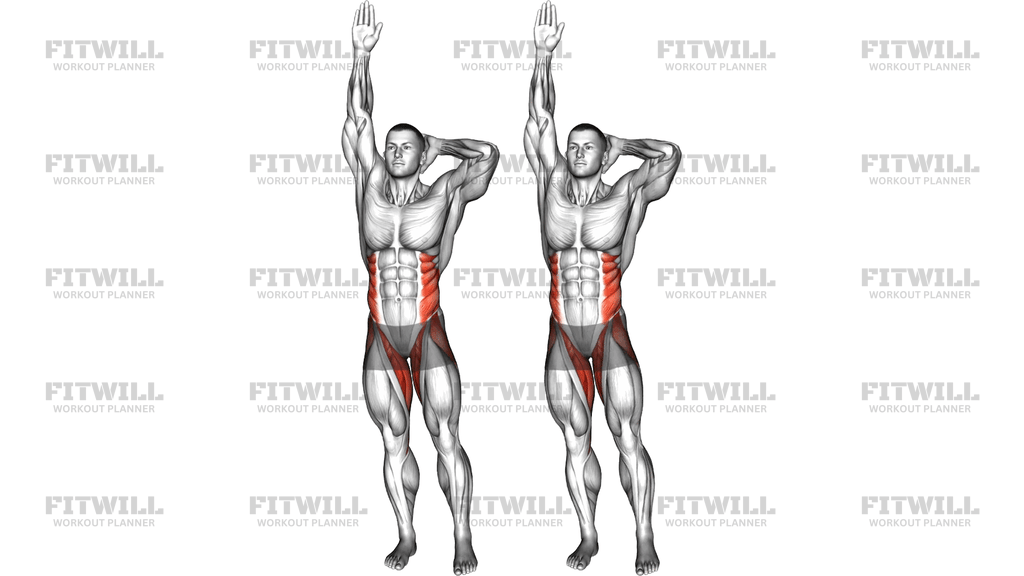
Upute
- Stand upright with your feet together on a flat, level surface, arms relaxed at your sides.
- Shift your weight onto your right foot, make a fist with your left hand, then raise that fist straight overhead until the arm is fully extended above your shoulder.
- Place your right hand lightly behind your head or at your side for balance, pull your ribs down, and brace your core as if preparing for a light push.
- Point your toes forward, spread the toes of your standing foot, and center your weight over the middle of that foot rather than the outer edge.
- Keeping your torso tall and hips square, lift your right leg out to the side in a smooth arc, leading with the outer thigh and stopping at whatever height lets you keep both hips level.
- Hold the top position for one to two seconds without letting your torso lean away from the lifted leg.
- Lower the leg back down under control until the toes lightly touch the floor or hover just above it.
- Breathe steadily throughout, exhaling as you lift the leg and inhaling as you lower it.
- Complete all repetitions on one side, then switch so the opposite fist is overhead and the other leg performs the lift.
- Reset your stance and brace between sides so each set starts from a balanced, upright position.
Savjeti i trikovi
- The most common mistake is hiking the hip of the lifting leg to gain height; keep both hip bones level and accept a lower lift if that is what it takes.
- If your standing foot keeps rolling onto the outer edge, deliberately press the base of your big toe into the floor before starting the lift.
- Do not let the raised fist drift forward over your face; keep it stacked above the shoulder so the lateral core stays loaded.
- A slow two-second lift with a one-second pause beats a fast swing every time, because momentum hides weak hip control rather than fixing it.
- If balance falls apart immediately, hover a fingertip against a wall on the same side as your standing hand rather than dropping the arm overhead.
- Watch for the torso tipping away from the lifting leg; cue yourself to grow taller through the crown of the head as the leg rises.
- Keep the lifted leg in a neutral position and lead slightly with the heel, because turning the toes up and out usually means the lower back is arching to fake extra range.
- Barefoot or in flat shoes works best; thick, soft running soles make the ankle stabilizers work overtime and can make you feel wobblier than you are.
- If one side lifts noticeably higher than the other, match the height of your weaker side on both sides until the difference closes.
Često postavljana pitanja
Which muscles does the side leg raise with raised fist in standing balance work the most?
The obliques on the side of the standing leg work hardest to keep your torso upright, while the gluteus medius and outer hip muscles of the lifting leg raise and control the leg. The inner thigh of the standing leg and the ankle stabilizers support the whole position.
Is this exercise suitable for beginners?
Yes, as long as you reduce the lift height and stay near a wall or chair for a light fingertip touch. Beginners often progress faster with short, frequent holds than with long, wobbly sets.
Why does the fist stay raised overhead during the side leg raise?
The overhead fist raises your center of mass and lengthens the lever your lateral core must control, which makes the obliques and hip stabilizers work much harder than in a plain side leg raise with arms down.
How high should I lift my leg?
Lift only as high as you can keep both hips level and your torso upright, which for many people is around 30 to 45 degrees. Height gained by leaning or hiking the hip comes from the wrong muscles.
What is the most common mistake in this movement?
Leaning the torso away from the lifting leg or letting the standing foot roll outward. Both errors shift the work away from the obliques and hip abductors and load the lower back and ankle joints instead.
Can I substitute it with a side leg raise lying down?
A side leg raise lying down targets the outer hip similarly, but it removes the balance demand, so it is easier and trains less lateral core. Use the lying version if standing balance is currently a limiting factor.
How many repetitions and sets should I do?
Start with 2 to 3 sets of 8 to 12 controlled lifts per side, resting briefly between sides. If your standing leg shakes early, switch to lower reps with a wall nearby and build up gradually.
Should I hold onto something for balance?
Only use a fingertip on a wall or the back of a chair, not a full grip. A full hand hold lets you lean on the support and takes most of the stabilizing work away from the standing hip and core.
Is it safe for people with knee or hip discomfort?
Generally yes because it is low-load and body weight only, but keep the range small and pain-free. If a specific position causes sharp joint pain, shorten the lift or consult a qualified professional before continuing.