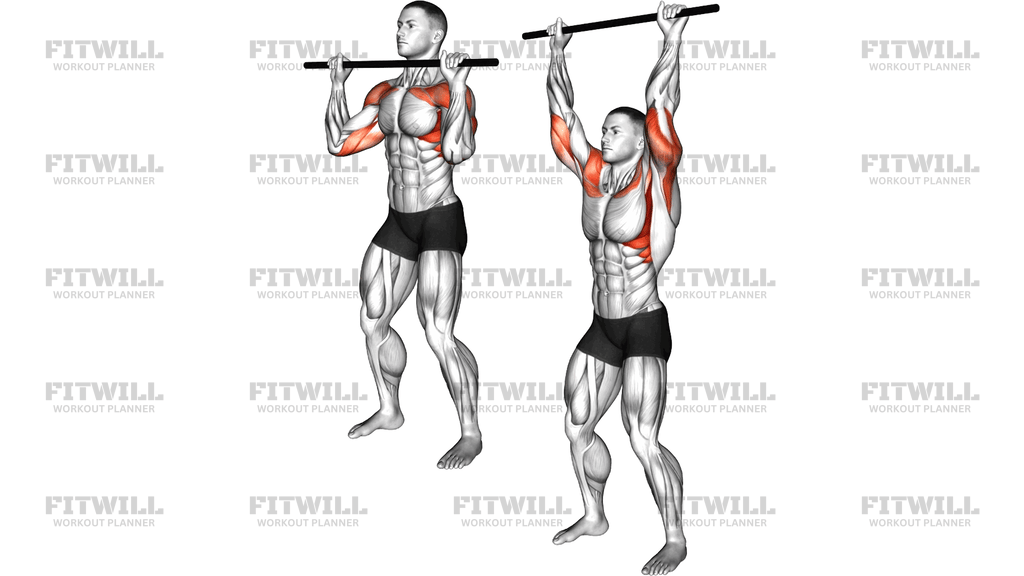
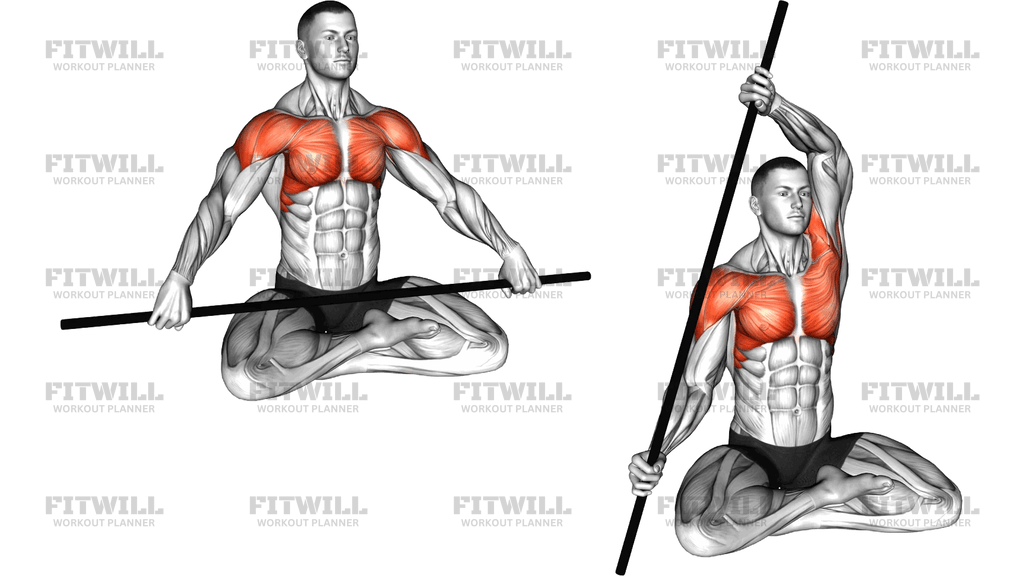
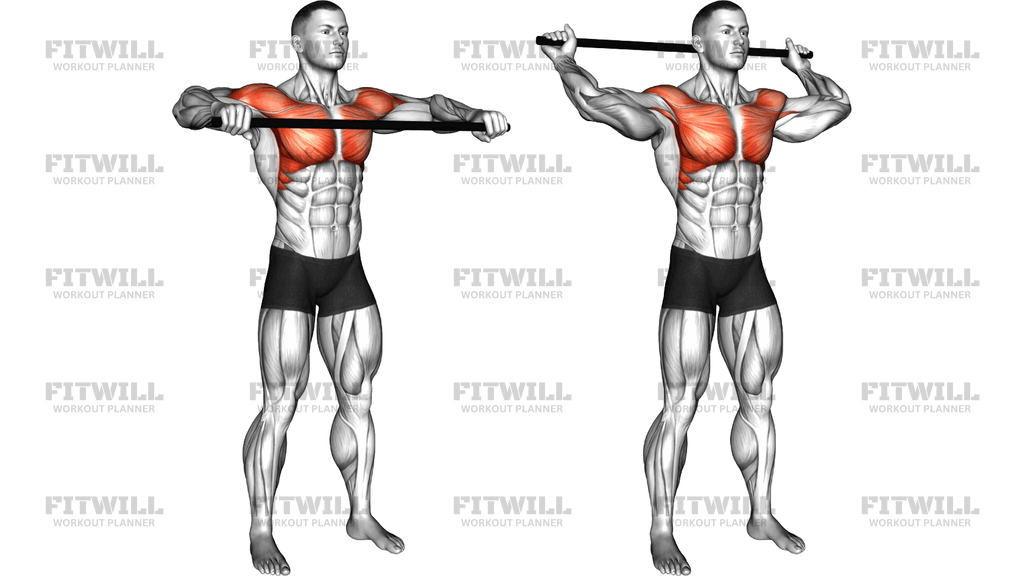
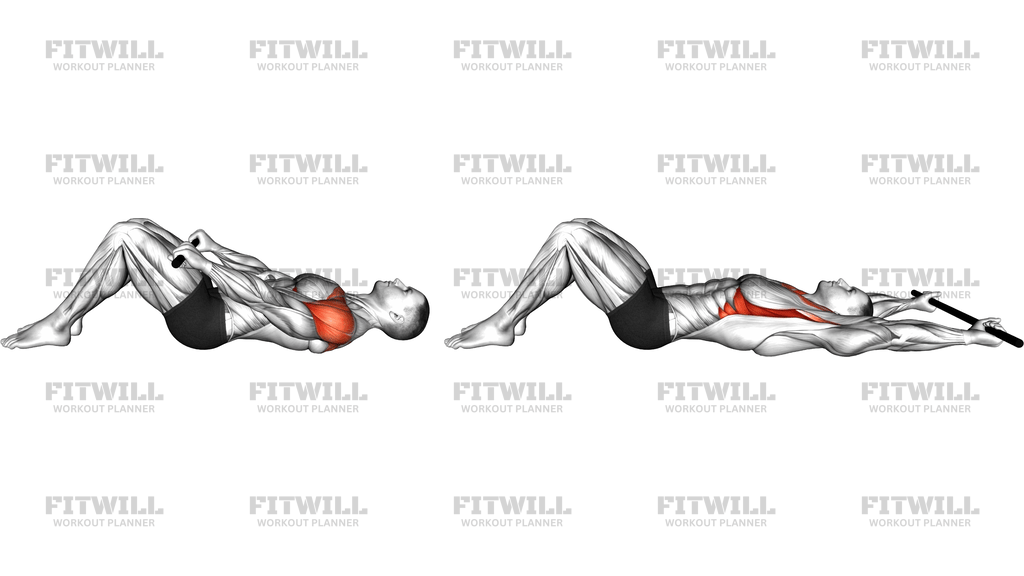
Assisted Shoulder Flexion While Standing With A Stick
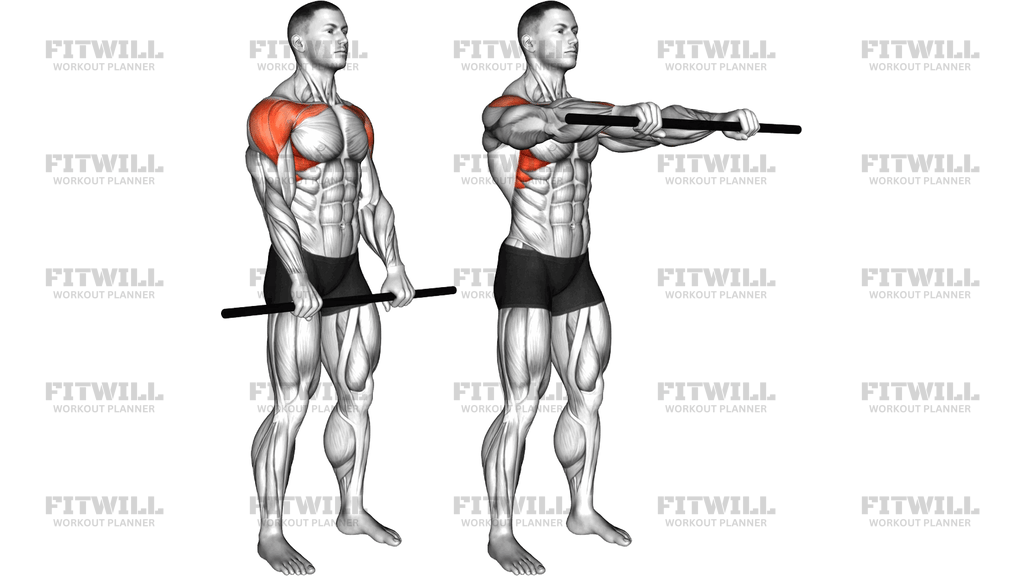
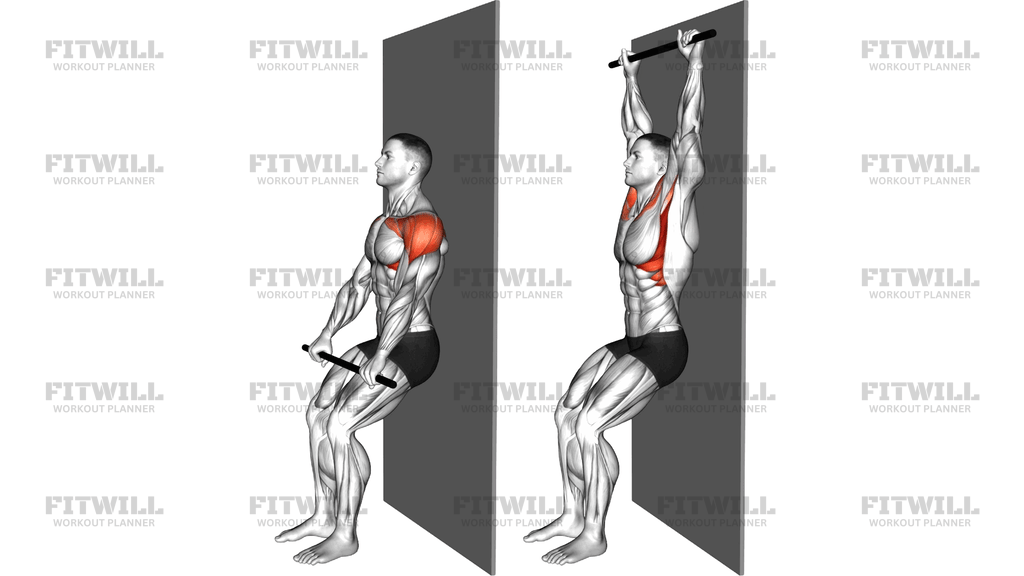
Assisted shoulder flexion while standing with a stick is an exercise for shoulder mobility in which you raise a stick from your thighs to above your head with straight arms, usually with your back against a wall. The stick serves as a fixed reference point between both hands, preventing one arm from cheating and forcing both shoulders to work through the same range. It is one of the simplest and most reliable ways to measure and improve shoulder flexion above the head.
This movement is useful for almost anyone with limited range of motion above the head: people recovering from shoulder stiffness, office workers with rounded upper backs, weightlifters who lose position in presses and pull-ups, as well as swimmers and racket sports athletes who need full overhead reach. Since the load is only a light stick, the exercise challenges range and control rather than strength, making it suitable for beginners and as a warm-up before heavier upper body training.
The main muscles engaged during the raise are the front delts, which drive the arms up, along with the serratus anterior and upper traps, which rotate and elevate the shoulder blade so the arm can travel fully above the head. The wall behind you adds an important constraint: if your ribs flare and your lower back arches to fake extra shoulder range, you will feel it immediately against the wall. That feedback is exactly what makes the setup more important than the movement itself.
To perform it correctly, stand with your back against a wall, feet a few centimeters out, knees slightly soft. Grip the stick with an overhand grip at shoulder width or slightly wider, hands resting on the front of your thighs. Keeping your arms straight and your wrists, elbows, and the back of your head in contact with the wall where possible, slide the stick up along your body until it is directly above your head. Move slowly and go only as high as you can without flaring your ribs, arching your lower back, or bending your arms.
A common use is a daily shoulder mobility routine: two or three sets of eight to ten slow repetitions, either as a warm-up or as a standalone mobility exercise on days between training. Many weightlifters also use the top position as an active stretch, holding the stick overhead for a few seconds to open the lats and chest. If you cannot maintain contact with the wall throughout the entire arc, that gap is your working range — train within it and let it improve gradually, rather than forcing your arms past the wall.
As with any mobility exercise, consistency beats intensity. Move within a range you can control, keep your neck relaxed, and stop if you feel sharp pain in the shoulder joint rather than a stretch in the chest, lats, or the shoulder itself.
[ Dnevnik i planer treninga ]
Isplaniraj sljedeći trening u Fitwillu
Plan i dnevnik treninga imaj pri ruci kad poželiš početi.


Upute za izvođenje
- Stand with your back against a wall, feet about 10-15 cm in front of it, knees slightly bent, with your head, upper back, and pelvis touching or close to the wall.
- Grip the stick with an overhand grip about shoulder-width apart, arms straight down in front of your hips with the stick resting on the front of your thighs.
- Lightly tighten your core and gently press your lower back toward the wall to keep your ribs down; this prevents arching as the arms rise.
- With elbows locked straight, begin sliding the stick up along the front of your body, allowing the shoulder blades to rotate upward as the arms travel.
- Continue raising the stick until it is directly above your head with your arms in line with your ears; keep the back of your head, upper back, and wrists in contact with the wall as much as your range allows.
- At the top, pause for one or two seconds and reach slightly taller with your arms, without aggressive shrugging or flaring the ribs.
- Slowly lower the stick back down along the same path to your thighs, resisting gravity instead of letting it fall.
- Breathe steadily: inhale as the stick rises, exhale as you lower it, and avoid holding your breath at the top.
- Reset your points of contact with the wall between repetitions, then repeat for 8-10 controlled reps.
Savjeti za vježbanje
- The most common mistake is arching the lower back off the wall to gain fake overhead range. Keep your ribs stacked over your pelvis; if you feel your back peeling off the wall, that is your true end range.
- Bending the elbows is the second most common mistake. It shortens the lever and hides shoulder limitation, so lock your arms straight and accept a shorter arc if necessary.
- If your wrists cannot stay against the wall at the start of the raise, widen your grip slightly. As mobility improves, gradually bring your hands closer to shoulder width.
- Shrugging your shoulders up before the arms start moving turns the exercise into a trap exercise. Allow the shoulder blade to rotate upward as a result of the arm rising, not as a separate movement.
- Treat the wall as a quality check, not an enemy. Points of contact may be limited at first; work within the range you can maintain and let it expand over the weeks.
- Move slower than necessary. A three-second raise and a three-second lower gives the shoulder time to work through its end range and reveals where you actually stall.
- If one side lags behind the other, the stick makes it obvious — the lower side will lift later and unevenly. Do a few extra reps with focus on the stiffer side, or perform the exercise with a narrower grip on that side to load it more.
- A hanging stretch position at the top can help tight lats, but never force the stick behind your head. Once the stick passes over the top of your head, hold it there instead of pulling it further back.
- Warm shoulders move better than cold ones. A minute of easy arm circles or a warm shower beforehand often adds noticeable range to this exercise.
- Expect a stretching sensation through the chest and lats rather than effort in the shoulders. Sharp pinching at the front of the shoulder means you should reduce the range or stop.
Često postavljana pitanja
Which muscles does assisted shoulder flexion while standing with a stick work?
The front delts lift the arms, while the serratus anterior and upper traps rotate and elevate the shoulder blade to allow full movement above the head. Since the load is light, it primarily trains shoulder range and control rather than strength.
Why does assisted shoulder flexion while standing with a stick use a wall behind the back?
The wall prevents arching of the lower back and flaring of the ribs, the two most common ways to fake overhead range. It gives you instant feedback on whether the movement comes from the shoulders or from your spine.
How wide should my grip on the stick be?
Start slightly wider than shoulder width if your shoulders are stiff, because a wider grip makes the raise easier. Narrow the grip gradually as your overhead range improves.
Is assisted shoulder flexion while standing with a stick good for beginners?
Yes. The stick weighs almost nothing, the wall provides clear positional feedback, and the range is self-limiting, so beginners can safely learn their true shoulder range.
My lower back keeps coming off the wall during the raise. What should I change?
Stop the raise at the point where your back stays flat and work only within that range. Also lightly tighten your core and bend your knees a bit more; as shoulder mobility improves, the arching will disappear on its own.
Can I do this exercise without a stick?
You can raise your arms without assistance, but without the stick each hand can drift and compensate independently, which defeats the purpose. A broom handle, dowel, or even a taut towel held between the hands works as a substitute.
How many reps and sets of assisted shoulder flexion while standing with a stick should I do?
Two to three sets of eight to ten slow repetitions work well, either as a warm-up before pressing or pulling, or as a daily mobility exercise. You can also hold the top position for a few seconds on the last rep of each set.
Should I feel it in the shoulder joint or around it?
You should feel effort in the front delts and a stretch through the chest, lats, and shoulder area, not a pinching inside the joint. Sharp pinching at the front of the shoulder is a signal to reduce the range or skip the exercise that day.
Can assisted shoulder flexion while standing with a stick help my overhead press?
Indirectly, yes. It builds the overhead flexion range and ribcage control required by a strict press, so many weightlifters use it as a warm-up before pressing work with a barbell or dumbbells.
How long before I notice better shoulder mobility from this exercise?
Most people notice a small improvement in ease of movement within a few sessions of consistent practice, while lasting range changes usually take several weeks of regular work. Progress is gradual, so retest your points of contact with the wall every two weeks.