Lying Triceps Extension With Rope On A Pulley
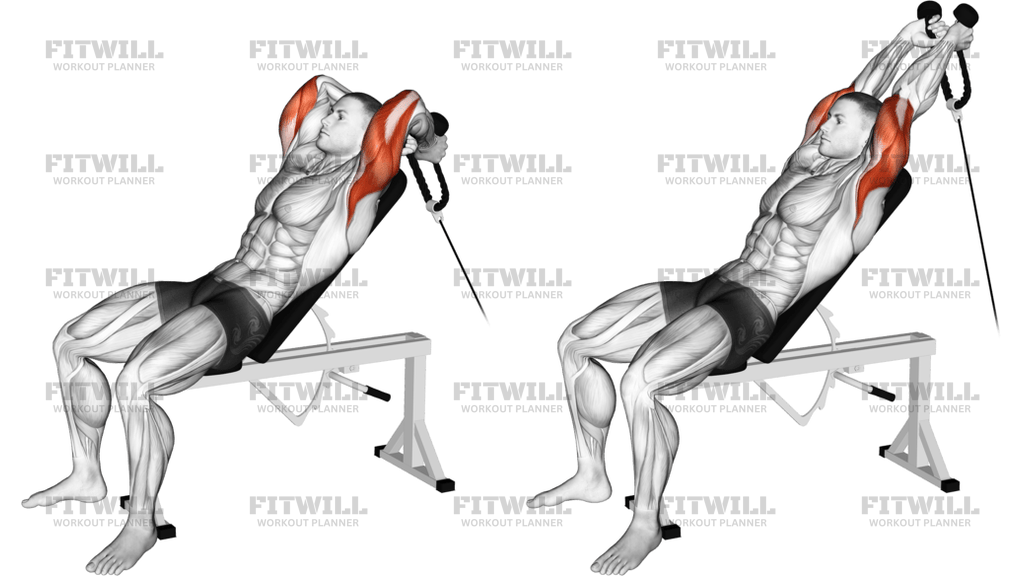
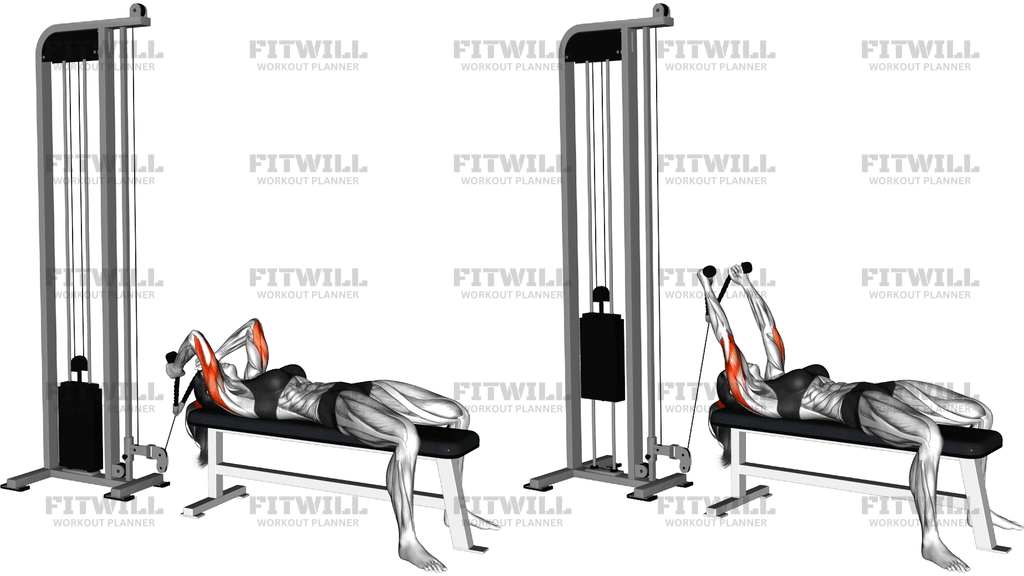
Lying triceps extension with rope on a pulley is a variation of the so-called skull crushers, performed on a flat bench with a rope attachment connected to the lower pulley of a cable machine. You lie on your back with your head toward the pulley, hold the rope ends in both hands, and extend your arms from a bent-elbow position until they point up toward the ceiling. Since the cable pulls from behind the head at a low angle, the tension on the triceps remains smooth and consistent in a way that dumbbells and barbells cannot match.
This movement primarily trains the triceps brachii, with particular emphasis on the long head. When the upper arms point back over the head, the long head is stretched across the shoulder joint, and extending against that stretch loads it with a strong mechanical load. The lateral and medial heads of the triceps also participate, while the wrists and shoulders work in a supportive role, holding the rope and stabilizing the position of the arms.
The setup matters here more than with many triceps exercises. The low pulley position means that gravity and the weight stack pull the hands down and back, so your body position on the bench determines whether the resistance hits the triceps or drains into the shoulders and elbows. Lying far enough down the bench that the cable clears your head, keeping your upper arms fixed and slightly angled back, and holding the rope in a neutral grip are the details that separate a productive set from an awkward one.
The execution is simple in principle: start with your elbows bent so your hands come back toward or just behind your head, then extend only at the elbows, slightly spreading the rope ends apart as you reach full extension. Tighten your triceps at the top, then lower with control, letting the elbows bend without the upper arms moving. The resistance curve of the cable makes the top of the rep especially effective, so a brief pause at full extension will pay off.
This exercise is suitable for exercisers who want a joint-friendly alternative to barbell skull crushers or heavy overhead extensions. The rope allows the wrists to settle into a neutral, natural angle, which many people find easier on the elbows than a fixed straight bar. It fits well as a secondary or finishing movement on arm or upper body training days, typically with moderate weights and controlled reps, and it is manageable even for beginners once they feel confident setting up at a cable machine.
For safety and quality, approach this as a precision exercise rather than an ego lift. Choose a load you can lower slowly without your elbows flaring out or your shoulders pulling off the bench, and keep your head neutral instead of tilting it forward. If you feel pinching in your elbows, reduce the weight, fix the elbow position, or shorten the range slightly before continuing.
[ Tréningový denník a plánovač ]
Priprav si ďalší tréning vo Fitwill
Tvoj plán aj tréningový denník vždy poruke.


Ako vykonať cvik
- Set a flat bench lengthwise in front of a cable machine and attach a rope to the lower pulley.
- Lie on your back with your head closest to the pulley, so the cable runs past the top of your head without touching it.
- Grip one end of the rope in each hand in a neutral grip with palms facing each other, and brace yourself with your feet flat on the floor.
- Raise your upper arms so they point slightly back over your head, and keep them fixed in that position throughout the entire set.
- Tighten your core and gently press your shoulders into the bench before starting each repetition.
- Start with your elbows fully bent so your hands come back toward or just behind your head, feeling the stretch in your triceps.
- Extend your elbows and press the rope up toward the ceiling, slightly spreading the rope ends apart as you straighten your arms.
- Pause briefly at full extension with vertical arms and firmly tighten your triceps.
- Slowly bend your elbows and return the rope back behind your head, exhaling during the press and inhaling on the way down.
- Finish the set, then carefully sit up and let the cable return to the weight stack before releasing the rope.
Tipy a triky
- Slide your body on the bench until the cable path is clear of your head; if the rope drags across your face or hair, you are too close to the pulley.
- The most common mistake is letting the elbows drift forward during the press, which turns the movement into a partial press. Imagine your upper arms are bolted in place and only your forearms move.
- Spread the rope ends apart at the top instead of pulling them together. Pulling inward causes the hands to drift toward each other and shortens the triceps contraction.
- If your elbows flare out as fatigue sets in, reduce the weight by one plate. Flared elbows shift stress to the shoulder joint and reduce the stretch of the long head.
- Keep your lower back in contact with the bench. Excessive arching to help with the press is a sign that the load is too heavy for strict triceps work.
- Since the low pulley provides no resistance at the very bottom when the cable goes slack, use the stretched position to prepare for the next rep instead of bouncing out of it.
- A neutral rope grip is kinder to the wrists than a fixed bar. If your wrists hurt when performing skull crushers with a straight bar, this rope version is often the better choice.
- Stop each rep just before a violent lockout; a soft but complete extension with a deliberate contraction trains the triceps better than snapping the elbows straight.
- Set the weight before you lie down and make sure the pin is fully seated so the weight stack does not jump during the set.
Často kladené otázky
Which muscles does the lying triceps extension with rope on a pulley target?
It targets the triceps brachii, with the long head doing most of the work, because the upper arms point back over the head, stretching it across the shoulder. The shoulders and wrists help only with stabilization.
Why use a low pulley and rope instead of dumbbells for lying triceps extensions?
The cable keeps constant tension on the triceps throughout the entire range of motion, including the fully extended position at the top, where the resistance of a dumbbell would fade. The rope also allows a neutral wrist position, which many exercisers find easier on the elbows than a fixed bar.
Is the lying triceps extension with rope on a pulley suitable for beginners?
Yes, once you feel confident setting up on a bench next to a cable machine. Start with a light weight to learn the elbow-only movement path and the position of the cable behind your head before adding load.
How far back should I angle my upper arms during this exercise?
Angle them slightly back over your head, past vertical toward the floor behind you. This position keeps the long head of the triceps under tension and ensures that the movement is driven by the elbows and not the shoulders.
Why does the cable go slack at the bottom of the rep?
With the pulley set low behind you, there is little to no tension when your hands return to the floor behind your head. This is normal; treat the bottom position as a reset point, keep your elbows fixed, and press back up with control instead of relying on momentum.
My elbows hurt when performing this movement. What should I change?
Reduce the weight, keep your elbows close to your body and stationary, and avoid letting your forearms drop so low that the stretch becomes uncomfortable. The neutral rope grip already helps, but forcing a very deep bottom position under a heavy load is a common cause of elbow discomfort.
Can I substitute a straight bar or EZ bar for the rope attachment?
Yes, the movement pattern remains the same, but the bar fixes the angle of your wrists, which some exercisers find harsher on the elbows. If you switch, use a moderate grip width and keep the same upper arm position.
How should I breathe during the lying triceps extension with rope on a pulley?
Exhale as you press the rope up toward the ceiling and inhale as you lower it back behind your head. Breathe evenly instead of holding your breath throughout the repetition.
Where should this exercise fit into my training week?
It works best as a secondary triceps movement after pressing exercises, with moderate weights in sets of roughly 8 to 15 controlled repetitions. Since the cable is gentle on the joints, it is also a great choice for the final arm exercise when your elbows are already fatigued.