Leg Raise On A Captain's Chair With A Dumbbell
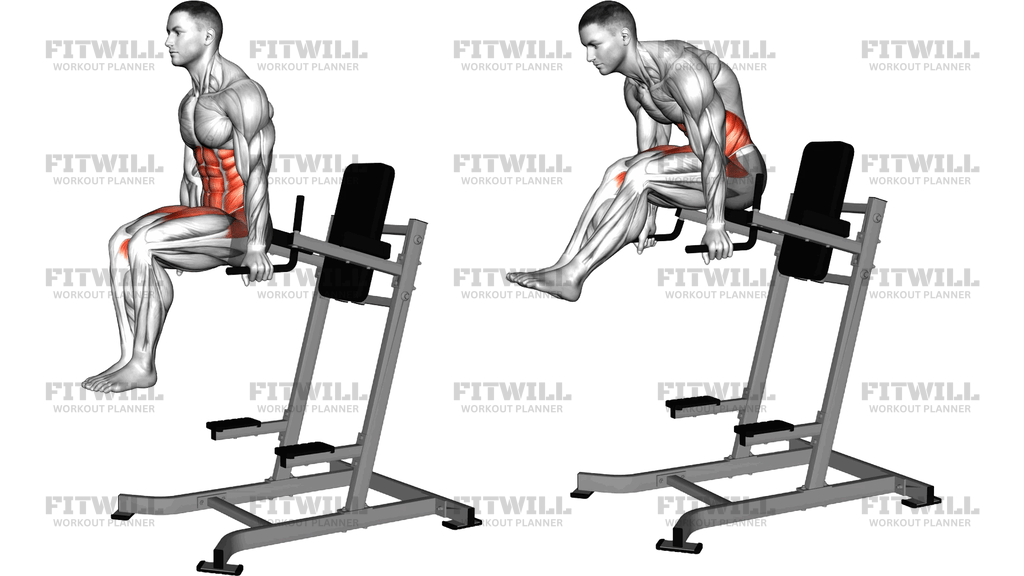
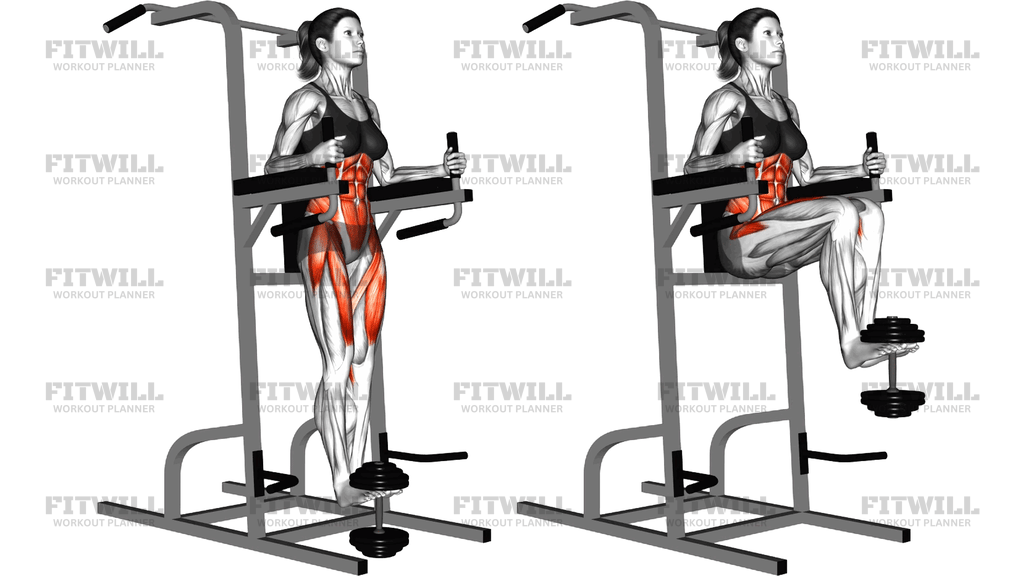
The leg raise on a captain's chair with a dumbbell builds on the classic raise of the knees or legs on the captain's chair and adds an external load that you clamp between your feet as a dumbbell. You hold yourself in the vertical station with your forearms resting on the pads, your back against the backrest and your legs hanging freely, and then lift your knees (or straighter legs) toward your chest against the added resistance. The weighted version is one of the most demanding abdominal exercises you can perform in this station, because the abs and hip flexors must accelerate and control not only the lower body, but also an additional load throughout the entire arc of the movement.
This exercise is suitable for intermediate and advanced trainees who can already perform 10 to 15 clean leg raises with their own weight without swinging. If hanging leg raises exhaust your grip and lats before the abs do enough work, the captain's chair completely removes this limitation: your torso is braced against the pad, so the forearm muscles never become the weak link. That is why it is a great choice for anyone who focuses purely on the strength of the abdominal muscles and hip flexors.
The main working muscles are the lower and middle fibers of the rectus abdominis, which pull the pelvis toward the ribcage as the legs rise. The hip flexors, especially the iliopsoas and rectus femoris, drive the legs upward, while the transverse abdominis and obliques work hard to prevent your spine from arching and your torso from rotating as the dumbbell pulls downward. The forearms, shoulders and upper back hold a static contraction throughout the entire series to keep you stable in the chair.
The setup matters here more than in most exercises for the abdominal muscles. Once the dumbbell is between your feet, any sloppiness is amplified: a loose grip on the weight, an arched lower back, or a torso that shifts forward off the pad will leak tension and shift the work away from the abs. Before each repetition, firmly press your lower back against the backrest and tense your midsection as if preparing to absorb a slight blow. This contact point is your guide to whether the movement remains honest.
For good execution, firmly clamp the dumbbell between your feet with your toes wrapped over it, and then lift your knees forward until your thighs are at or above parallel with the floor. Perform the last few degrees by curling the pelvis upward, rather than just letting the hip flexors do all the work. Lower with control, resist the dumbbell on the way down, and stop just before your legs hang completely loose, so that the tension remains on the abdominal muscles.
The most common uses are building abdominal strength for calisthenics skills such as toes-to-bar, adding progressive overload to core training once leg raises with your own weight feel too easy, and strengthening the hip flexors for sprinting and kicking sports. Start with a light weight, stay in the 8 to 12 repetition range, and add load only when you can keep your back flat against the pad in every repetition. If the dumbbell starts to slip or your lower back peels off the backrest, the series is over.
[ Tréningový denník a plánovač ]
Priprav si ďalší tréning vo Fitwill
Tvoj plán aj tréningový denník vždy poruke.


Ako vykonať cvik
- Step onto the footrests of the captain's chair and settle in so that you have your forearms on the armrests and your hands are gripping the vertical handles.
- Place the dumbbell on the floor below your feet, hook your toes under the handle, and firmly clamp it between both feet before lifting your legs off the footrests.
- Press your lower back flat against the backrest, let your legs hang straight down, and firmly tense your abdominal wall.
- Exhale and lift your knees up and forward, while holding the dumbbell firmly clamped between your feet the entire time.
- Continue lifting until your thighs are at or above parallel with the floor, and then slightly curl the pelvis upward to engage the lower abs at the finish.
- Pause briefly at the top without letting your torso slide forward off the backrest.
- Inhale as you lower your legs with control, resisting the weight of the dumbbell throughout the entire movement.
- Stop just before your legs hang completely loose, so that the tension remains on the abdominal muscles, and then begin the next repetition.
- Throughout the entire series, keep your shoulders pulled down away from your ears and your head in a neutral position.
- When finished, place your feet on the footrests, release the dumbbell to the floor, and then step down.
Tipy a triky
- Most people lose the dumbbell because they only rest their toes on top of it instead of hooking them over the handle. Curl your toes downward over the weight so that it remains clamped between the top of the foot and the shin.
- If your lower back arches off the backrest at the bottom of the repetition, you are lifting too heavy a weight or lowering too deep. Slightly reduce the range of motion so that your sacrum stays in contact with the pad.
- Do not turn this into an exercise based on momentum: if the dumbbell swings forward and your torso rocks, slow the descent to a three-second count until the swinging disappears.
- If possible, choose a dumbbell with a thinner handle. Very thick dumbbells are harder to secure between the feet and may slip during the series.
- Do not let your shoulders creep up and sink into the armrests. Depressing the shoulder blades keeps the upper body rigid and prevents the neck and trapezius muscles from taking over the series.
- If you only feel the work in the front of the hips, finish each repetition with an additional curl of the pelvis so that the abdominal muscles, and not just the hip flexors, do the top portion of the movement.
- Work in a repetition range that you can perform so that the dumbbell remains silent. A clanging and rotating dumbbell usually means that your feet are not gripping evenly on both sides.
- Warm up first with 8 to 10 leg raises on the captain's chair with your own weight, so that you can honestly assess the added load instead of guessing.
- Watch that your knees do not drift to the side. A dumbbell that rotates during the repetition pulls the hips into rotation and reduces the stabilization of the obliques to mere compensation instead of controlled work.
Často kladené otázky
Which muscles does the leg raise on a captain's chair with a dumbbell work?
The rectus abdominis works the hardest, especially its lower portion, which is strongly assisted by the hip flexors such as the iliopsoas and rectus femoris. The obliques and transverse abdominis stabilize the spine, while the shoulders and forearms hold you in position against the pads.
How heavy should the dumbbell between my feet be?
Start with a light dumbbell, often 5 to 10 pounds (approx. 2 to 4.5 kg), and prioritize keeping your lower back flat against the backrest in every repetition. Add weight only when you can perform all repetitions with the pelvis curling at the top and without arching your back.
Is the leg raise on a captain's chair with a dumbbell suitable for beginners?
It is more suited to intermediates who can already perform 10 or more controlled leg raises with their own weight on the captain's chair. Beginners should first master the version without weight, because adding a dumbbell amplifies any arching or swinging.
Should I do leg raises with bent knees or straight legs with weight?
Raises with bent knees are a safer and more controllable option with a dumbbell, because the shorter lever makes it easier to keep the back pressed against the pad and the weight secured. Switch to a straighter leg position only when the bent-knee version feels stable.
Why does my dumbbell slip during the series?
Usually, your toes are not hooked over the handle, or the weight rotates because one foot is gripping harder than the other. Wrap your toes over the top of the handle and check before each series that both feet are gripping symmetrically.
What can I use instead of a dumbbell for the leg raise on a captain's chair with a dumbbell?
Ankle weights are the most convenient alternative because nothing can slip out of your feet. A small weighted ball or a medicine ball clamped between the feet or knees also works, although it requires the same clamping control.
How is this exercise different from hanging leg raises?
On the captain's chair, your back and forearms are supported by the station, so your grip and lats do not fatigue and your torso remains fixed. This allows you to focus all your effort on the abs and hip flexors, which is why it pairs well with weighted training.
Why do I feel the leg raise on a captain's chair with a dumbbell mostly in my hip flexors?
The hip flexors legitimately contribute significantly, but if they dominate, you are likely stopping at knee height without completing the curl of the pelvis. Add that final upward tilt of the pelvis at the top and slow the lowering phase to shift more work to the abdominal muscles.
Is this exercise safe for the lower back?
It is generally well tolerated as long as your lower back stays in contact with the backrest and you avoid swinging. If you feel tension in the lumbar region, reduce the weight, bend your knees more, and stop each descent before your hips roll forward off the pad.