Seated Shoulder Press On Cable Machine
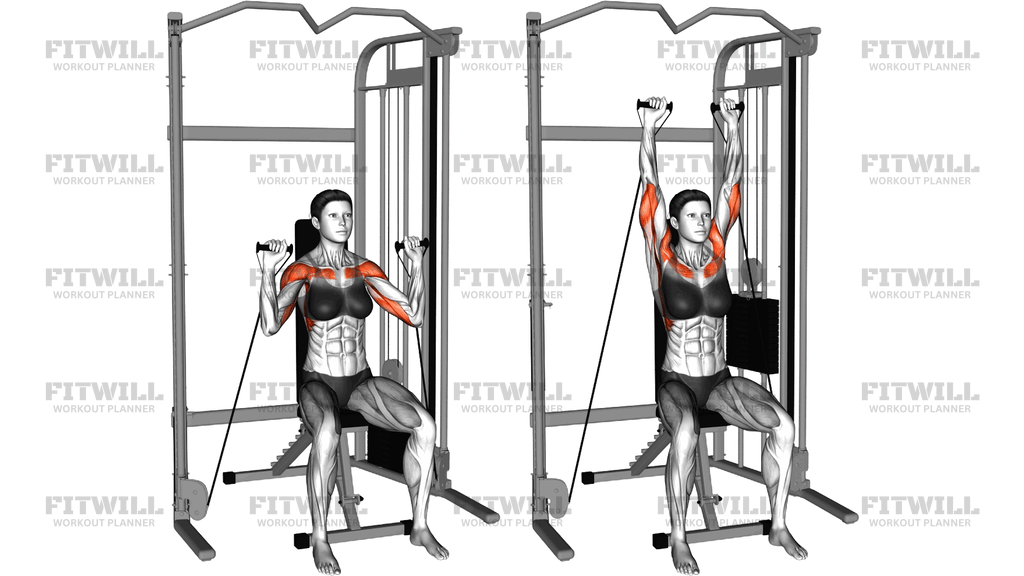
The seated shoulder press on cable machine is an overhead pressing exercise performed while seated on an upright bench, with a handle in each hand attached to the low pulleys of a dual cable tower. Because the resistance comes from cables that run behind and below your shoulders, the tension follows a slightly upward-angled path rather than pulling straight down like a dumbbell or barbell. That changes the feel of the press: the front delts stay under tension through the entire range, including at the bottom, where free weights usually give a short rest.
This setup suits lifters who want consistent tension on the shoulders without the spinal loading and stabilization demands of a heavy barbell press. It is also friendly to those whose shoulders complain about pressing along a fixed bar path, since each arm can travel along its own natural line. If you train alone, the cable setup makes it easy to get into position with the handles already in your hands and to exit safely by simply letting the handles travel back toward the stacks.
The main work falls on the front delts, with the side delts helping through the middle of the press and the upper chest contributing near the bottom position. The triceps extend the elbows to finish each rep, and the traps and serratus help control the shoulder blades as your arms rise overhead. Your core quietly works the whole time to keep your torso from arching backward or twisting as the cables pull down and back.
Setup matters here more than with most presses. The bench should be upright or angled only slightly back, positioned so that both pulleys sit behind your shoulders at roughly hip to waist height. If you sit too far forward, the cables will drag your arms backward; if too far back, the tension drops off at the start of each rep. Feet flat on the floor, ribs stacked over the pelvis, and a proud chest give you a stable base to press from.
For good execution, start each rep with the handles at shoulder height and elbows slightly in front of your torso, then press up and slightly inward until your arms are extended overhead without hard lockout. Lower under control until your upper arms are roughly parallel to the floor or your hands reach shoulder level again. The cables should never jerk or slacken between reps, as the moment of slackening followed by sudden tension is where most technique breakdown happens.
You will see this movement used as the main shoulder builder on upper body days, as a higher-rep finisher after pressing with a barbell or dumbbells, or as a joint-friendly alternative during phases when overhead pressing with free weights feels rough. Because each stack is loaded independently, it also exposes and gradually corrects left-right strength differences.
[ Dnevnik in načrtovalec vadb ]
Načrtuj naslednjo vadbo v Fitwillu
Načrt in dnevnik vadbe imej pri roki, ko želiš začeti.


Navodila za izvedbo
- Set an upright bench facing away from the dual cable machine, centered so that both low pulleys are aligned with your shoulders.
- Attach a single handle to each low pulley, then sit down and grab one handle in each hand with palms facing forward or slightly inward.
- Place your feet flat on the floor about hip-width apart and pull the handles up to shoulder height, with elbows bent and slightly in front of your torso.
- Tighten your core and lift your chest so your ribs stack over your hips and your lower back stays in a neutral position instead of arching.
- Press both handles up and slightly inward until your arms are extended overhead, with your wrists stacked over your elbows.
- Pause briefly at the top with elbows just short of lockout, and feel your shoulders doing the work instead of shrugging up toward your ears.
- Slowly lower the handles back to shoulder height, stopping when your upper arms are about parallel to the floor and the cables remain taut.
- Exhale as you press up and inhale as you lower with each rep, keeping your breathing steady instead of holding your breath.
- Finish the set, then stand up and return the handles one at a time so the cables do not snap back against the stacks.
Nasveti za vadbo
- If the cables pull your arms behind your shoulders at the start of each rep, slide the bench forward a few centimeters; the handles should track in front of your body, not behind your head.
- Watch that your lower back does not arch as the weight gets heavy. Pressing with flared ribs turns the movement into a leaning press and shifts stress away from the shoulders, so reset your brace between reps.
- Keep both stacks moving evenly. A common habit is letting the stronger side finish slightly faster, which hides a strength imbalance instead of fixing it.
- Avoid bouncing out of the bottom. Letting the handles drop and using the stretch to launch the next rep reduces shoulder work and adds risk at the shoulder joint.
- Choose a weight that allows a two to three second lowering. Cables tempt you to rush the eccentric because the stack does the braking, but the lowering phase is where much of the shoulder stimulus comes from.
- If your wrists bend backward at the top, turn your grip slightly inward so your knuckles point toward the ceiling and your wrists stay straight over your forearms.
- Start lighter than on the dumbbell shoulder press. The constant cable tension makes the same load feel heavier, especially in the stretched position at shoulder height.
- Keep your neck relaxed and your gaze forward. Lifting your chin to 'help' the handles overhead usually signals that the weight is too heavy or that the brace has broken down.
Pogosta vprašanja
Which muscles does the seated shoulder press on cable machine work?
Most of the work is done by the front delts, with help from the side delts, upper chest, and triceps. The traps and serratus assist as the arms move overhead, and the core stabilizes the torso against the downward pull of the cables.
What is the difference between the seated shoulder press on cable machine and the dumbbell shoulder press?
The cables pull from low pulleys behind you, so the tension stays constant through the entire range instead of peaking only when the dumbbells are overhead. Each arm also works independently against its own stack, which helps even out left-right differences.
Is the seated shoulder press on cable machine suitable for beginners?
Yes. The seated position supports your back, the fixed path of the cables is easy to follow, and light stacks let you learn the pressing pattern safely. Beginners should start with a weight they can control for ten to twelve smooth reps.
Why do the cables pull my arms backward during the press?
You are probably sitting too far forward on the bench relative to the pulleys. Move the bench slightly back or tilt it a bit, so the cables line up with your shoulders and the handles stay in front of your body throughout the rep.
Should my palms face forward or inward during the seated shoulder press on cable machine?
Both work. A forward grip emphasizes the front delts and upper chest, while a neutral grip with palms facing each other is often more comfortable for stiff shoulders and shifts slightly more work to the side delts.
How far down should I lower the handles with each rep?
Lower until your hands are at shoulder height and your upper arms are roughly parallel to the floor. Going much deeper with the cables pulling from behind can pinch the shoulder joint, especially with limited overhead mobility.
Can I press with one arm at a time during the seated shoulder press on cable machine?
You can, and single-arm reps are useful for correcting the weaker side, but be ready for the cable on the working side to pull you into a twist. Firmly tighten your core or reduce the weight before trying it.
What can I substitute if my gym has no dual cable tower?
The closest replacement is the seated dumbbell shoulder press, or you can use a single cable tower with one handle at a time. Resistance bands anchored behind the bench also mimic the angled, backward-directed resistance path.
Is it safe to fully extend my elbows at the top of the seated shoulder press on cable machine?
Full extension of the elbows is fine for most people, but slamming into a hard lock under tension is unnecessary. Stop just short of forced lockout and keep the tension on the shoulder muscles rather than resting on the joint.