Cable Bent-Over Single-Arm Kickback
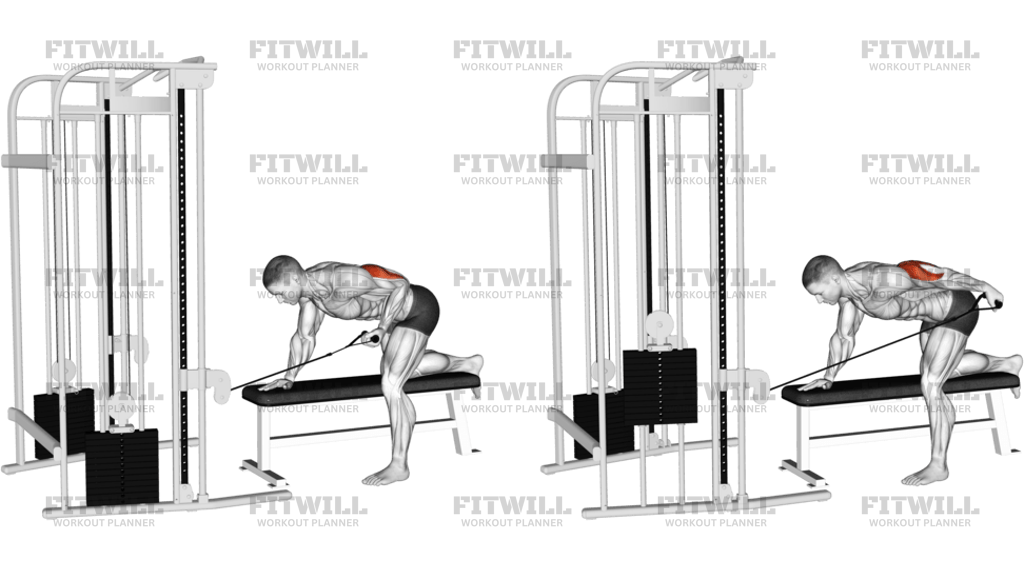
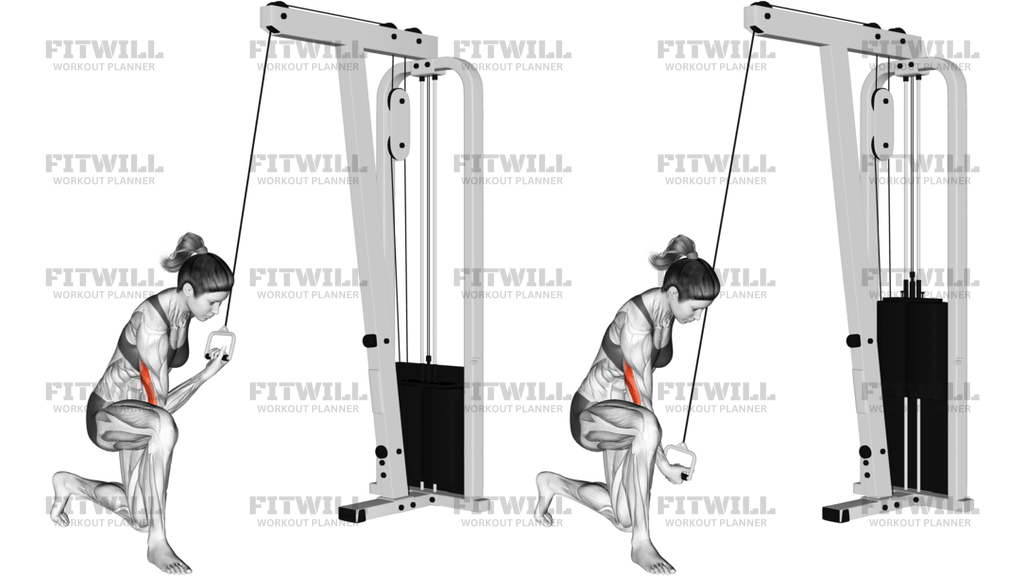
Cable Bent-Over Single-Arm Kickback is a cable triceps isolation exercise that uses a low pulley, a single handle, and a bent-over bench-supported position to keep tension on the arm through the entire rep. The working arm extends straight back from a fixed elbow angle, so the movement is most useful when you want to train elbow extension without turning the set into a shoulder swing or a full-body row.
The bench support matters because it locks the torso into a stable hinge and gives you a clear base for the free hand and knee. That setup reduces cheating, keeps the cable line consistent, and makes it easier to feel the triceps doing the work. When the body stays still, the handle path becomes simple: the elbow stays tucked near the torso while the forearm moves from a bent position to a straight finish.
This exercise is especially useful for arm-focused hypertrophy work, accessories after pressing, or any session where you want a small, controlled movement with a big local burn. It is also a good option when you want unilateral triceps work and need to compare sides, clean up left-right imbalances, or train with lighter loads while keeping continuous cable tension.
Good repetitions start with a square setup at the bench, a neutral spine, and a shoulder that stays quiet while the elbow extends. At the top, squeeze the triceps without snapping the elbow or shrugging the shoulder. On the way back, let the forearm return under control until the upper arm is loaded again, but keep the torso and upper arm from swinging.
Use a load that lets you keep the elbow fixed and the torso steady for every rep. If the handle starts drifting forward, the low back starts rotating, or the shoulder takes over, the set is too heavy or the bench setup is off. Kept strict, this movement is a precise way to build triceps tension with very little joint noise.
[ Workout Log & Planner ]
Put your next workout in Fitwill
Keep your plan and training log ready when you are.


Instructions
- Set the cable pulley low and attach a single handle.
- Place one hand and the opposite knee on a flat bench, then hinge forward until your torso is almost parallel to the floor.
- Grip the handle with the working arm and let the upper arm hang close to your side with the elbow bent.
- Brace your midsection and keep your neck long so your torso stays fixed on the bench.
- Start with the forearm under control, then extend the elbow by driving the handle straight back behind you.
- Keep the upper arm still as the forearm moves until the arm is nearly straight and the triceps are fully squeezed.
- Pause briefly at the finish without lifting the shoulder or twisting the torso.
- Return the handle forward slowly until the elbow is bent again and the triceps are loaded.
- Breathe out as you kick back and inhale on the controlled return.
- Finish the set by lowering the handle with control before stepping away from the cable.
Tips & Tricks
- Keep the working elbow pinned close to your ribcage; if it drifts outward, the cable turns the rep into a shoulder swing.
- Use the bench hand for balance, not for pushing your torso around or taking weight off the working side.
- Choose a load that lets you lock out smoothly; if you have to jerk the handle to finish the rep, it is too heavy.
- Let the upper arm stay almost parallel to the floor, because a changing upper-arm angle usually means the torso is moving.
- Squeeze the triceps at the top for a short pause instead of chasing more speed or a bigger arc.
- Keep the wrist neutral so the handle stays in line with the forearm and the elbow joint does the work.
- Use a slow return to keep tension on the triceps and prevent the weight stack from slamming back down.
- If your lower back rounds, raise the bench height or lighten the load so the hinge stays stable.
- Train one side at a time with the same elbow path on both arms; uneven shoulder rotation is a sign the setup needs work.
- Stop the set when the handle starts traveling with body swing rather than elbow extension.
Frequently Asked Questions
What muscle does the cable bent-over single-arm kickback train most?
It mainly targets the triceps, especially the elbow-extension phase of the arm.
Why do I need one hand and one knee on the bench?
That support keeps your torso fixed so the working arm can extend cleanly instead of turning the rep into a full-body swing.
How bent should my working elbow be at the start?
Start with the elbow clearly bent and the upper arm close to your side, then keep that upper arm steady as you kick back.
Should the handle move in a straight line or an arc?
The handle should travel mostly straight back from the elbow, with only a small natural arc from the cable path.
Why do I feel this in my shoulder or lower back?
That usually means the torso is rotating, the elbow is drifting away from the body, or the weight is too heavy for a strict bench-supported setup.
Can beginners use this cable kickback?
Yes. It is beginner-friendly if the weight is light enough to keep the elbow fixed and the return phase slow.
How heavy should the handle be for this exercise?
Use a load that lets you fully straighten the arm without shrugging, twisting, or losing the bench-supported position.
What is the most common mistake with this movement?
The biggest mistake is turning the kickback into a shoulder-driven swing by letting the upper arm move or the torso rotate.
Is this better for strength or muscle growth?
It is usually used more for triceps isolation and muscle growth than for maximal strength.
Can I swap the bench for another support?
Yes, but you still need a stable support that lets you hinge forward and keep the torso from moving during the rep.