Stick Twist Lunge Stretch
Stick Twist Lunge Stretch is a split-stance mobility drill that combines a deep lunge, a hip-opening stretch, and a controlled trunk rotation while holding a stick for feedback. The stick is not there to create load; it helps you keep the shoulders level, the chest open, and the torso from collapsing as you move into the twist. In the image, the front leg is bent deeply, the back knee lowers toward the floor, and the upper body turns over the front thigh.
This exercise is especially useful when the hips, thighs, and trunk all need to move together. The rear leg gets a strong stretch through the hip flexor and quadriceps, while the front leg works through glutes, adductors, and inner-thigh stabilizers to keep the stance solid. The rotation also asks the core and upper back to control the twist instead of letting the lower back take over. That makes the drill useful before lower-body training, athletic warmups, or cooldown work after squats, lunges, running, or field sports.
The setup matters because a narrow or unstable stance turns the movement into a wobble instead of a stretch. Step into a long lunge, keep the front foot planted, and lower the back knee with control. Hold the stick with both hands and keep it roughly level across the body while you settle into the bottom position. From there, rotate smoothly through the ribcage and shoulders, but keep the pelvis organized so the twist comes from the upper body rather than a hard arch in the low back.
Use the stretch range that feels productive, not forced. You should feel tension across the front of the rear hip, the front thigh, and the torso as you rotate, but the knee and lower back should stay comfortable. If the front knee caves inward or the back hip twists wildly open, shorten the stance and reduce the rotation. The goal is clean, repeatable positions with steady breathing, not a bigger-looking lunge.
Stick Twist Lunge Stretch works best as a controlled mobility sequence or a movement prep drill. Treat each side like a separate rep: sink, rotate, hold briefly, then return with the same control you used to enter the stretch. When done well, it improves position awareness, hip extension, and rotational control without needing speed, momentum, or heavy external resistance.
[ Workout Log & Planner ]
Put your next workout in Fitwill
Keep your plan and training log ready when you are.


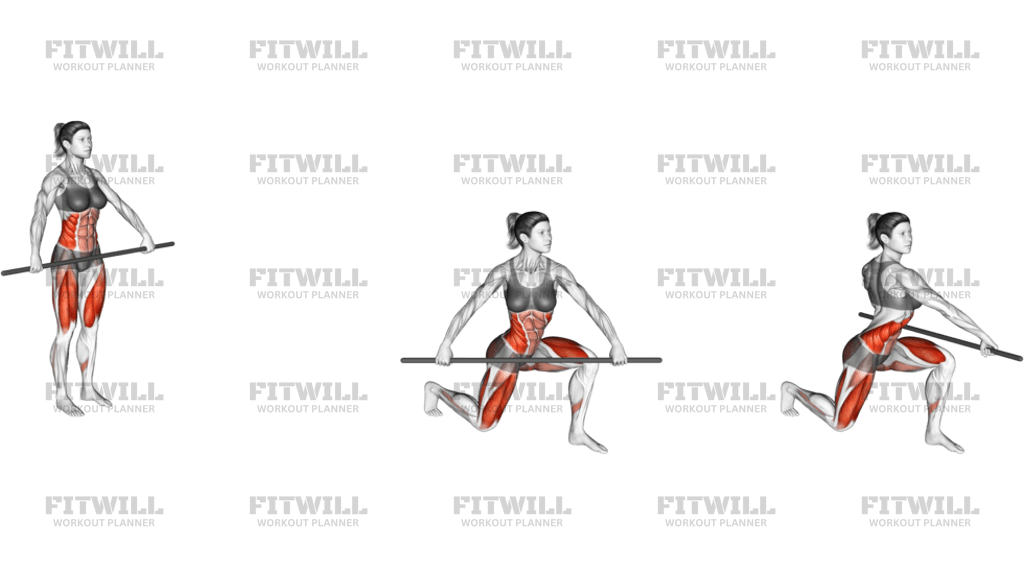
Instructions
- Stand tall on an exercise mat and hold the stick with both hands in front of your body, hands wider than shoulder width and elbows softly bent.
- Step one foot forward into a long split stance, then lower the back knee toward the floor until both knees are bent and the front heel stays planted.
- Keep the stick level as you settle into the lunge so your shoulders stay square and your torso stays tall.
- Brace lightly, then sink a little deeper by driving the hips forward and down without letting the front knee collapse inward.
- Rotate your chest toward the front leg while the pelvis stays mostly pointed forward, using the stick as a visual cue for control rather than leverage.
- Keep the movement smooth and let the twist come from the upper back and ribs instead of cranking through the lower back.
- Pause in the deepest pain-free stretch for a breath or two, keeping the rear hip and front thigh under steady tension.
- Return the torso to center, press through the front foot, and come back to standing with control before switching sides.
Tips & Tricks
- A longer stance usually makes the rear-hip stretch easier to feel; a short stance often turns the drill into a knee-dominant squat.
- Keep the front knee tracking over the middle toes so the lunge stays stable when you rotate.
- Hold the stick lightly; if you pull hard on it, the shoulders will twist ahead of the hips and the stretch loses quality.
- Let the back heel stay lifted and the back knee hover close to the floor if that gives you a better hip-flexor line.
- Exhale into the twist to help the ribs settle over the pelvis instead of holding tension in the torso.
- If the lower back feels pinchy, reduce the depth of the lunge and rotate less aggressively.
- The front inner thigh should feel active, not crammed together; widen the stance if the groin feels jammed.
- Move slowly enough that you can reset the stick level at the bottom of every rep.
Frequently Asked Questions
What does Stick Twist Lunge Stretch train most?
It mainly targets hip mobility and split-stance control, with a strong stretch through the rear hip flexor and front-thigh line.
Why do I need the stick for this stretch?
The stick helps you keep your shoulders level and gives you a reference for how much you are rotating through the torso.
Should the back knee touch the floor?
It can touch lightly if that feels comfortable, but it does not need to slam down. Keep the descent controlled either way.
Where should I feel the stretch most?
You should feel it in the rear hip flexor and quad, with extra work through the front leg, core, and upper back as you rotate.
How do I keep my front knee safe?
Keep the front foot flat, let the knee track over the toes, and shorten the stance if the knee drifts inward or feels jammed.
Can beginners do this exercise?
Yes. Beginners should use a shorter range, keep the stick light, and focus on balance before adding more rotation.
What is the biggest form mistake?
The most common mistake is twisting only the shoulders and arching the lower back instead of rotating the ribcage over a stable pelvis.
When should I use Stick Twist Lunge Stretch?
It works well in a warmup, between lower-body sets as a mobility reset, or in a cooldown after running, squatting, or lunging.