Seated Lateral Neck Stretch (Version 2)
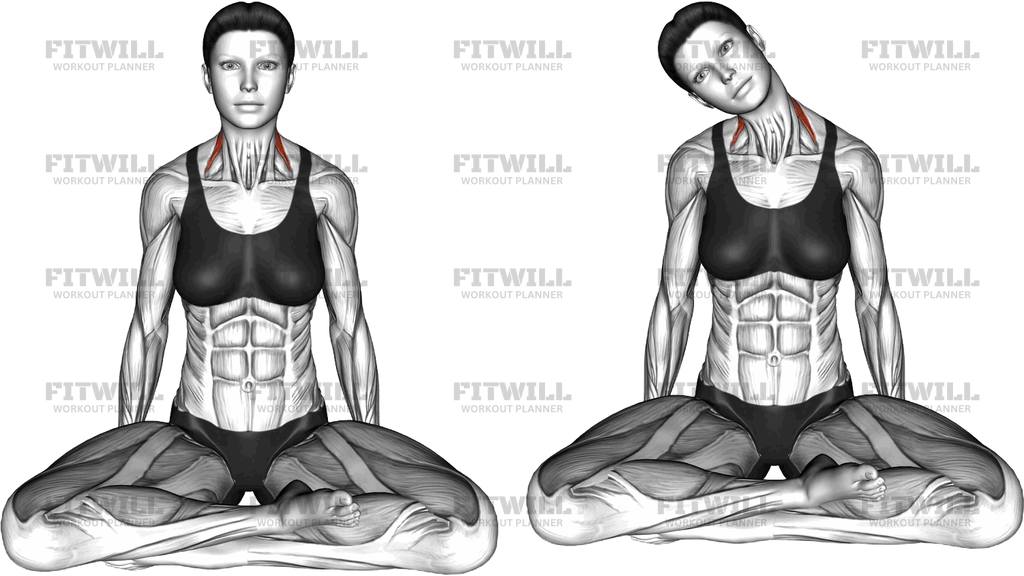
Seated lateral neck stretch (Version 2) is a gentle stretch in lateral flexion of the neck, performed sitting cross-legged. Instead of pulling the head with your hand, you let gravity do the work: the head simply leans to the side toward one shoulder, while the opposite shoulder remains fixed and lowered. This approach without hand assistance makes it one of the safest ways to release tension along the side of the neck, especially in the upper trapezius and levator scapulae — the muscles that most often accumulate tension from sitting at a desk, driving, or looking down at a phone.
This version is well suited for anyone for whom neck stretches with hand assistance are too intense, as well as for beginners who have not yet learned how much pressure is optimal in the area of the cervical spine. Since there is no pulling force, the stretch goes only as deep as the weight of the head itself allows, which keeps the intensity honest and self-limiting. Office workers, drivers, and people who carry stress in their shoulders will usually feel it quickly, most often along the line that extends from the top of the shoulder toward the base of the skull on the side being stretched.
The sitting position with crossed legs is more important than it may seem. Sitting on the floor with legs folded encourages an upright, tall spine, unlike the slouching that happens when you do neck stretches in a chair with poor support. When the torso is upright and level, the side of the neck stretches evenly. If you lean or collapse to one side, you lose the clean stretch line and may feel tension in the wrong place. Lightly resting your hands on your knees helps the shoulders stay relaxed and level throughout the stretch.
To perform the movement well, first lengthen upward through the crown of the head, then glide your ear directly to the side toward the shoulder without dropping the chin or turning the nose. The stretch should feel like a long, even pull from just above the shoulder to behind the ear on the opposite side. Stay in that position, breathe slowly, and let the tissues relax gradually instead of chasing a deeper position. Repeat on the other side to keep both sides balanced.
Use this stretch as part of your morning routine, a midday break at the desk, or as a cool-down after upper body training. Two to three sets per side, held fifteen to thirty seconds each, is a practical dose. The key safety rule is restraint: never bounce, never force the head lower, and stop if you feel sharp pain, dizziness, or tingling that radiates down the arm. The neck responds to patience far better than to pressure.
[ Dnevnik i planer treninga ]
Isplaniraj sledeći trening u Fitwillu
Plan i dnevnik treninga neka ti budu pri ruci kada poželiš da počneš.


Kako se izvodi
- Sit on the floor in a cross-legged position and lightly rest your hands on your knees, with your arms relaxed.
- Lengthen the spine so that the crown of the head is directly above the hips, and level both shoulders so they are at the same height.
- Relax your shoulders and pull them away from your ears, then take one slow breath to settle into the position.
- With your face facing forward and your chin level, glide your head to the side so that one ear moves toward the shoulder on the same side, as if the head were tilting over an axis passing through the neck.
- Allow the stretched side of the neck to lengthen without lifting or raising that shoulder; the shoulder remains heavy, on the opposite side of the movement.
- Hold the end position in which you feel a steady pull from the top of the opposite shoulder toward behind the ear, breathing slowly and evenly for fifteen to thirty seconds.
- Do not pull with your hands and do not add a nodding motion; the depth of the stretch comes exclusively from the weight of the head itself.
- To return, slowly bring the head back to the middle, guiding it upward in a controlled manner rather than letting it jerk back.
- Pause briefly in the neutral position, then repeat the tilt toward the other shoulder with the same duration of the hold.
- Do two to three gentle repetitions per side, keeping the torso upright and facing forward the entire time.
Saveti za vežbanje
- The most common mistake is rotating the face toward the ceiling as the head tilts; imagine that the nose remains pointed straight ahead, so the stretch stays on the side of the neck instead of turning into a rotation.
- If the stretching shoulder slowly lifts toward the ear, deliberately press that hand a bit firmer into the knee; fixing the shoulder is exactly what allows the stretch on the opposite side.
- If you feel the stretch behind the shoulder blade instead of in the neck, it usually means the torso is leaning; sit up straight again on both sit bones before repeating the tilt.
- Keep your chin level and do not pull it toward your chest; this version targets pure lateral flexion, and dropping the chin shifts the tension to another part of the neck.
- Less is more during the first hold; go to about seventy percent of your available range of motion, and the tissues will usually relax further on their own within fifteen to twenty seconds.
- Exhale slowly as you go into the stretch; holding your breath tends to tighten the very muscles you are trying to lengthen.
- If one side is noticeably tighter, do one extra set on that side instead of pushing a single hold deeper.
- On a hard floor, sit on a folded blanket or thin pad so the hips are slightly higher than the knees; this makes it much easier to maintain an upright spine.
- Do not interlace your fingers behind your head or behind your knees during the hold, as tension in the arms tends to pull the shoulders out of a level position.
Često postavljana pitanja
Which muscles does the seated lateral neck stretch target?
It primarily lengthens the upper trapezius and levator scapulae on the side opposite the tilt, along with the lateral flexors of the neck. These are the muscles that most often become tense due to desk posture, stress, and long drives.
Why is there no hand pull in Version 2 of the seated lateral neck stretch?
The version without hand assistance relies solely on the weight of the head, which keeps the intensity mild and self-limiting. This makes it safer for beginners and for anyone sensitive to pressure in the area of the cervical spine.
Should I sit cross-legged on the floor, or can I do this stretch in a chair?
Sitting cross-legged is the standard position because it encourages an upright, tall torso and level shoulders, but the same lateral tilt can be done on a firm chair if sitting on the floor is uncomfortable. The key, in either case, is that the hips remain level and the spine upright.
How long should I hold each side during the seated lateral neck stretch?
Fifteen to thirty seconds per side works well, repeated two to three times. Long, steady holds with slow breathing are more effective than brief or repetitive bouncing tilts.
I feel the stretch more in the shoulder than in the neck. Is that wrong?
Feeling it along the top of the shoulder is normal, as that is where the upper trapezius is located. If the stretch is only in the shoulder and nothing in the neck, check that the torso is not leaning and that the face is not rotating during the tilt.
Is it normal for one side to feel much tighter than the other?
Yes, most people have a tighter side, usually the one on which they habitually carry a bag or the one they turn toward while working at a desk. Simply do one extra hold on the tighter side instead of forcing a deeper stretch to match the more flexible side.
Can I do the seated lateral neck stretch every day?
Yes, a gentle neck stretch without hand assistance is well suited for daily practice, especially for people who work desk jobs. Keep the intensity comfortable and avoid aggressive holds at the end range of motion at every session.
When should I avoid this stretch?
Skip it if you feel sharp pain, dizziness, or tingling that radiates down the arm, and be careful after any recent neck injury without professional guidance. Mild stretching discomfort is expected; pain is not.
What is a good substitute if I cannot sit on the floor?
The same lateral neck tilt works sitting upright on a firm chair, with feet flat on the floor and hands resting on the thighs. The stretch on the neck is identical; only the seat changes.