Weighted Seated Bicep Curl On Stability Ball
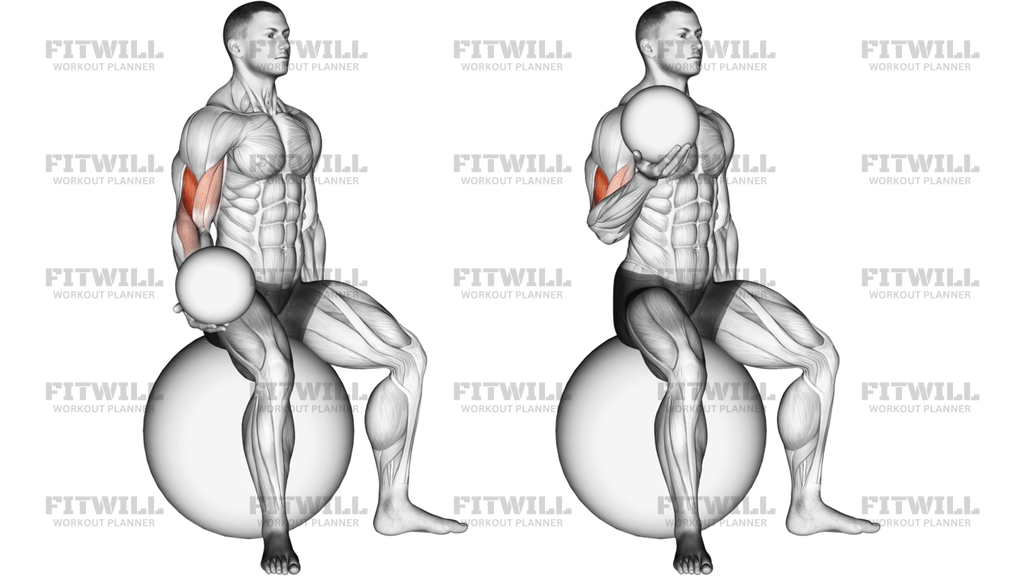
Weighted Seated Bicep Curl On Stability Ball is a single-arm curling exercise that combines direct elbow flexion work with a balance challenge from the ball. The lifter sits upright on a stability ball while holding a medicine ball and curls it toward the shoulder, so the biceps do the main work while the torso, hips, and grip help keep the body steady.
This movement trains the biceps brachii first, with brachialis and brachioradialis assisting the curl and the forearm flexors helping keep the ball secure. The unstable seat changes the feel of the rep: if you lean back, swing the torso, or let the ball roll, the exercise becomes less about the arm and more about surviving the setup. A good rep keeps the ribs stacked over the pelvis, the shoulders quiet, and the elbow close to the side.
The stability ball matters because it forces you to control your posture before you try to move the load. Sit tall near the middle of the ball, plant both feet firmly, and find a stance wide enough that you do not wobble every time the arm moves. From there, curl the ball in a smooth arc toward the front of the shoulder, then lower it under control until the elbow is nearly straight again.
This exercise is useful as accessory work when you want arm training without heavy loading or aggressive swinging. It can fit in a biceps day, an upper-body circuit, or a beginner-friendly strength session, provided the ball and the medicine ball are light enough to keep the motion strict. The main goal is repeatable tension through the curl, not maximal speed or range.
Because the ball is moving under you, safety and positioning matter more than chasing load. Keep the neck relaxed, the wrist in line with the forearm, and the shoulder from rolling forward at the top. If the torso rocks or the medicine ball drifts away from the body, the set is usually too heavy or the seat position is too unstable. Clean, controlled repetitions should feel organized from the first rep to the last.
Fitwill
Log Workouts, Track Progress & Build Strength.
Achieve more with Fitwill: explore over 9600 exercises with images and videos, access built-in and custom workouts, perfect for both gym and home sessions, and see real results.
Start your journey. Download today!




Instructions
- Sit on the middle of the stability ball with both feet planted slightly wider than hip width and hold the medicine ball in one hand at the side of the working leg.
- Stack your ribs over your pelvis, let the free arm rest for balance, and keep the working elbow close to your ribcage before the first rep.
- Start with the arm nearly straight and the wrist aligned with the forearm so the medicine ball hangs beside the thigh without the shoulder drifting forward.
- Exhale and curl the ball in a smooth arc toward the front of the same-side shoulder by bending only at the elbow.
- Keep the upper arm quiet as the forearm rotates up; avoid leaning back or letting the ball swing across your body.
- Squeeze briefly near the top when the hand is close to shoulder height and the biceps is fully shortened.
- Lower the ball slowly until the elbow is almost straight again, keeping tension on the arm instead of dropping into the bottom position.
- Reset your posture on the ball if you feel it rolling, then begin the next rep with the same upright setup.
- Complete all planned reps on one side before switching hands, or alternate sides only if your program calls for it.
Tips & Tricks
- Sit far enough forward on the ball that your feet can spread and stabilize you, but not so far that the ball slides during the curl.
- A lighter medicine ball usually works better than a heavy one because the goal is a strict curl, not a grip challenge.
- Keep the elbow parked near the ribs; if it drifts forward, the front shoulder starts helping too much.
- Do not bounce the medicine ball off the thigh to start the rep.
- Use a controlled lowering phase of about two to three seconds to keep tension on the biceps.
- If the ball wobbles, widen your stance or move to a firmer seat before increasing load.
- Keep the wrist stacked instead of letting it bend back under the weight of the ball.
- Stop the set when your torso starts leaning back to finish the curl.
Frequently Asked Questions
What does Weighted Seated Bicep Curl On Stability Ball train most?
The biceps are the primary movers, with the brachialis, brachioradialis, and forearm flexors helping control the curl.
Why use a stability ball for a bicep curl?
The ball adds a balance demand, so you have to keep your torso stacked and your hips steady while the arm moves.
Should the medicine ball travel straight up?
It should arc toward the front of the shoulder on the same side, not swing across the body or away from the thigh.
How do I keep from rolling on the ball?
Sit near the center of the stability ball, plant your feet wide enough to feel grounded, and keep your ribs stacked over your pelvis.
Can I use this as a beginner?
Yes, if the medicine ball is light and you can keep the curl strict without leaning or bouncing.
What is the biggest form mistake?
Letting the elbow drift forward and turning the curl into a shoulder movement or a body swing.
Do I curl one arm at a time or both arms together?
The image shows a single-arm curl, so one arm at a time is the clearest way to keep the stability-ball setup strict.
What should I do if the ball feels unstable?
Reduce the load, widen your foot stance, and sit a little more upright before trying to add speed or range.