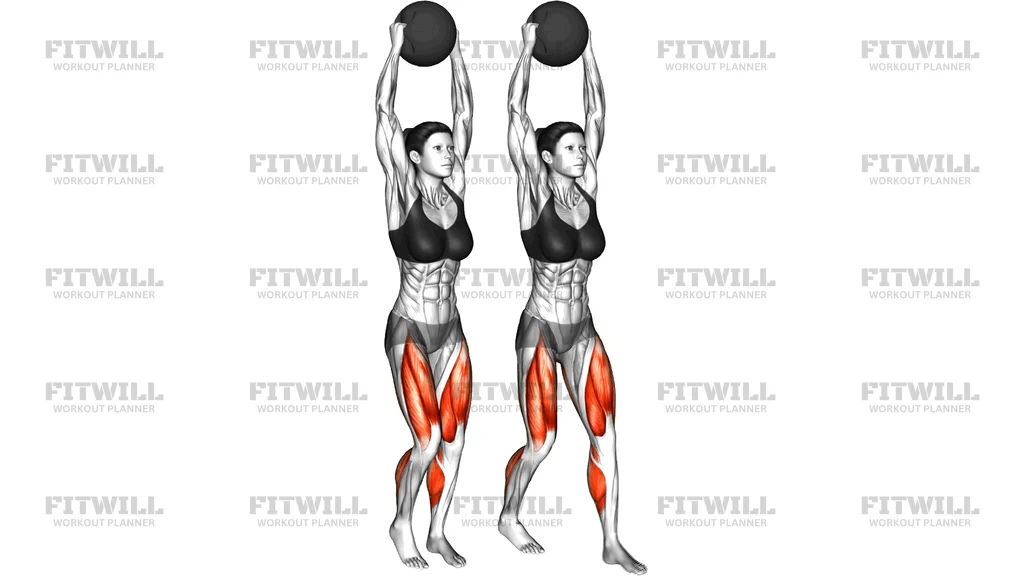
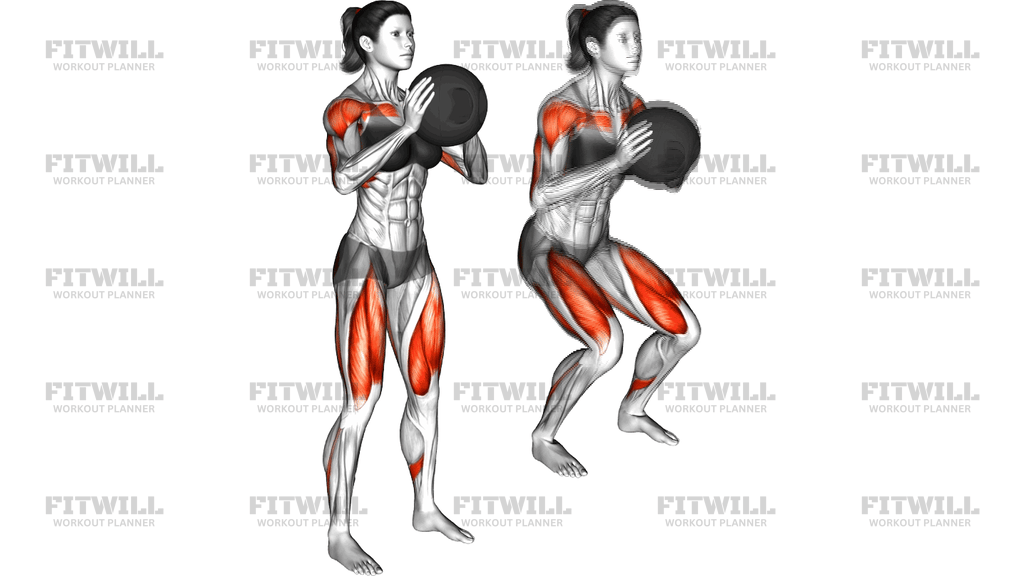
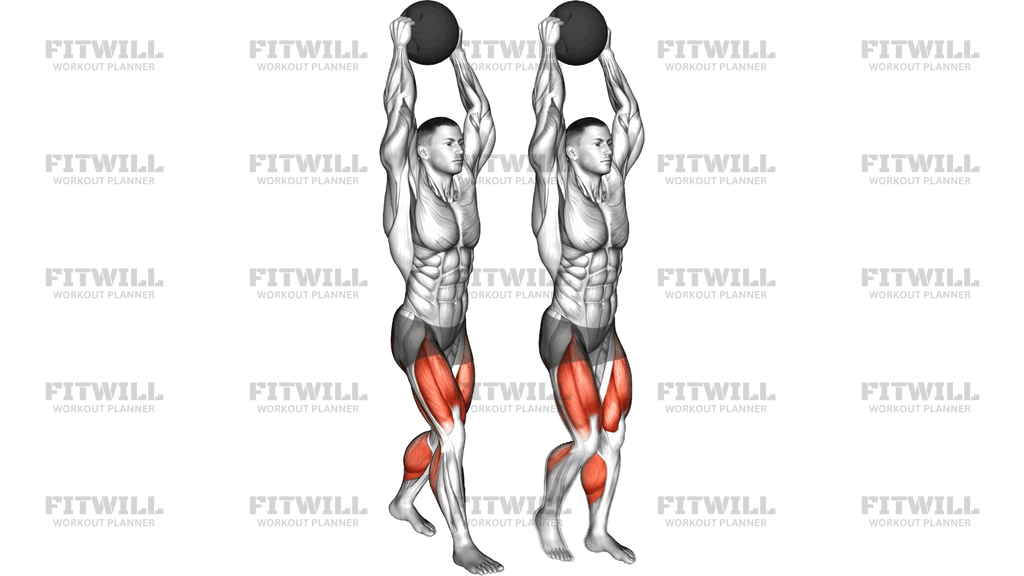
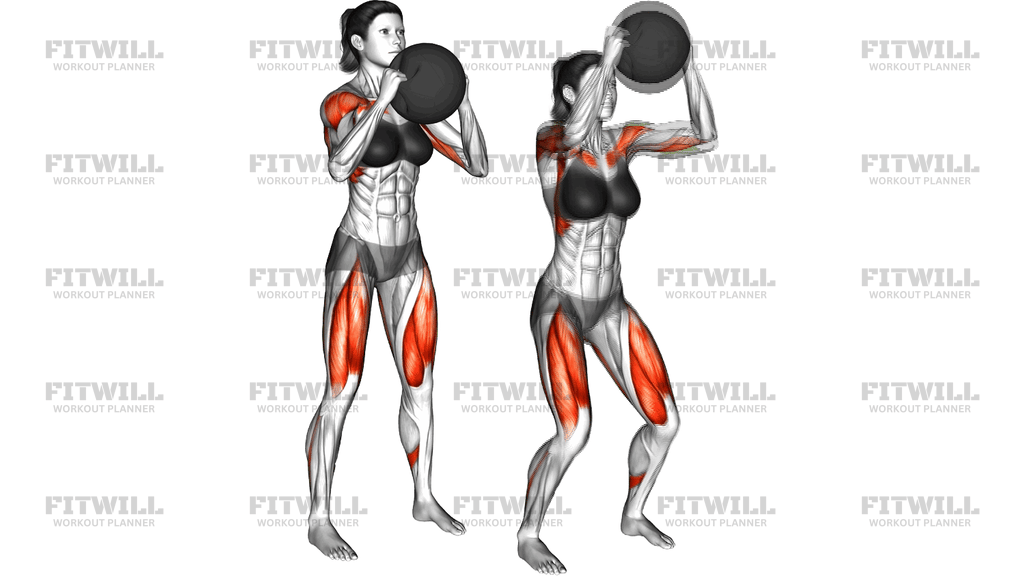
Medicine Ball Lunge With Biceps Curl
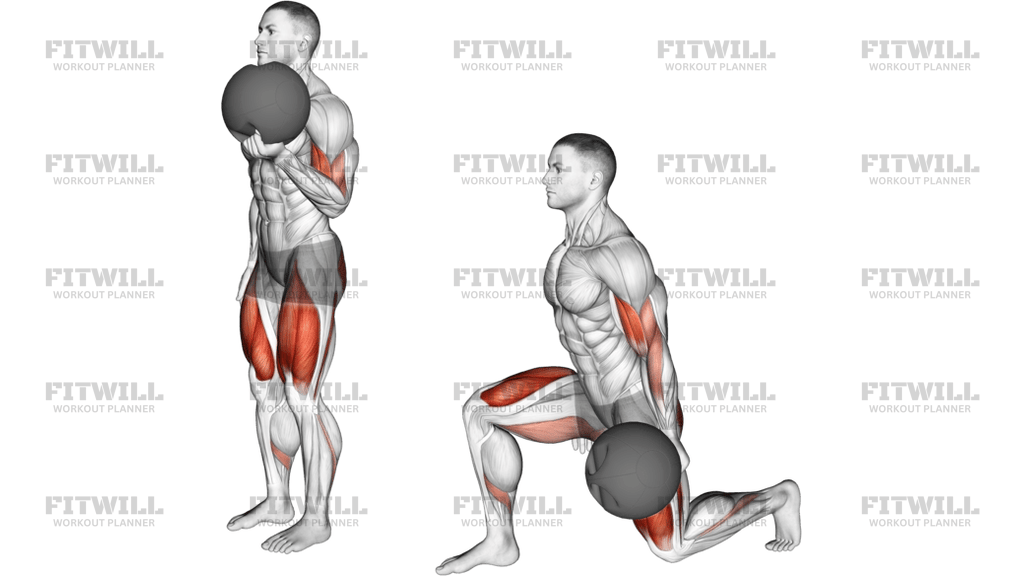
Medicine Ball Lunge With Biceps Curl combines a reverse lunge with an upper-body curl pattern, so it trains your legs, balance, and arm flexors in the same rep. The movement is useful when you want a simple conditioning-strength hybrid that keeps the torso honest while the lower body works through a split stance.
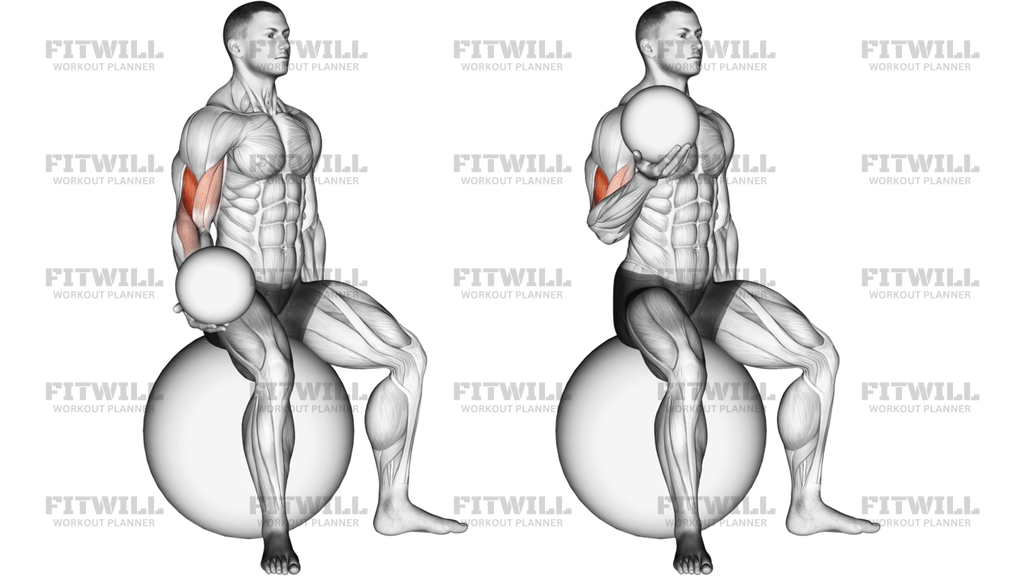
The medicine ball stays close to the body instead of swinging freely, which makes the curl more controlled and reduces the chance of twisting through the trunk. In this exercise the biceps do the obvious elbow-flexion work, while the brachialis, brachioradialis, forearms, and front shoulders help stabilize the ball as you move between the standing and lunge positions.
The setup matters because the lunge demands balance before the curl starts to feel challenging. Stand tall, hold the ball with both hands, and keep your ribs stacked over your pelvis. As you step back into the lunge, let the ball travel with you in a smooth line rather than drifting away from the chest or dropping in front of the knees.
A clean rep looks controlled at both ends: the back knee lowers toward the floor, the front shin stays in a comfortable track, and the curl finishes with the ball close to the chest or upper torso. On the way back up, drive through the front foot, stand fully, and resist the urge to jerk the ball or lean back to fake the curl.
This is a good accessory choice for mixed lower-body and arm work, circuit training, warm-ups, or light conditioning blocks. It is also a practical option when you want to challenge coordination without needing a lot of equipment. Use a medicine ball you can control for every repetition, and stop the set if the lunge shortens, the torso collapses forward, or the curl turns into a swing.
[ Workout Log & Planner ]
Put your next workout in Fitwill
Keep your plan and training log ready when you are.


Instructions
- Stand tall holding the medicine ball with both hands in front of your torso, elbows close to your sides.
- Set your feet hip-width apart, then brace your trunk and keep your chest stacked over your pelvis.
- Step one leg back into a reverse lunge while keeping the ball close to your body.
- Lower until the back knee hovers just above the floor and the front knee stays aligned over the foot.
- Curl the medicine ball toward your chest as you settle into the bottom of the lunge.
- Drive through the front foot to stand back up while keeping the ball under control.
- Lower the ball smoothly as you reset for the next repetition instead of letting it swing.
- Alternate sides or finish all reps on one side if that is how the set is programmed.
Tips & Tricks
- Keep the medicine ball close to your sternum so the curl stays strict instead of turning into a front raise.
- Let the back knee travel straight down rather than reaching it far behind the hip.
- Track the front knee over the second or third toe to avoid collapsing inward during the lunge.
- Avoid leaning backward at the top of the curl; finish tall with the ribs still stacked.
- Use a ball that feels light enough to keep the lunge smooth and deep on every rep.
- Exhale as you drive up from the lunge and finish the curl, then inhale as you lower back down.
- Keep your rear heel lifted and your weight centered over the front foot during the descent and ascent.
- If your balance wobbles, shorten the lunge and clean up the curl before adding load.
Frequently Asked Questions
What muscle does Medicine Ball Lunge With Biceps Curl target most?
The biceps are the main arm focus, while the legs and glutes handle the lunge portion.
Can beginners perform this exercise?
Yes, beginners can use a light medicine ball and a short reverse lunge to learn the pattern.
Should the medicine ball stay in front of my chest or hang lower?
Keep it close to the torso through the curl and lunge so you do not swing it away from your body.
What is the most common mistake with the lunge?
Letting the front knee cave inward or rushing the step back usually makes the rep unstable.
Should I alternate legs or do all reps on one side?
Both work. Alternate legs for conditioning, or stay on one side if the program wants more focused leg work.
Is this more of a strength exercise or a conditioning exercise?
It can serve both roles, but the lighter-ball version is usually used as controlled accessory or conditioning work.
How deep should the lunge be?
Lower until the back knee is just above the floor and you can still keep the torso tall and balanced.
What if the curl makes me lose balance?
Reduce the load, shorten the lunge, and keep the ball closer to your chest until the rep feels stable.