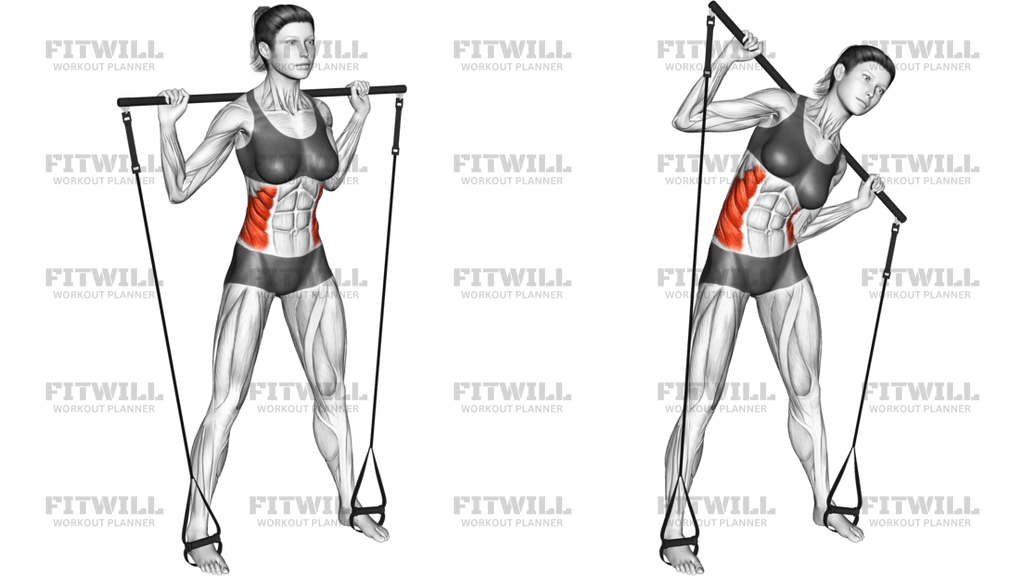
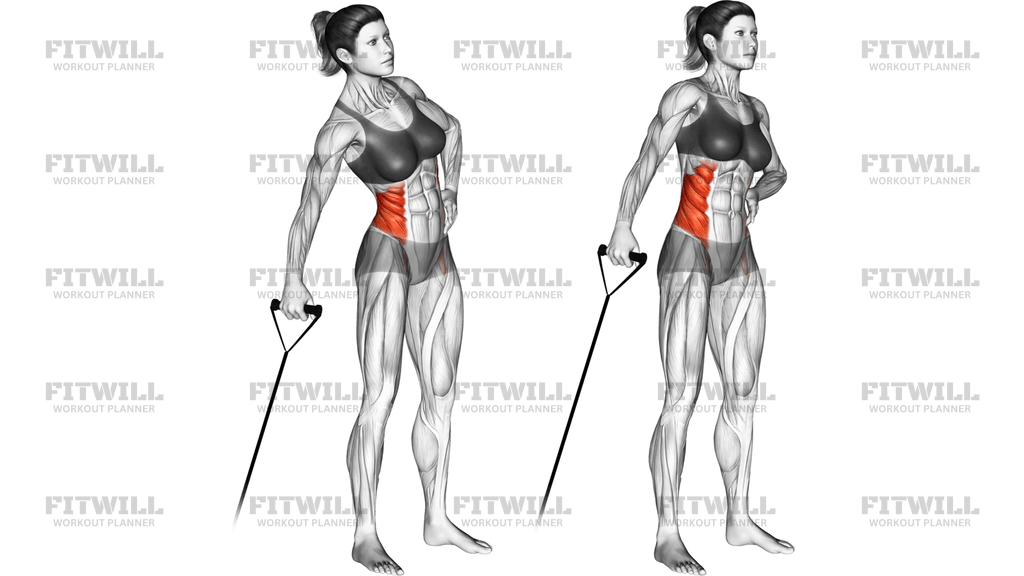
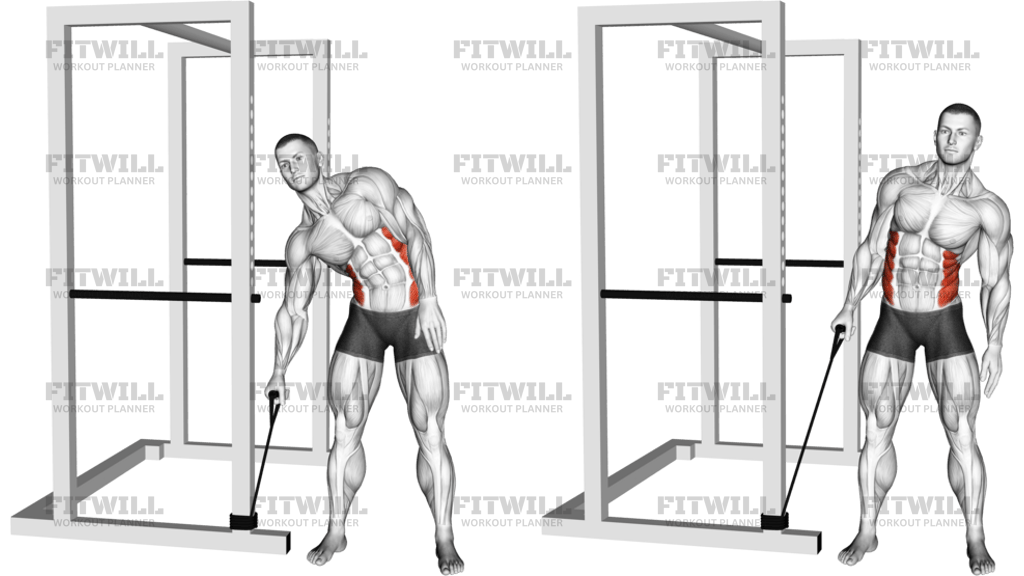
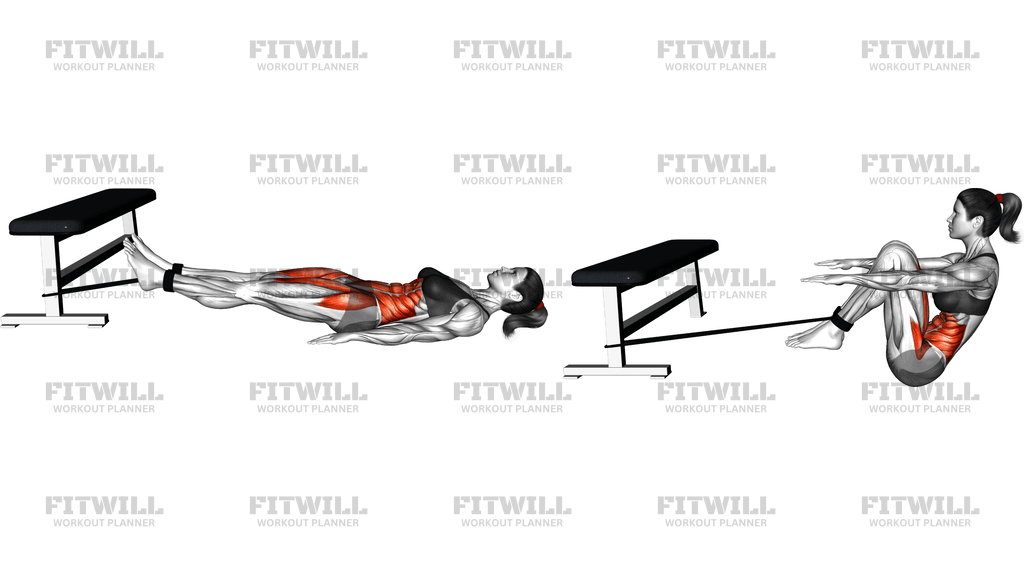
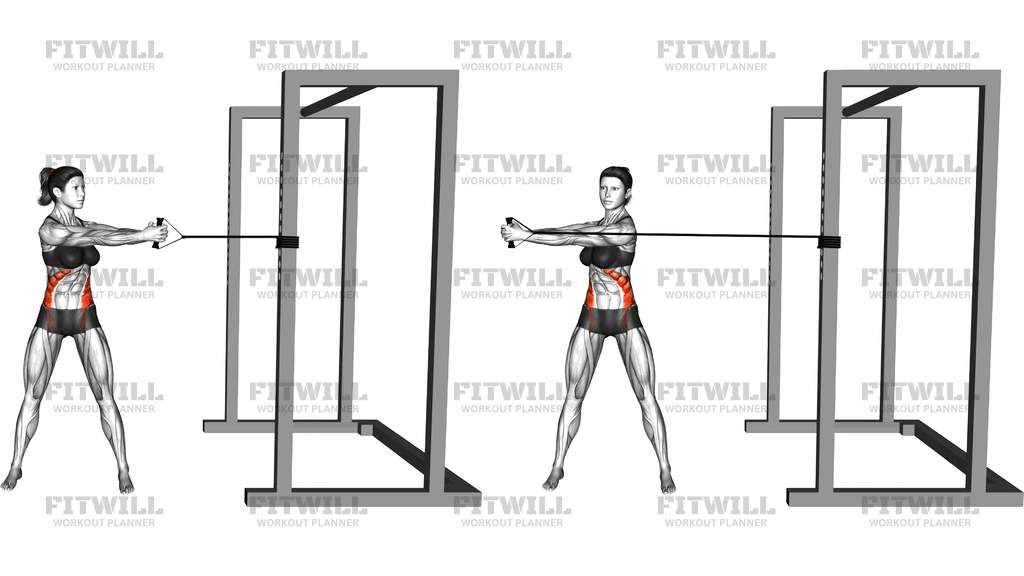
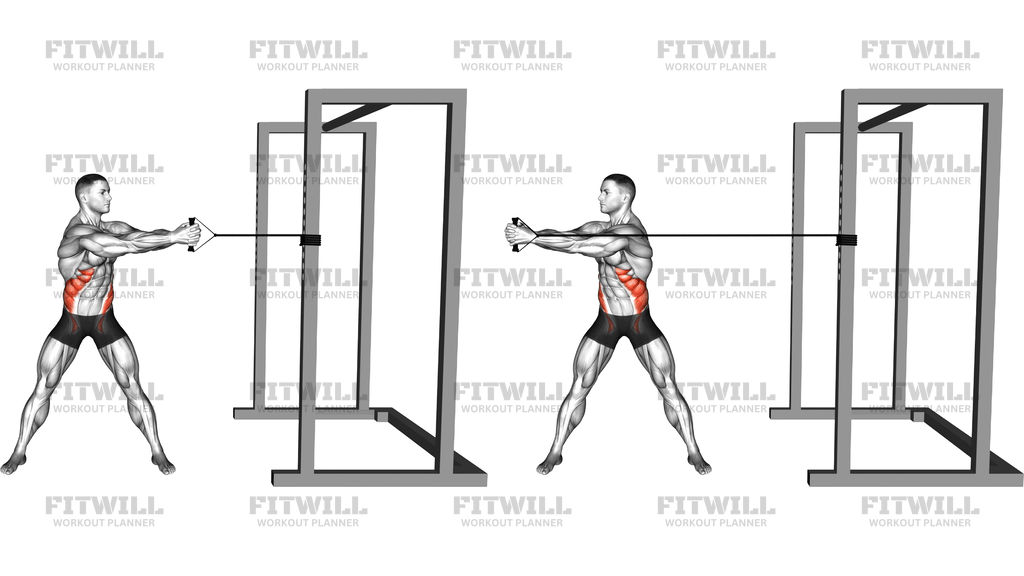
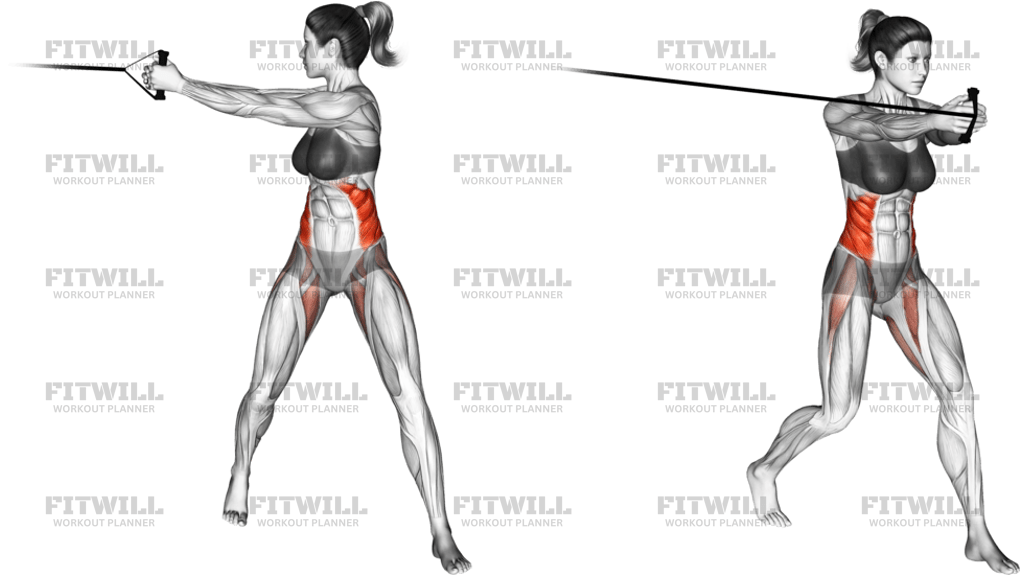
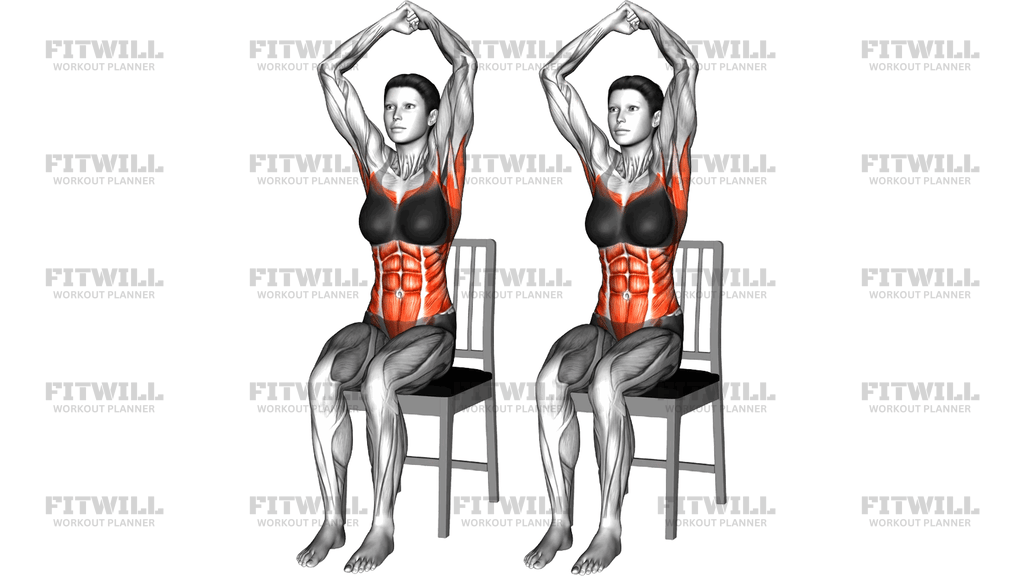
Band Standing Twisting Crunch
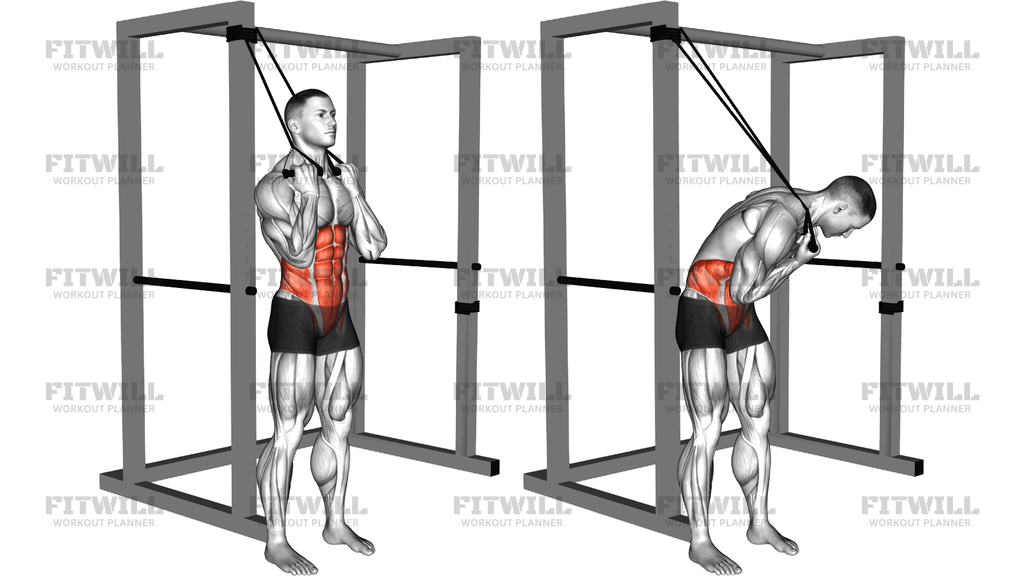
Band Standing Twisting Crunch is a standing band-resisted core exercise that combines trunk flexion with a small, controlled twist. It is useful when you want direct work for the obliques without lying on the floor, and it also asks the abs and deep trunk muscles to keep the torso organized while the band pulls you back toward the anchor point.
This movement is most valuable when the goal is to train the waist to brace, flex, and rotate under tension. The External obliques do most of the work, with help from the Rectus abdominis, Transversus abdominis, and spinal stabilizers. Because the resistance comes from a high anchor and travels through the hands into the upper torso, the starting position matters a lot: if the feet, ribs, and pelvis are out of line, the set turns into a tug-of-war instead of a clean crunch.
Set the band high behind you and stand far enough forward that you already feel light tension in the handles before the first rep. From there, keep the knees soft, the feet planted, and the chest stacked over the pelvis as you brace. The actual rep should feel like bringing the ribs down toward the hips while the ribcage turns slightly, not like yanking with the arms or swinging the shoulders around.
Band Standing Twisting Crunch is a good choice for accessory work, core circuits, or warm-up sets before heavier lifting because it teaches the midsection to control rotation and flexion together. The range should stay short and deliberate, especially if the band is strong or the anchor is high. A smaller, cleaner crunch is usually more useful than a bigger rep that collapses the neck, bends the hips, or twists the whole body off balance.
Treat the return phase as part of the exercise, not just a reset. Let the band pull you back only as far as you can maintain rib and pelvis control, then repeat with the same line of tension and the same amount of twist on every rep. If your lower back starts taking over or the band forces you into a staggered stance, step closer to the anchor or use less resistance so the obliques stay in charge.
Fitwill
Log Workouts, Track Progress & Build Strength.
Achieve more with Fitwill: explore over 9600 exercises with images and videos, access built-in and custom workouts, perfect for both gym and home sessions, and see real results.
Start your journey. Download today!




Instructions
- Clip or anchor the band high behind you, then stand a step in front of it with your feet about hip-width apart and the handles held at upper-chest height.
- Keep your knees softly bent, tuck your ribs down, and square your pelvis so your torso starts tall instead of leaning back into the band.
- Hold the handles close to the sides of your neck or upper chest with your elbows bent and pointing slightly forward, not flared wide.
- Brace your midsection, then begin the rep by curling your sternum toward your pelvis as if you are shortening the space between your ribs and hips.
- Add a small twist through the ribcage as you crunch, keeping the hips mostly still so the rotation comes from the waist rather than the legs.
- Pause briefly at the bottom when your abs and obliques are fully shortened, without collapsing your head forward or shrugging your shoulders.
- Inhale as you return slowly to the tall starting position and let the band bring you back only as far as you can keep tension through the torso.
- Reset your stack before the next rep, then repeat for the planned number of repetitions with the same foot pressure and the same twist angle.
Tips & Tricks
- Step farther from the anchor only if you can keep the crunch strict; extra band tension should not pull your shoulders out of position.
- Keep the twist small enough that your hips stay nearly square. If your feet spin or your pelvis swings, the band is too heavy or you are using too much rotation.
- Think about bringing the lower ribs toward the front pocket on the working side instead of pulling with your hands.
- Let the elbows stay in front of the torso rather than flaring wide, which helps keep the tension on the waist instead of the shoulders.
- Use a short pause at the bottom to stop the set from turning into fast, bouncing reps.
- If your neck gets sore, keep the chin gently tucked and stop the crunch when the upper back starts to round, not when your head reaches forward.
- A lighter band often works better than a heavy one because the obliques need time under tension, not a hard yank from the anchor.
- If you feel the movement mostly in the lower back, reduce the twist and focus on curling the ribs down before you rotate.
- Keep pressure through both feet, especially the big toe and heel, so the trunk can rotate without wobbling.
- Finish each rep under control instead of snapping upright, since the return phase is where the band can pull you into a sloppy stretch.
Frequently Asked Questions
What does Band Standing Twisting Crunch work most?
It primarily targets the obliques, with the rectus abdominis and deep core muscles helping control the crunch and the twist.
How far should I rotate during Band Standing Twisting Crunch?
Keep the twist small and deliberate. The ribcage should rotate a little, but the hips should stay mostly square so the waist does the work.
Where should I hold the band handles?
Hold them close to the upper chest or sides of the neck with bent elbows. That keeps the band from turning the movement into a shoulder raise.
Is Band Standing Twisting Crunch beginner friendly?
Yes, as long as the band is light enough to let you keep your ribs down and your hips still. Beginners usually do better with a smaller range and slower tempo.
What is the biggest mistake with this exercise?
The most common mistake is swinging the torso or letting the hips twist hard to fake more range. The rep should look compact and controlled, not explosive.
Should I feel this in my lower back?
No, the lower back should not be the main sensation. If it takes over, reduce the band tension and shorten the twist so the abs and obliques stay in charge.
Can I use this instead of cable crunches?
It can be a useful substitute if you only have a band and want standing core work. The loading feels different, but the crunch pattern is similar enough for accessory training.
How many reps work best for Band Standing Twisting Crunch?
Moderate to higher reps usually work best because the band tension is smooth and the exercise depends on clean control. Stop the set when the twist starts to get sloppy.