Standing Twisting Side Leg Kick Tap
The Standing Twisting Side Leg Kick Tap is a body weight movement that combines a lateral leg kick with a rotation of the torso, finishing each rep with a light tap of the foot back to the floor. You stand tall on one leg, sweep the other leg out to the side while your upper body twists in the opposite direction of the kick, then control the leg back down and tap your toes beside the standing foot before repeating. Because everything happens from a single-leg stance, the move asks a lot from your balance at the same time as it works your hips and waist.
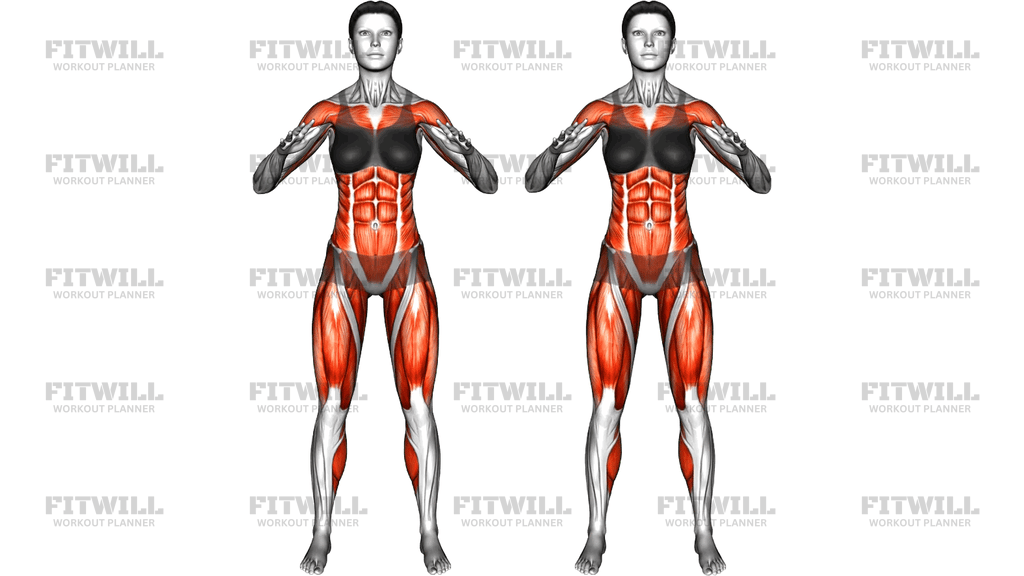
This exercise is useful for anyone who wants to train the outer hips and obliques without equipment or floor work. The side kick portion targets the gluteus medius and other hip abductors, the muscles responsible for lifting the leg away from the body and keeping your pelvis level when you walk or run. The twisting component adds rotational work for the obliques and deep core, which is often missing from straightforward standing leg raises.
Setup matters more than it looks. With no support to hold, your standing foot, knee, and torso need to be organized before you kick, or the twisting motion will pull you off balance. Keep a soft bend in the standing knee, brace the abdominals before each rep, and let the rotation come from the ribcage and waist rather than from swinging your arms wildly.
To execute it well, kick with control instead of speed. The leg should travel out to the side at roughly hip height or wherever your flexibility allows, with the toes pointing forward or slightly up, not collapsed inward. The torso counter-rotates as the leg lifts, which lengthens the working side of the waist and engages the obliques on the kicking side. Lower the leg deliberately and make a clear, gentle tap with the ball of the foot next to the standing foot — that tap is your timing checkpoint and keeps the rhythm honest.
Common use cases include warm-ups for lower body training, home workouts with no equipment, circuit training where a balance challenge is welcome, and rehab-style programs for hip stability, provided the range stays pain-free. Because it is done one side at a time, it also exposes left-right differences in hip strength and balance that bilateral exercises hide.
The main safety points are simple: stay near a wall or sturdy chair until your balance is solid, keep the standing knee tracking over the foot rather than caving inward, and avoid arching the lower back as the leg lifts. If you feel the work shifting into your lower back or you start hopping on the standing foot, reduce the kick height and slow the tempo.
[ Workout Log & Planner ]
Put your next workout in Fitwill
Keep your plan and training log ready when you are.


Instructions
- Stand tall with your feet together, arms relaxed at your sides or held lightly in front of your chest for balance, and your weight spread evenly across one standing foot.
- Shift your weight fully onto that standing leg, keep a soft bend in the standing knee, and press the ball of the foot into the floor to create a stable base.
- Brace your abdominals and lightly tuck the ribs so your pelvis stays level before any movement begins.
- Lift the other leg and kick it out to the side, leading with the heel or outer edge of the foot, to about hip height or as high as you can control.
- As the leg rises, twist your torso in the opposite direction of the kick, rotating from the waist and ribcage while keeping your hips facing forward as much as possible.
- Pause briefly at the top of the kick with the leg extended and the torso rotated, feeling the outer hip and same-side waist doing the work.
- Lower the leg slowly back toward the center, resisting gravity rather than dropping it, and untwist the torso as the leg comes down.
- Tap the ball of the foot lightly on the floor next to the standing foot, keeping tension in the leg so it does not fully rest between reps.
- Exhale as you kick and twist, inhale as you lower and tap, keeping the breath steady throughout the set.
- Complete all reps on one side, then reset your stance and switch to the other leg, or alternate sides rep by rep if that suits your balance better.
Tips & Tricks
- If you wobble on the kick, the usual culprit is a locked standing knee — keep it softly bent so the ankle and hip can make small corrections.
- Do not let the kicking hip hike up toward your ribs as the leg lifts; imagine lengthening the leg away from the hip instead of shrinking the space between them.
- A common mistake is turning the rotation into an arm swing. Keep the arms quiet and let the twist come from the waist so the obliques, not momentum, drive the movement.
- If your toes turn outward and the knee collapses as you kick, point the toes forward and think about kicking through the heel to keep the hip in a better line.
- Lower back arching on the kick usually means the leg is going higher than your hip mobility allows. Reduce the height until you can keep the pelvis neutral.
- Use the tap as a tempo tool: if you cannot make a controlled tap before the next rep, you are rushing the lowering phase.
- Practicing near a wall with one fingertip for support is a smart progression, not a cheat — remove the support as your single-leg stability improves.
- Alternate sides rep by rep if one hip fatigues faster than the other, and match the weaker side's rep count rather than letting the strong side run away.
- Wear flat, stable footwear or go barefoot so your standing foot can grip the floor; cushioned running shoes make the balance demand noticeably harder.
Frequently Asked Questions
Which muscles does the Standing Twisting Side Leg Kick Tap work?
The primary work comes from the outer hip muscles, especially the gluteus medius, which lifts the leg sideways. The twisting action adds the obliques and deep core, while the standing leg's glutes and quads work isometrically to keep you stable.
Is the Standing Twisting Side Leg Kick Tap suitable for beginners?
Yes, as long as the kick height stays within a comfortable range. Beginners should kick lower, move slower, and stand near a wall until single-leg balance feels secure.
How high should I kick during the Standing Twisting Side Leg Kick Tap?
Aim for roughly hip height, but only as high as you can go without your pelvis tilting or your lower back arching. A controlled knee-height kick beats a sloppy high kick every time.
Why does my standing foot feel unstable when I twist?
Rotation on one leg shifts your center of mass quickly, which challenges the ankle stabilizers. Widen your base of attention by gripping the floor with your toes, keep the standing knee soft, and slow the twist until your balance catches up.
Can I do the Standing Twisting Side Leg Kick Tap every day?
Since it uses only your body weight and moderate resistance, it can be performed frequently, such as in warm-ups or daily mobility routines. If your outer hips feel sore, give them a day of recovery before repeating higher-volume sessions.
What can I use if I need balance support?
Stand beside a wall, countertop, or sturdy chair and place one or two fingertips on it for light support. Keep the support passive so your hips and core still do the stabilizing work.
What is the purpose of the foot tap in this exercise?
The tap sets your rhythm and gives each rep a defined end point, which prevents you from swinging the leg without control. It also lets you reset your balance briefly before the next kick.
Can the Standing Twisting Side Leg Kick Tap replace side leg raises on the floor?
It trains a similar hip abduction pattern but adds a balance and rotational demand the floor version does not have. The two complement each other, and the standing version is a good progression once floor side leg raises feel easy.
Should I feel this exercise in my lower back?
No, the work should sit in your outer hips and waist. If your lower back takes over, the leg is likely kicking too high or your ribs are flaring — lower the kick, brace the abdominals, and keep the pelvis neutral.
How many reps and sets should I do of the Standing Twisting Side Leg Kick Tap?
Eight to twelve controlled reps per side for two to three sets is a solid starting point. Focus on matching the balance quality on both sides rather than chasing a high rep count.