Lever Standing Hip Extension
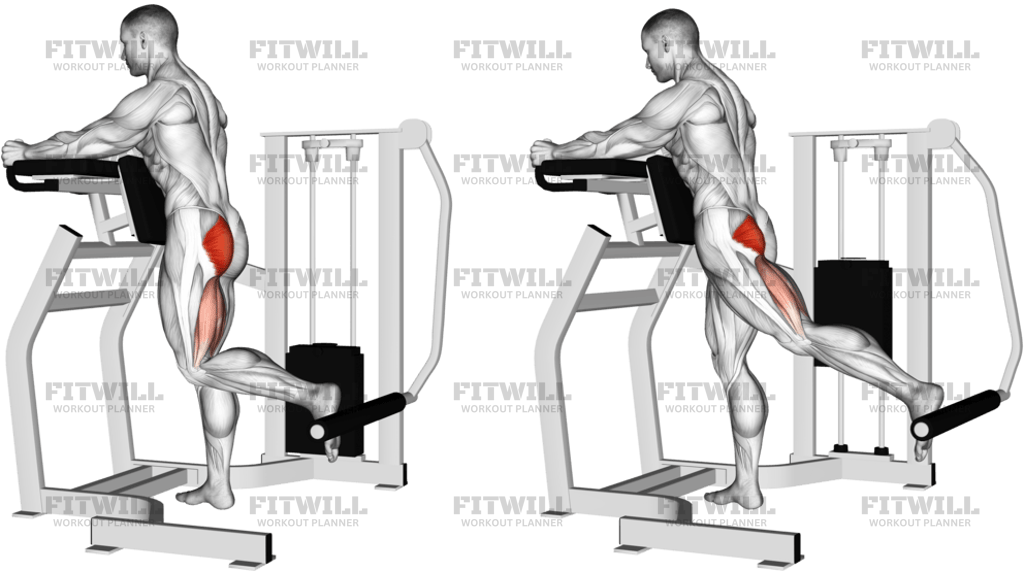
Lever Standing Hip Extension is a machine-based glute exercise that trains hip extension with your torso supported and your working leg moving against a guided lever. The support from the machine helps you stay organized through the rep, which makes it useful when you want to load the glutes and hamstrings without turning the movement into a loose back swing.
This exercise is especially helpful for lifters who want a straightforward way to isolate hip extension while keeping the upper body quiet. With the forearms braced on the pad and the standing leg grounded, the work should stay concentrated in the hip that is driving backward, not in the lower back or the pelvis twisting open.
Setup matters because the lever has to line up cleanly with the working leg. If the pad sits too high, too low, or too far behind you, the rep turns awkward fast and the machine can pull you out of position. A stable stance, a soft knee on the standing side, and a square pelvis make it much easier to keep tension on the glute through the full arc.
During each repetition, extend the hip by driving the working leg back and slightly up, then pause briefly before returning under control. The goal is a smooth, repeatable path with the ribs down, the trunk steady, and the movement coming from the hip joint rather than a lower-back arch. That makes the exercise more effective for strength, hypertrophy, and glute-focused accessory work.
Lever Standing Hip Extension fits well in lower-body sessions, glute accessories, and single-leg training blocks where you want a controlled machine movement instead of a free-standing hinge. It is also a practical option for beginners because the machine gives clear feedback and reduces balance demands, as long as the load stays light enough to keep the torso quiet and the pelvis from rotating.
[ Workout Log & Planner ]
Put your next workout in Fitwill
Keep your plan and training log ready when you are.


Instructions
- Step onto the machine platform facing the chest pad and place your forearms on the support so your torso can stay steady.
- Set the working lower leg or ankle against the lever pad behind you and keep your standing foot planted flat on the floor.
- Square your hips to the machine, soften the standing knee, and keep your torso pressed into the pad without rounding your lower back.
- Brace your midsection, then begin with the working hip slightly flexed and the foot behind your body.
- Drive the working leg backward by extending the hip, keeping the pelvis level instead of rotating open.
- Squeeze the glute at the back of the rep and pause for a brief moment without arching your lower back.
- Lower the lever slowly until you are back in the starting position and keep tension on the pad the whole way down.
- Breathe out as you press back, breathe in as the leg returns, and reset your posture before the next rep.
- Finish the set by bringing the lever fully under control and stepping out of the machine safely.
Tips & Tricks
- Adjust the pad so it contacts the working leg cleanly; if it sits too low or too far back, the hip will feel jammed instead of loaded.
- Keep the standing knee soft rather than locked out so you can balance without shifting into your lower back.
- Think about pushing the heel back and slightly up, not swinging the leg high behind you.
- Stop the rep when the pelvis starts to open toward the side; the glute works best when the hips stay square.
- A short pause at the top usually improves glute tension more than chasing a bigger range.
- If you feel the movement mostly in your lower back, reduce the load and shorten the top end of the rep.
- Keep your ribs down against the pad so the machine does not tempt you into a back arch.
- Use a slower return than the drive phase to keep the lever from pulling you out of position.
- Choose a load that lets you control every rep without bouncing the lever off the stack.
Frequently Asked Questions
What does Lever Standing Hip Extension train?
It mainly trains the glutes through hip extension, with the hamstrings and core helping to stabilize the body.
Is Lever Standing Hip Extension good for beginners?
Yes. The machine support makes it easier to learn the hip-driving pattern, as long as the load is light enough to keep the torso still.
Where should the pad sit on Lever Standing Hip Extension?
The lever pad should contact the lower part of the working leg cleanly so the hip can extend without the machine forcing your posture out of line.
Why do I feel Lever Standing Hip Extension in my lower back?
That usually means you are arching to finish the rep or letting the pelvis twist. Reduce the load, keep your ribs down, and stop the set before the back takes over.
Should my standing leg stay straight on Lever Standing Hip Extension?
No. A slight bend in the standing knee helps you stay balanced and keeps the movement focused on the working hip.
How far back should I drive the leg?
Only as far as you can keep the pelvis square and the lower back neutral. A smaller controlled range is better than reaching high with body swing.
Can I use Lever Standing Hip Extension on a glute day?
Yes, it fits well as an accessory movement after heavier hip hinges, squats, or bridges when you want extra glute volume without much spinal loading.
What is the most common mistake on Lever Standing Hip Extension?
The biggest mistake is opening the hips and arching the lower back to finish the rep instead of extending through the working hip.
How should I progress Lever Standing Hip Extension?
Add load only when you can keep the same torso angle, hip path, and pause at the top for every rep.