Band Horizontal Pallof Press Twist
The Band Horizontal Pallof Press Twist is an anti-rotation core exercise with a rotational finish. You stand side-on to a resistance band anchored at chest height, hold the handle with both hands at your sternum, press the band straight out in front of you, and then rotate your torso away from the anchor before reversing the whole movement under control. The band constantly tries to pull you back toward the anchor, and your job is to refuse it.
This movement combines two demands that rarely show up together in one drill: resisting rotation during the press, and then producing rotation deliberately once your arms are extended. That makes it more challenging than a standard Pallof press, because your obliques and deep core have to switch from braking to driving without letting your lower back or hips take over. The pressing phase also lights up the chest, front shoulders, and triceps, but those muscles are working to hold position rather than to move heavy load.
The setup is what makes or breaks this exercise. Anchor the band at sternum height and stand far enough away that there is tension even with your hands at your chest. Your stance should be about hip-width or slightly wider, with your weight balanced evenly, because any lean away from the anchor quietly robs the core of the work. If the band sags at the start or your torso is already turned, the anti-rotation challenge disappears before you even press.
To execute it well, brace your midsection as if bracing for a light punch, press the handle forward until your arms are fully extended at chest height, pause, and then rotate your torso and arms together so the handle travels across your body away from the anchor. Keep your hips square to the front for most of the rotation, letting the turn come from your midsection rather than from swinging your pelvis or shoulders. Exhale as you press and rotate, inhale as you unwind back to center, and bring the handle back to your chest before resetting.
This exercise suits lifters who already own a solid Pallof press and want to add rotational strength for sports like golf, tennis, baseball, or throwing events, as well as anyone training the core for real-world twisting tasks. It is also a smart choice in rehab-adjacent settings because the band load is easy to scale and the position is upright and joint-friendly. Go lighter than you think you need to at first; the twist at full arm extension is the point where most people lose their braced torso.
A few practical points: work both sides evenly, keep the band path horizontal and away from your face, and inspect the band for wear before each session since a snapped band at chest height is genuinely dangerous. Two to three sets of six to ten controlled reps per side is plenty, and quality of the pause at full extension matters more than rep count.
[ Workout Log & Planner ]
Put your next workout in Fitwill
Keep your plan and training log ready when you are.


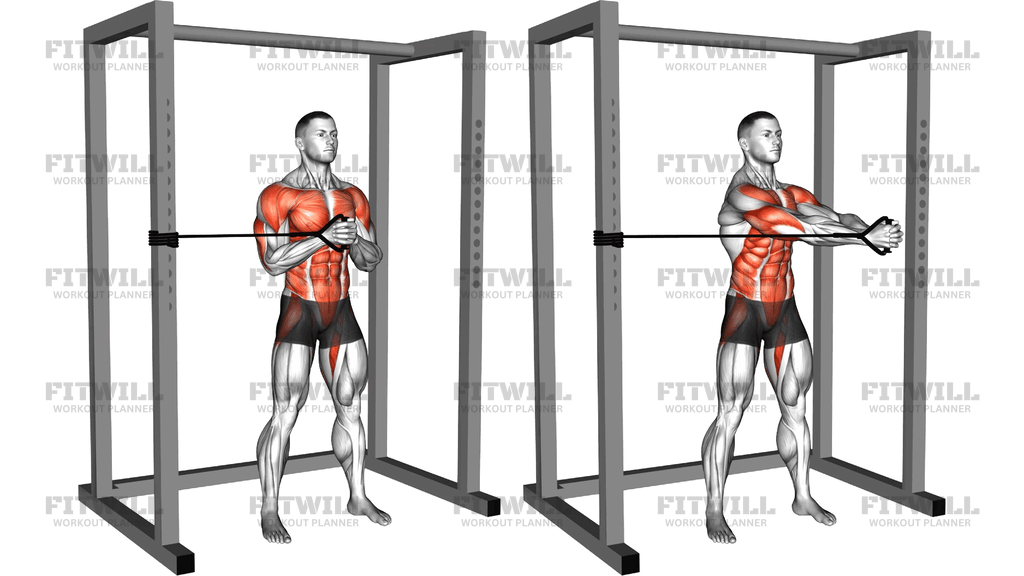
Instructions
- Anchor a resistance band at chest height to a power rack, with a handle attached to the free end, and stand sideways to the anchor point about an arm's length away so the band has light tension.
- Grab the handle with both hands, fingers interlaced or one hand over the other, and pull it in to your sternum with your elbows tucked by your ribs.
- Set your feet roughly hip-width apart with your toes pointing forward, knees soft, and your torso square to the front so the band crosses your body at chest height.
- Brace your core firmly, tuck your ribs slightly, and squeeze your glutes to lock your pelvis in place before anything moves.
- Press the handle straight forward from your chest until your arms are fully extended at chest height, resisting the band's pull to rotate you toward the anchor.
- From the extended position, rotate your torso and arms together, pulling the handle across your body away from the anchor until you feel your midsection fully turned, keeping your hips as square as you can.
- Pause briefly at the end of the rotation, then slowly unwind your torso back to the pressed-forward position without letting the band whip you around.
- Draw the handle back to your sternum with control, exhaling on the press and rotate and inhaling as you return.
- Complete all reps on one side, then turn around and repeat on the other side so both directions of rotation are trained evenly.
Tips & Tricks
- Choose a lighter band than you would use for a standard Pallof press; the twist at full arm extension multiplies the rotational force on your torso, and a band that is too heavy forces you to lean away from the anchor to survive the rep.
- If your shoulders start drifting toward the anchor during the press, you have stopped bracing. Reset at your chest, exhale hard, and rebuild tension before pressing again.
- Keep the band tracking at sternum height the whole time. If the handle rises toward your face during the rotation, your arms are separating; drive the movement with your torso and keep both hands working as one unit.
- Watch your back foot. A common failure in this setup is pivoting or lifting the heel on the side nearest the anchor to fake extra rotation range, which turns the drill into a hip exercise.
- Slow down the return from the twist. Most people control the press and then let the band snap them back to center, and it is that uncontrolled unwind that usually causes the lower back to complain.
- Match your rotation range on both sides rather than chasing maximum turn on your looser side; a noticeable difference usually means the hips or lumbar spine are compensating for a stiff midsection.
- Check the band and anchor point before every set, especially where the band attaches to the rack, since a worn band failing at chest height is a real safety risk.
- If you cannot stop your hips from rotating, regress to a plain Band Horizontal Pallof Press without the twist for a few weeks and earn the rotation back gradually.
Frequently Asked Questions
Which muscles does the Band Horizontal Pallof Press Twist work?
The primary work comes from the core, especially the obliques and deep stabilizing muscles that resist the band during the press and then drive the rotation. The chest, front shoulders, and triceps assist during the pressing phase, and the glutes and legs stabilize your stance throughout.
How is the Band Horizontal Pallof Press Twist different from a regular Pallof press?
A regular Pallof press is purely anti-rotation: you press out and hold still against the band's pull. The twist version adds a deliberate rotation at full arm extension, so your obliques produce torque instead of only resisting it.
Should my hips rotate during the twist, or stay facing forward?
Keep your hips mostly square to the front and let the rotation come from your midsection, allowing only a small natural turn at the hips. If your whole pelvis swings with the twist, the anti-rotation demand of the exercise largely disappears.
Why do I feel this in my lower back instead of my abs?
That usually means your brace has broken down and your lumbar spine is absorbing the band's rotational pull. Lighten the band, squeeze your glutes, and reduce how far you rotate until the tension sits in your midsection rather than your lower back.
How high should I anchor the band for this exercise?
Anchor it at chest or sternum height so the band travels horizontally in line with the handle's path. Anchoring too low or too high turns the movement into a press with an upward or downward angle and changes which muscles resist the pull.
Is the Band Horizontal Pallof Press Twist suitable for beginners?
It is better treated as a step two. Beginners should first master a standard Pallof press with a light band, since holding still against the pull builds the bracing skill the twist demands. Once that feels solid, adding rotation with a light band is a reasonable progression.
What can I use instead if I don't have a band and a rack?
A cable machine set at chest height with a single handle is the closest substitute and works exactly the same way. Without any equipment, a partner holding a stick or band at chest height to pull against can replicate the rotational resistance.
How many reps and sets should I do?
Two to three sets of six to ten controlled reps per side works well, treating the pause at full extension as part of the rep. Because the band tension rises as you rotate, favor control over volume and stop the set when your torso position starts to drift.
Do I need to train both sides?
Yes. Turn around after each set so the band pulls from the other side as well, otherwise one set of obliques gets all the braking and rotational work while the other is neglected.
Is it safe to do this exercise every day?
There is nothing inherently risky about frequent practice with a light band, but the twisting under tension is demanding on the trunk and most people progress better with a day of recovery between harder sessions. Keep daily sessions easy if you use it as part of a warm-up.