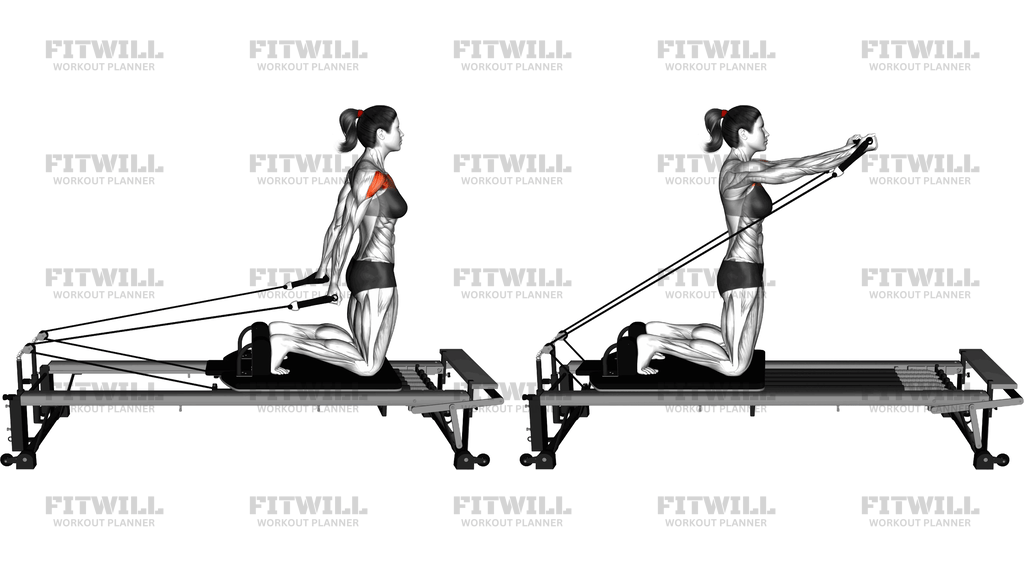
Pilates Machine Side Split
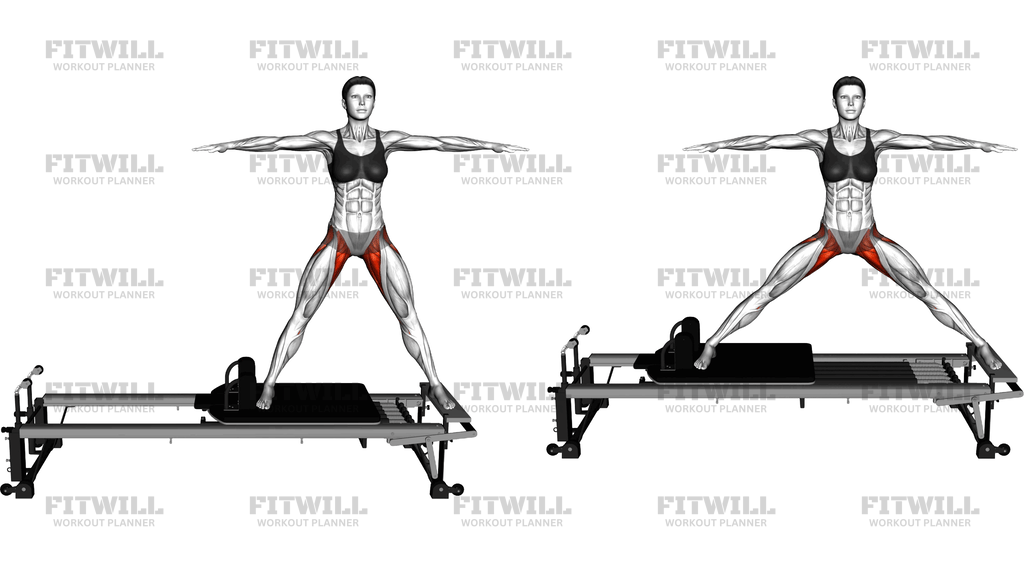
The Pilates Machine Side Split is a standing reformer exercise that trains the inner thighs, outer hips, and deep core through a controlled widening and closing of the legs. One foot rests on the moving carriage while the other stays planted on the stationary end of the reformer, so every inch the carriage travels away from the machine has to be controlled by the muscles of the working leg. The arms reach out to the sides at shoulder height, which helps you balance and gives you a visual reference for staying level.
Because the stance widens across the front of the body rather than along it, the adductors work eccentrically as the carriage slides out, then concentrically as you draw the legs back together. The standing leg's outer hip and glute medius stabilize the pelvis the whole time, and the trunk muscles keep the ribs stacked over the hips. It is demanding in a way that floor adductor work is not, since you are balancing on a moving surface under spring tension.
This movement is a staple for dancers, skaters, and anyone who wants usable hip range under load rather than passive flexibility. It is also common in intermediate and advanced Pilates programming for hip strength and pelvic control. Beginners can do it with heavier spring settings, which limit how far the carriage travels, and progress to lighter springs for a larger range as control improves.
Setup matters more than most people expect. The foot on the carriage should press fully against the shoulder rest, and the foot on the stationary platform should be far enough out that you start in a comfortable straddle. If your base is too narrow the springs do most of the work; if it is too wide you lose balance before the hips get challenged. Both feet should stay fully weight bearing, with toes pointing forward or very slightly outward.
To perform it well, keep your weight even between both feet and let the carriage glide away only as far as you can keep the pelvis square and the torso tall. The temptation is to hinge forward or let one hip drop as the legs separate. Think of the arms and sternum staying lifted while the femurs move apart underneath you. The return should be just as smooth as the travel out, since the closing phase under spring tension is where the inner thighs do their best work.
Treat the exercise as a control drill, not a flexibility contest. A moderate range with a still pelvis builds far more hip strength and coordination than a wide, wobbly split. Keep the springs set so the carriage moves at your pace, and step off the machine only after the carriage has fully returned to rest.
[ Workout Log & Planner ]
Put your next workout in Fitwill
Keep your plan and training log ready when you are.


Instructions
- Set the reformer to a moderate spring load and stand facing sideways to the frame, with one foot pressed firmly against the shoulder rest on the carriage and the other foot planted on the stationary platform at the far end of the machine.
- Position both feet flat and parallel, toes facing forward, with your legs already in a straddle wide enough that the pelvis sits comfortably between them.
- Reach both arms straight out to the sides at shoulder height and lengthen the spine so the ribs stack over the pelvis.
- Brace the trunk lightly by drawing the lower abdomen in, and check that your weight is distributed evenly between the two feet before moving.
- Press the carriage foot against the shoulder rest to slide the carriage away, letting the legs widen while the torso stays vertical and both hips stay level.
- Stop at the widest point you can hold with a square pelvis, feeling the inner thighs lengthen under load rather than collapsing into the stretch.
- Pull the carriage back in by squeezing the inner thighs, keeping tension in the springs the whole way so the carriage does not slam home.
- Exhale as the legs widen, inhale as they close, keeping the breath steady rather than holding it.
- Complete the desired repetitions on the first side, then carefully step the carriage foot off, reset your stance, and repeat with the opposite foot against the shoulder rest.
- Finish by letting the carriage return fully to rest before stepping off the machine.
Tips & Tricks
- The most common mistake is letting the pelvis tilt or rotate as the carriage slides out. Watch that both hip points stay facing the same direction, and reduce the range if you cannot keep them square.
- Do not let the foot on the carriage peel or grip with the toes. A flat, full-foot press against the shoulder rest keeps the leg alignment honest.
- If you feel the work in the knees instead of the inner thighs, your toes are probably turned too far out or the carriage foot is drifting. Recheck foot placement before adding range.
- Heavier springs actually make the exercise easier for most people because they limit travel. Progress by lightening the load, not by adding resistance.
- Avoid dropping the arms as the legs widen. The arm line at shoulder height is your balance reference, and losing it usually means the trunk has started to lean.
- Keep a small amount of spring tension at the top rather than letting the carriage rest against the stop between reps. This protects the closing phase and keeps the adductors engaged.
- Move slower on the return than on the way out. The eccentric control on the closing phase is the point of the exercise, not just the stretch.
- If your balance wavers, look at a fixed point on the wall instead of down at the carriage. Dropping the gaze tends to tip the whole torso forward.
Frequently Asked Questions
Which muscles does the Pilates Machine Side Split work?
The inner thighs (adductors) are the primary movers, controlling both the widening and the closing of the legs. The outer hips and glute medius of the standing leg stabilize the pelvis, while the deep core keeps the trunk tall over the moving base.
Why is one foot on the carriage and one on the platform in the Pilates Machine Side Split?
That split stance is what makes it a side split: as the carriage slides away, the legs separate laterally while both feet stay fixed. The stationary foot anchors you while the carriage foot controls the spring-loaded travel.
Is the Pilates Machine Side Split suitable for beginners?
Yes, if it is scaled properly. Start with heavier springs to limit how far the carriage travels, keep a narrower starting stance, and widen only once you can keep the pelvis square through the whole range.
Should I use light or heavy springs for the Pilates Machine Side Split?
Heavier springs restrict the carriage travel and make the exercise more manageable, while lighter springs allow a longer, more demanding range. Progress by reducing spring load as your hip control improves, not by pushing the carriage farther than you can stabilize.
What is the most common mistake in the Pilates Machine Side Split?
Letting the pelvis tilt or twist as the legs widen, often combined with leaning the torso forward. Fix it by reducing the range and reaching the arms firmly out to the sides so the upper body has a stable reference.
How wide should my stance be at the start of the Pilates Machine Side Split?
Wide enough that your pelvis sits comfortably between the two feet with a small amount of inner-thigh tension already present. Too narrow and the springs do the work; too wide and balance becomes the limiting factor before the hips are challenged.
Can I substitute anything for the Pilates Machine Side Split at home?
Standing side leg lifts or sliding lateral lunges on a smooth floor with a towel under one foot come closest, though neither provides the spring resistance and guided carriage path of the reformer. Resistance bands looped above the knees can add load to the closing phase.
Does the Pilates Machine Side Split improve flexibility or strength?
It trains both, because the inner thighs lengthen under spring load and then actively pull the legs back together. That combination of loaded stretch and active return is what makes it useful for functional hip range rather than passive flexibility alone.
Is the Pilates Machine Side Split safe if I have hip or knee issues?
It can be gentle because the springs control the path, but a narrower stance, heavier springs, and a smaller range are the right starting points. Stop if you feel pinching in the groin or knee, and check with a qualified instructor for foot and leg positioning before continuing.