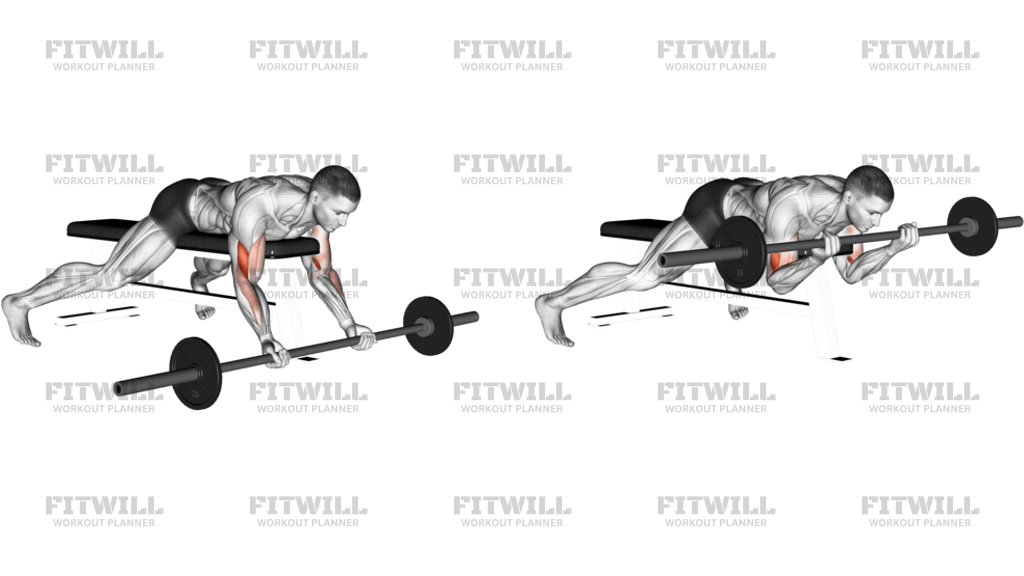
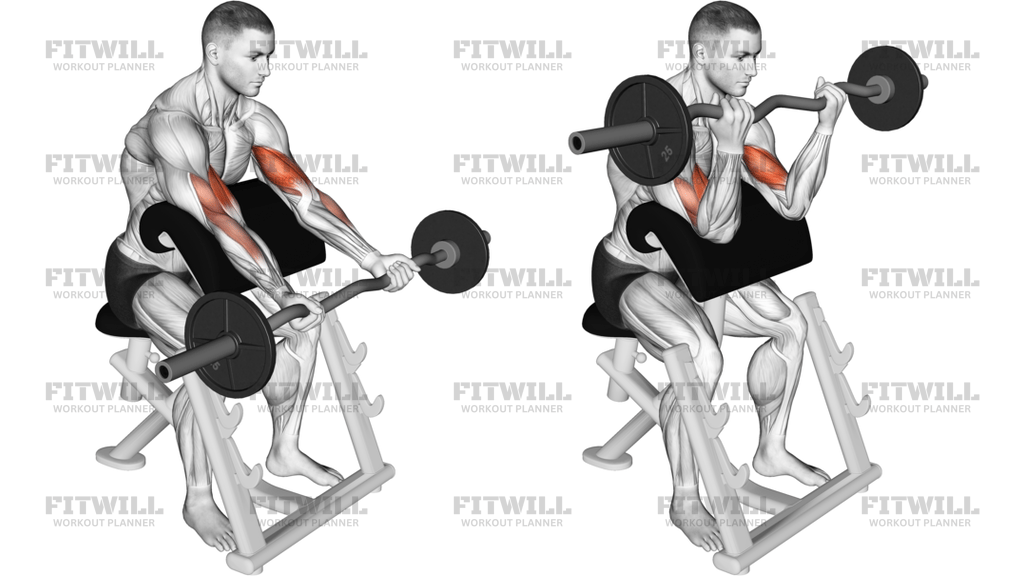
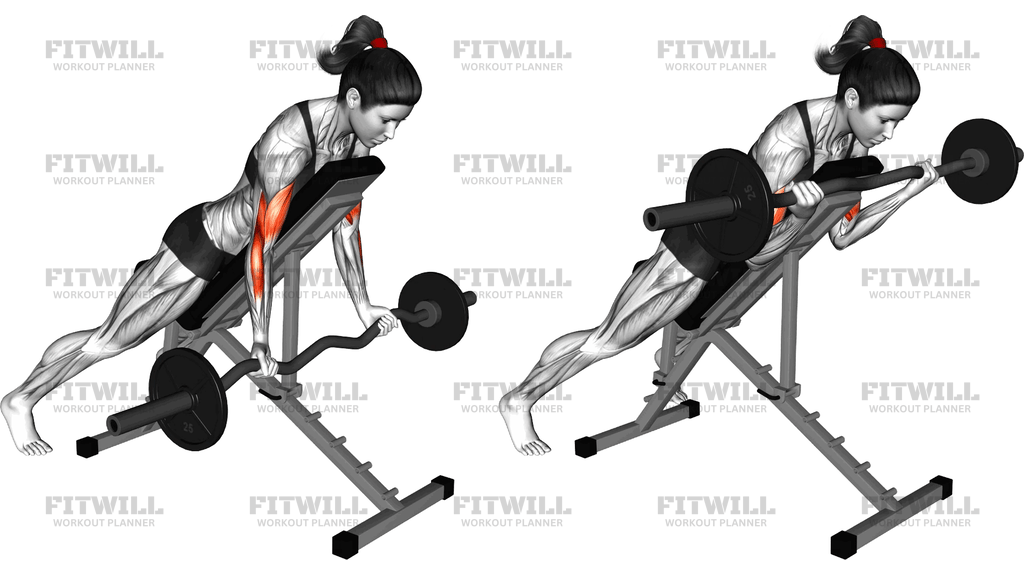
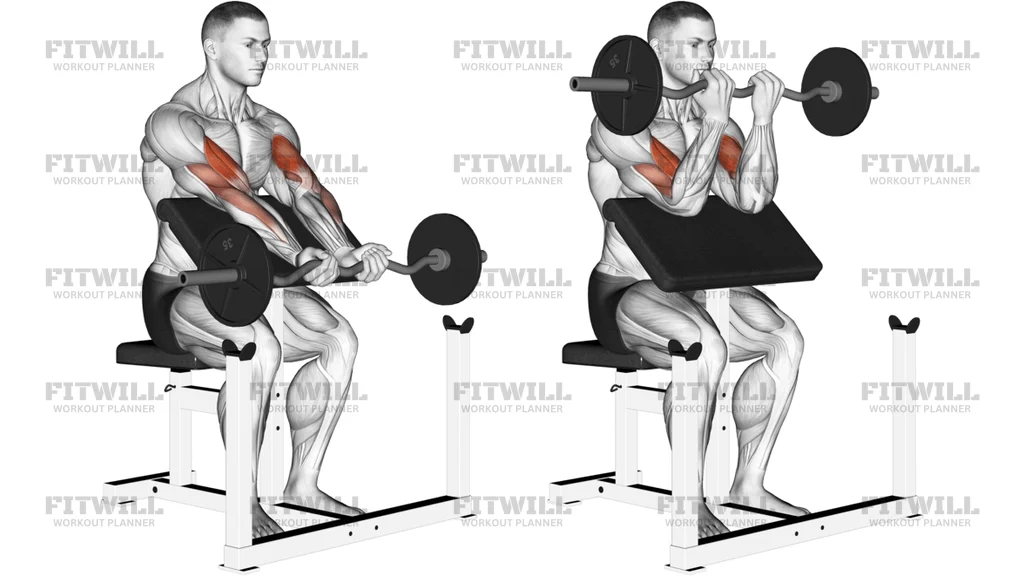
Ez Bar Srtict Curl
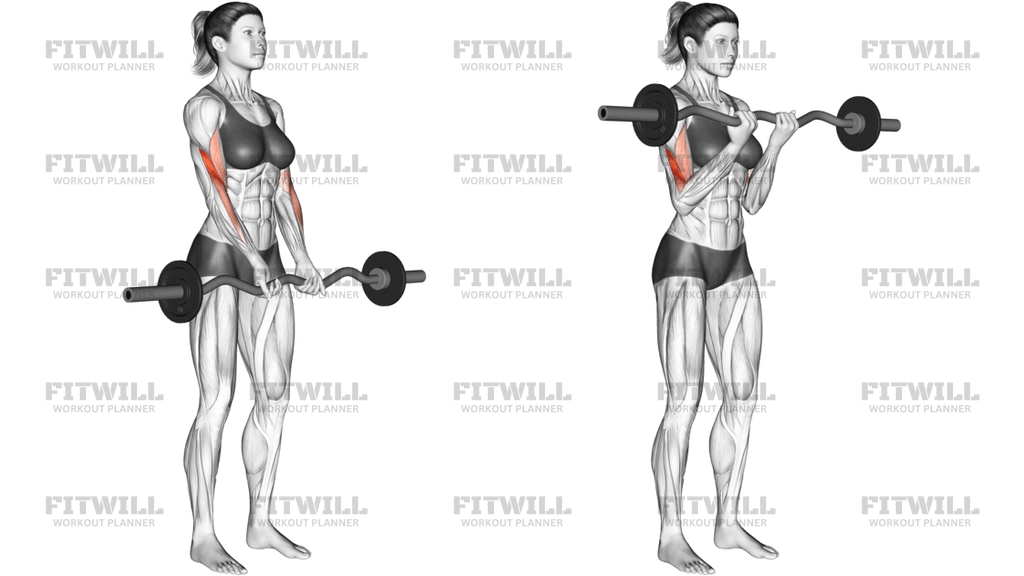
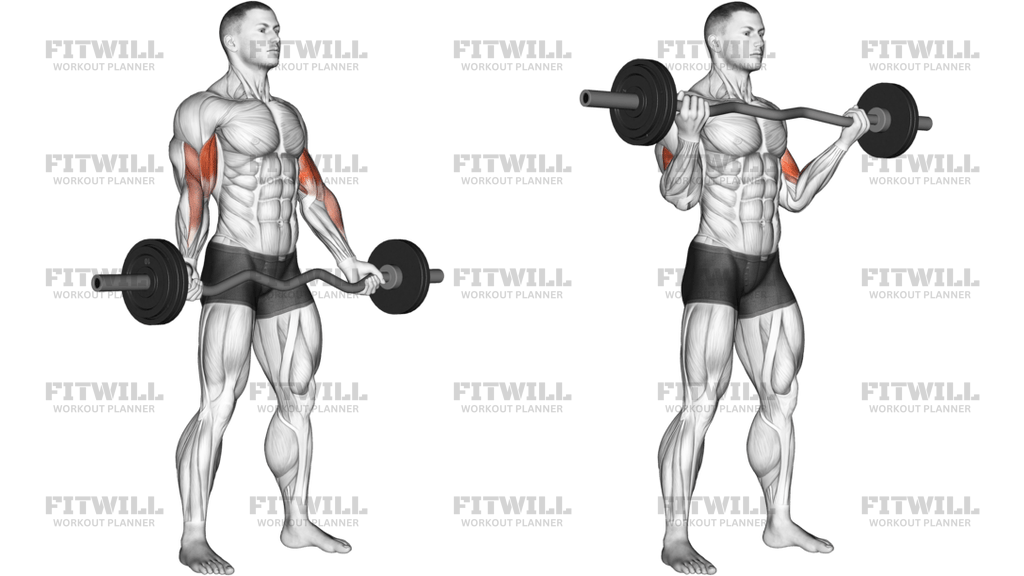
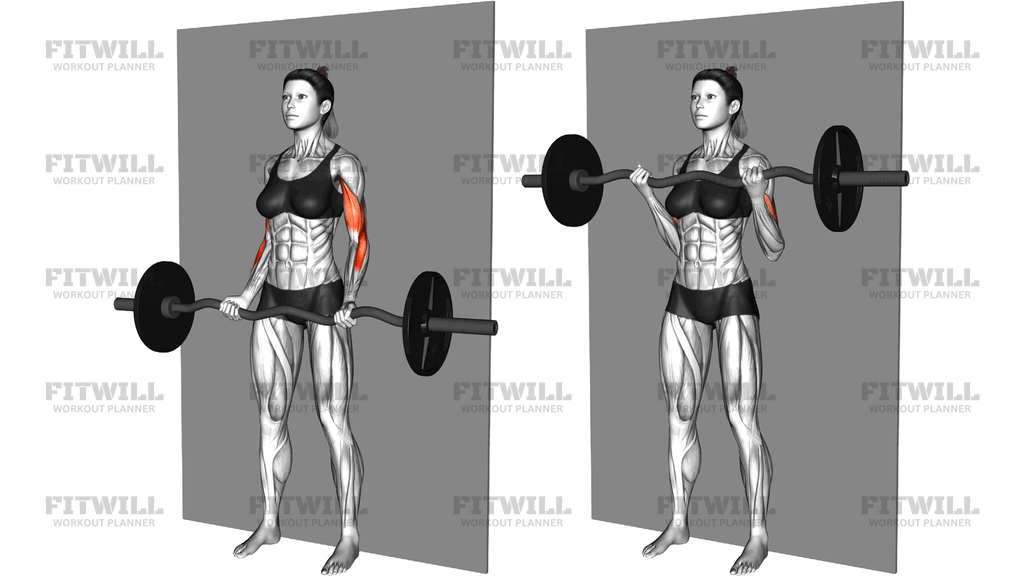
The Ez Bar Strict Curl is a standing biceps exercise performed with the angled cambered bar held in front of the thighs with an underhand grip. The word "strict" is the key: your torso stays upright, your elbows stay pinned to your sides, and your lower back does not help the bar up. The EZ bar's zigzag shape places your wrists in a semi-supinated position, which many lifters find more comfortable than the fully supinated grip of a straight barbell.
This movement targets the biceps brachii as the primary flexor of the elbow, with the brachialis underneath and the brachioradialis of the forearm assisting. Because the standing position offers no backrest, your core and upper back also work isometrically to keep you from swinging, though they are stabilizers rather than prime movers.
The strict setup matters more here than in almost any other curl variation. With a straight bar, it is easy to cheat by leaning back and driving with the hips; the EZ bar makes that temptation just as real, so discipline at the start of each rep is what separates a biceps set from a full-body heave. Keeping the elbows fixed also ensures the resistance stays on the elbow flexors through the entire range instead of shifting to the front shoulders.
To perform it well, stand with feet about hip-width apart, grip the inner angled portions of the bar so your palms face up and slightly inward, and let the bar hang at arm's length against your thighs. Curl the bar up in a smooth arc without letting your elbows drift forward, squeeze at the top when your forearms approach your upper arms, then lower under control to a full stretch at the bottom.
The Ez Bar Strict Curl fits well as a primary mass-builder early in an arm session when you are fresh, or as a strictness benchmark to measure your curling strength against a looser barbell curl. It suits most training levels because the load is easy to scale with small plate jumps, and it is a practical choice for anyone whose wrists complain on a straight bar.
A few safety points are worth internalizing before you load the bar. Choose a weight you can lower slowly for every rep, keep your knees slightly bent rather than locked, and stop the set the moment your torso starts rocking or your elbows travel forward. Controlled cheating on a curl might move more weight, but it moves the stress away from the exact muscles the exercise is meant to train.
[ Workout Log & Planner ]
Put your next workout in Fitwill
Keep your plan and training log ready when you are.


Instructions
- Load the EZ bar with an even amount of weight on each side and set it on the floor or a rack in front of you.
- Stand with your feet about hip-width apart, knees softly bent, and grip the inner angled sections of the bar with an underhand grip so your palms face up and slightly inward, hands roughly shoulder-width.
- Stand tall with the bar hanging at full arm's length in front of your thighs, shoulders pulled back, chest up, and abs braced to keep your torso from moving.
- Pin your upper arms against your sides and keep them there for the entire set; they are the fixed frame, not part of the lift.
- Exhale and curl the bar up in a smooth arc by bending only at the elbows, letting the bar travel close to your body toward shoulder height.
- Pause briefly at the top with your forearms near your upper arms and squeeze your biceps without shrugging your shoulders.
- Inhale and lower the bar slowly along the same arc until your arms are fully extended and you feel a complete stretch in the biceps at the bottom.
- Reset your posture between reps if you feel yourself leaning, then begin the next curl from the dead hang position at your thighs.
- Keep the tempo controlled on the way down, aiming for a lowering phase of about two to three seconds on every rep.
Tips & Tricks
- If your wrists ache at the top of the rep, adjust your hand position on the angled grips until the bend feels neutral; the camber exists precisely so you can fine-tune this.
- Swinging the torso is the most common fault on this lift. A quick fix is to stand with your back close to a wall or the uprights of a rack so any lean becomes immediately obvious.
- Watch that your elbows do not drift forward as the bar rises. If they travel toward the ceiling, you are turning the movement into a front raise and shifting work off the biceps.
- Do not drop the bar from the top. The lowering half of the Ez Bar Strict Curl builds a large share of the tension, so treat the descent as the actual work.
- Grip the bar firmly but avoid squeezing so hard that your forearms fatigue before your biceps do; a white-knuckle grip shortens every set.
- Use the smaller plate increments on this exercise. Jumping ten or more pounds at a time usually costs you the strict form that gives the lift its name.
- At the bottom, let the arms reach full extension each rep instead of stopping short. Cutting the stretch turns a full-range curl into a partial that mostly works the mid-range.
- If your lower back feels strain, check your stance: feet hip-width, knees slightly bent, and weight spread across the whole foot create a stable base that protects your spine.
Frequently Asked Questions
Which muscles does the Ez Bar Strict Curl work?
The biceps brachii is the primary mover, with the brachialis and brachioradialis assisting elbow flexion. The forearms also work to hold the bar, and your core stabilizes the upright torso.
Why use an EZ bar instead of a straight barbell for curls?
The angled grips put your wrists in a semi-supinated position that reduces strain on the wrist joints for many lifters. The biceps still work hard, but the grip angle is friendlier for people who find straight-bar curls uncomfortable.
What does "strict" mean in the Ez Bar Strict Curl?
It means no body English: your torso stays upright, your elbows stay glued to your sides, and the bar moves only by elbow flexion. If you have to swing or lean back to lift it, the weight is too heavy.
Is this exercise suitable for beginners?
Yes, as long as you start with a light bar or even just the empty EZ bar to learn the elbow position. Beginners often benefit from the strict style because it teaches good curl mechanics before heavier loads invite cheating.
How wide should my grip be on the EZ bar?
A shoulder-width grip on the inner angled sections works well for general biceps development. Bring your hands slightly closer to bias the outer biceps and brachialis, or slightly wider to shift a little more toward the inner biceps.
Why do my elbows keep moving forward during the curl?
Forward elbow drift usually means the weight is too heavy or you are trying to raise the bar higher than your elbows allow. Stop the curl when your forearms reach your upper arms and reduce the load if you cannot get there with fixed elbows.
Can I substitute the Ez Bar Strict Curl with dumbbell curls?
Yes, alternating or simultaneous dumbbell curls with palms up are a close substitute and allow each arm to work independently. The dumbbell version lets you supinate freely, while the EZ bar fixes the wrist angle for you.
How many reps and sets should I do?
For muscle growth, three to four sets of eight to twelve strict reps is a reliable range. Because form breaks down quickly on this lift, prioritize clean technique over chasing higher rep counts with swinging.
Is it safe for my wrists and elbows?
For most people, yes, and the EZ bar is often chosen specifically because it is easier on the wrists than a straight bar. Warm up with lighter sets, keep the movement smooth, and avoid locking out hard or bouncing at the bottom.