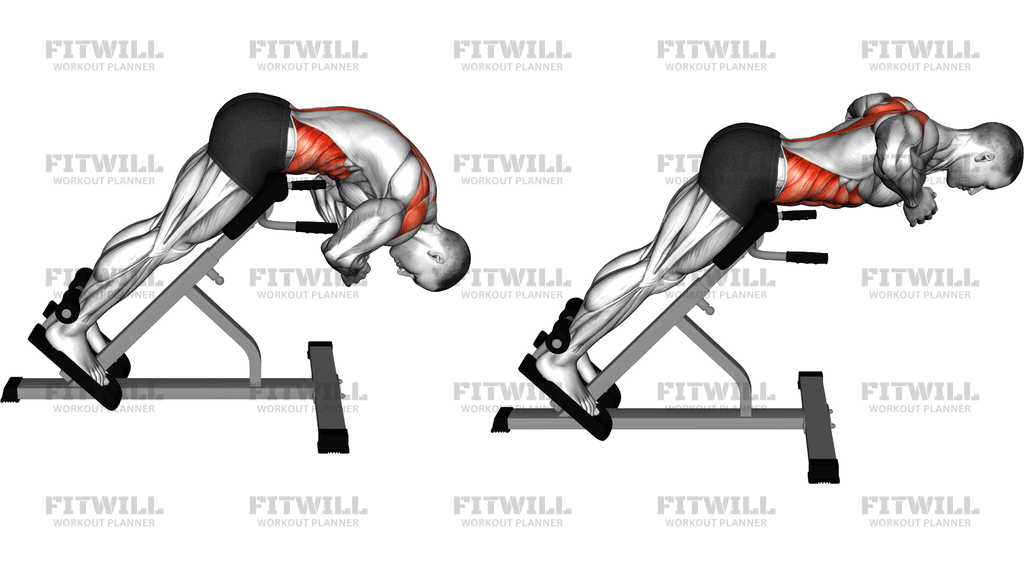
45 Degrees Back Extension Scapular Adduction
The 45 Degrees Back Extension Scapular Adduction is a body weight movement performed on an angled hyperextension bench, combining two jobs into one rep: extending the trunk up to a horizontal line and then squeezing the shoulder blades together at the top. Because the torso works against gravity at a 45-degree angle, the erector spinae, glutes, and hamstrings hold the trunk steady while the rhomboids and mid-traps finish each rep with a deliberate scapular squeeze.
This exercise suits lifters who want to train upper back retraction without rowing equipment, and it is a smart pick for people who spend long hours at a desk and lose the ability to pull their shoulder blades together. It is also useful as a teaching drill: the bent-over position removes momentum, so any cheating in the scapular squeeze becomes obvious immediately.
The setup matters more than in a standard back extension. Your hip crease should sit just above the pad so the pelvis can hinge freely, the ankles stay hooked under the rollers, and the feet press into the platform. If the pad sits too high on your thighs, the lower back takes over; if it sits too low, the hamstrings and glutes dominate and the trunk extension gets sloppy.
To execute it well, fold forward until the hamstrings and lower back feel a mild stretch, then rise by extending the hips and spine until your body forms a straight line from head to heels. Once you reach that line, keep it locked and draw the shoulder blades back and down, letting the arms hang relaxed at your sides. The scapular adduction is a short, precise pull — an inch or two of travel — not a shrug and not an arch of the lower back.
A common use case is pairing this with rows or pull-ups to cover retraction from a different angle, or using it as a higher-rep finisher when the grip is already fatigued. Beginners can start with just the trunk extension and add the scapular squeeze once the hip hinge feels stable. Move at a pace you can own: about two seconds down, one second up, a clear squeeze at the top, and no bouncing out of the bottom.
[ Workout Log & Planner ]
Put your next workout in Fitwill
Keep your plan and training log ready when you are.


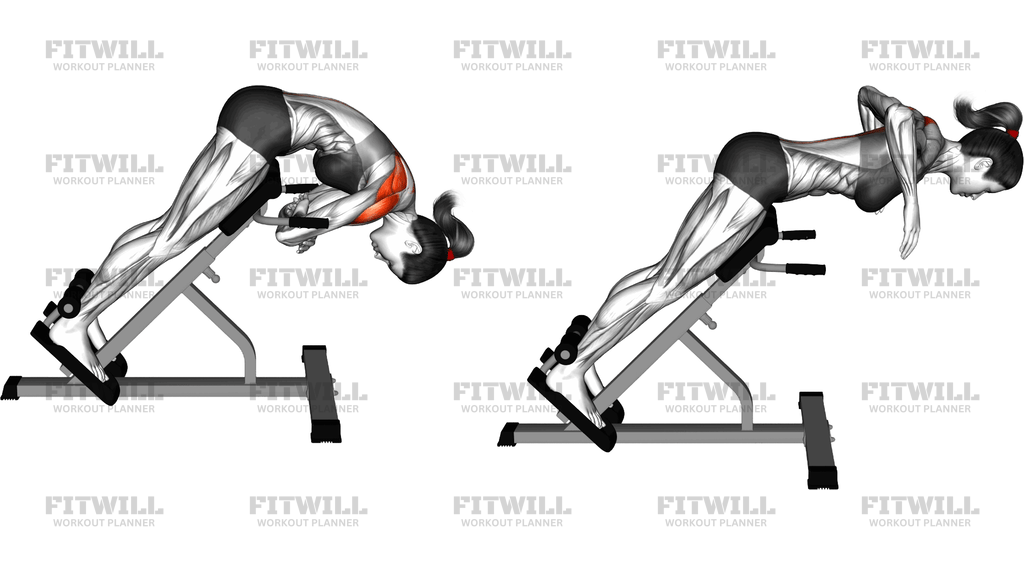
Instructions
- Adjust the 45-degree bench so the top pad sits just below your hip crease and your thighs can tilt forward when you fold down.
- Place your feet on the platform with the backs of your ankles hooked firmly under the roller pads, knees nearly straight but not locked.
- Hold the side handles for support as you hinge at the hips and lower your torso toward the floor until you feel a stretch across the hamstrings and lower back.
- Let go of the handles and let your arms hang straight down toward the floor, shoulders relaxed.
- Brace your abdominals lightly and keep your neck in line with your spine before starting the lift.
- Exhale and extend up by driving the hips forward and straightening the spine until your head, hips, and heels form one horizontal line.
- At the top, hold that line and draw your shoulder blades back and down toward each other, keeping your arms loose and your lower back from arching further.
- Pause for a beat on the scapular squeeze, then inhale and reverse the movement under control, hinging back down to the stretched position.
- Grip the side handles again if you need help steadying yourself between reps, reset your brace, and continue.
- Keep the range smooth from start to finish — no jerking up from the bottom and no bouncing off the stretch.
Tips & Tricks
- If your lower back takes over at the top, stop the trunk extension a few degrees short of horizontal and put all your attention on the scapular squeeze instead.
- A common mistake is shrugging the shoulders toward the ears during the adduction — think shoulder blades moving back and down, not up.
- Do not swing the arms backward to fake the squeeze; the arms should stay passive so the rhomboids and mid-traps do the work.
- If the pad digs into your thighs or your hips slide forward during the rep, reposition so the pad sits just below the hip crease.
- Keep the hips in contact with the pad the whole time; letting them rise and fall turns this into an uncontrolled see-saw movement.
- Squeeze the roller pads gently with your ankles and press your feet into the platform to stop the legs from drifting during the extension.
- If the full range feels unstable at first, hold the side handles through the bottom half of the rep and only release them once you are halfway up.
- Cross your arms over your chest only during the trunk extension if hanging arms feel too easy for the lower back — then return the arms to your sides for the scapular portion.
- Tempo is your safety net here: a fast, bouncy rise usually means the hamstrings and momentum are moving the weight instead of your back muscles.
Frequently Asked Questions
Which muscles does the 45 Degrees Back Extension Scapular Adduction work?
The rhomboids and middle trapezius drive the scapular squeeze, while the erector spinae, glutes, and hamstrings handle the trunk extension and hold the horizontal position. The rear shoulders assist as stabilizers.
How is this different from a regular back extension on a 45-degree bench?
A regular back extension ends when the trunk reaches horizontal. Here, you add a deliberate shoulder blade squeeze at the top with the arms hanging, which shifts part of the workload to the upper back.
Is the 45 Degrees Back Extension Scapular Adduction suitable for beginners?
Yes, provided you start with a modest range and master the hip hinge first. Beginners can perform the extension and add the scapular squeeze only once the top position feels stable.
Should my arms stay hanging or hold onto the handles during the rep?
Use the side handles only to steady yourself in the folded bottom position or between reps. During the actual lift, the arms hang relaxed so the shoulder blades, not the arms, do the adduction.
Why do I feel this more in my lower back than my upper back?
That usually means you are arching the spine further at the top instead of squeezing the shoulder blades. End the trunk extension at a straight line and spend a full second on the scapular squeeze before descending.
What can I use if I do not have a 45-degree hyperextension bench?
A Roman chair or an adjustable bench anchored low can work, or you can train the components separately: floor back extensions for the trunk and prone Y-T raises or band pull-aparts for the scapular adduction.
How many reps and sets should I do?
Two to four sets of 10 to 15 controlled reps works well, either as a warm-up activation or as a higher-rep finisher after rows or pulls.
Is it safe to do this every day?
Daily use is possible at low intensity, but the lower back extensors respond better to recovery like any other muscle. Two to four sessions per week with at least a day between harder sessions is a sensible rhythm.
How far down should I fold at the bottom of the 45 Degrees Back Extension Scapular Adduction?
Lower until you feel a mild stretch through the hamstrings and lower back while the hips stay on the pad. Going deeper adds little and encourages rounding under load.