Twist Hip Lift
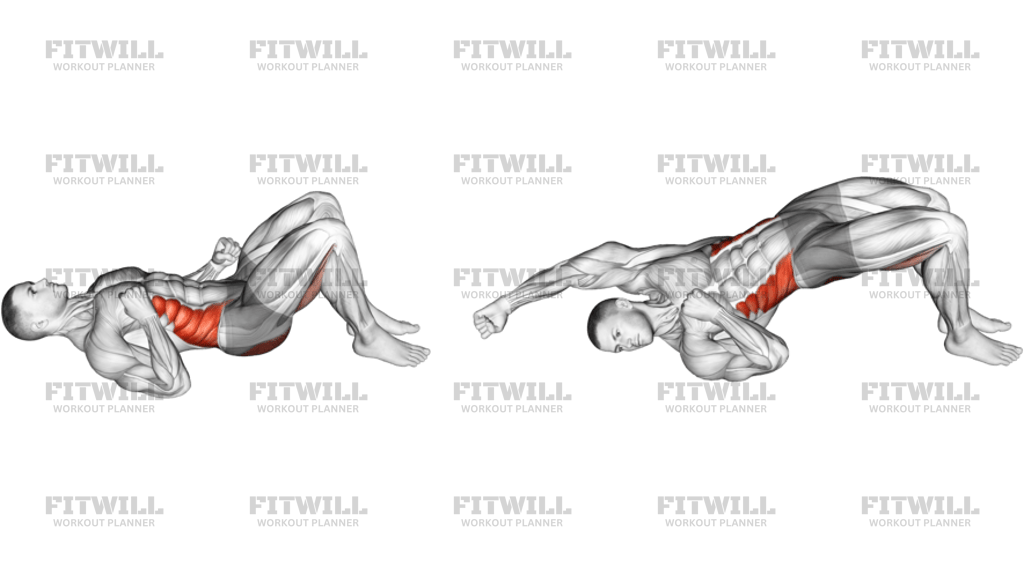
Twist Hip Lift is a bodyweight floor exercise that combines a short bridge with a controlled pelvic twist. It is used to train the obliques and surrounding trunk stabilizers while also involving the glutes and deep abdominal wall to keep the pelvis from drifting or sagging as the hips rise. The movement is simple in appearance, but the value comes from how cleanly you can control the lift, the rotation, and the return.
The exercise starts from a supine position with the knees bent and the feet planted. That setup matters because the feet, hips, and shoulders all need to stay organized while the torso changes shape. If the feet slide, the knees collapse, or the ribs flare, the twist gets taken over by the lower back instead of the side of the waist. A good setup keeps pressure through the feet and keeps the chest quiet while the pelvis does the work.
As you lift the hips, the body should move like a compact bridge rather than a loose crunch. The pelvis rises first, then rotates just enough to create a clear oblique contraction without forcing a large range of motion. The shoulders stay anchored, the neck stays relaxed, and the top position should feel like a stable hold rather than a violent heave. The goal is controlled tension through the midsection, not height for its own sake.
This exercise fits well as accessory core work, warm-up activation, or a low-load conditioning drill when you want trunk control without heavy spinal loading. It can be scaled by reducing the height of the bridge, slowing the lowering phase, or shortening the twist. Beginners can usually learn it quickly because the pattern is bodyweight-based, but it still rewards precision. If the lower back takes over or the motion becomes jerky, reduce the range and reset the position before the next rep.
[ Workout Log & Planner ]
Put your next workout in Fitwill
Keep your plan and training log ready when you are.


Instructions
- Lie on your back with your knees bent, feet flat on the floor, and your heels close enough to press firmly through the full foot.
- Keep your arms relaxed on the floor for balance or bring one hand across your chest, then settle your shoulders and back of your head on the ground.
- Brace your midsection and keep your ribs down before the first rep so the lift starts from a controlled position.
- Exhale as you press through your feet and lift your hips into a bridge.
- As the hips rise, rotate the pelvis slightly to one side so the twist comes from the waist and hips, not from flailing the knees.
- Pause briefly at the top when you feel the obliques tighten and the glutes support the bridge position.
- Lower the hips back to the floor with control, keeping the knees bent and the feet planted.
- Reset in the center before the next rep or alternate sides if that is how the set is programmed.
Tips & Tricks
- Keep the twist small and deliberate; the exercise is about oblique control, not about rolling all the way onto the side.
- Press evenly through both feet so the pelvis can rotate without one heel popping off the floor.
- If your lower back arches, lower the hips less and bring the ribs down before trying another rep.
- Think about lifting the beltline, not flinging the knees upward.
- A slow lower makes the obliques work longer than a fast drop back to the floor.
- Keep the chin relaxed and the gaze neutral so the neck does not help with the twist.
- If one side feels much stronger, pause a beat longer on the weaker side and keep the range symmetrical.
- Stop each set when the bridge turns into a lumbar extension pattern or the feet start sliding around.
Frequently Asked Questions
What does Twist Hip Lift train most?
The main target is the obliques, with the glutes and deeper core muscles helping stabilize the bridge and control the twist.
Can beginners perform this exercise?
Yes. It is a beginner-friendly bodyweight drill as long as the bridge stays controlled and the rotation stays small.
Should my feet stay flat during the rep?
Yes. Keep both feet planted so you can drive the bridge from the floor instead of shifting around on your toes.
Where should the twist come from?
The rotation should come from the pelvis and waist while the shoulders stay mostly grounded. If the knees are swinging wildly, the motion is too loose.
How high should I lift my hips?
Lift only high enough to create a strong bridge without arching your lower back. A shorter, cleaner bridge is better than a high one with poor control.
What is the biggest form mistake?
The most common mistake is turning the rep into a lower-back arch instead of a controlled hip lift with a small twist.
Can I alternate sides each rep?
Yes, if the program calls for alternating sides. Just make sure each side gets the same range and tempo.
How can I make Twist Hip Lift harder?
Slow the lowering phase, pause longer at the top, or increase the total reps while keeping the bridge and twist very controlled.