Supine Spinal Twist Yoga Pose
Supine Spinal Twist Yoga Pose is a floor-based bodyweight mobility exercise that rotates the spine while giving the outer hip, glutes, obliques, and lower back a strong but controlled stretch. The pose is done lying on your back with the arms spread wide and one knee guided across the body, so the whole repetition is built around calm positioning rather than force. It is useful when you want to restore rotation, ease stiffness after lifting, or finish a session with a low-stress trunk and hip reset.
The setup matters because the twist should come from the torso and hips, not from yanking the knee across the body. When the opposite shoulder stays rooted to the floor, the rib cage can open and the spine can rotate without the stretch turning into a sloppy pull on the low back. In the image, the body is arranged in a classic supine twist shape: one leg reaches long, the other knee folds across the body, and the arms stay out for balance and support.
This pose is not about speed or depth. A good rep or hold feels like a steady spiral from the waist through the trunk, with the pelvis relaxing as far as the shoulders and lower back allow. If the top knee does not reach the floor, that is fine; the correct range is the one where both shoulders can stay heavy and the breath stays slow. Turning the head away from the bent knee can increase the stretch, but it should never create neck strain.
Use it as a warm-down, recovery drill, or mobility accessory after training days that leave the hips, spine, or trunk feeling tight. It also works well after long periods of sitting because it encourages gentle rotation through the lumbar and thoracic regions while stretching the glutes and outer hip. Beginners can use it comfortably, but they should shorten the range and keep the movement smooth. The goal is a controlled, repeatable twist that leaves the back feeling freer, not one that forces the knee to the floor.
Fitwill
Log Workouts, Track Progress & Build Strength.
Achieve more with Fitwill: explore over 9600 exercises with images and videos, access built-in and custom workouts, perfect for both gym and home sessions, and see real results.
Start your journey. Download today!




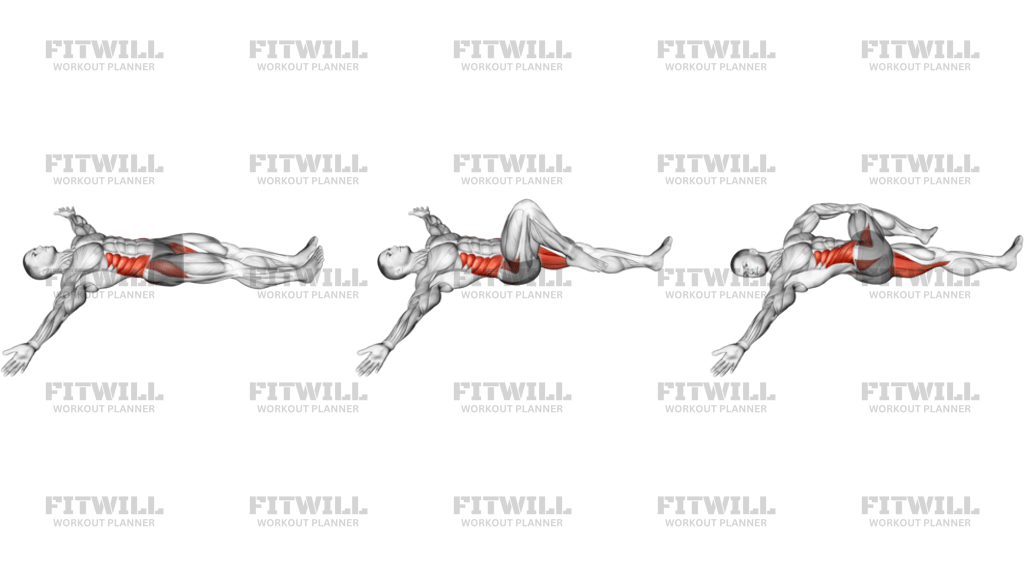
Instructions
- Lie on your back on the floor with both arms out to the sides in a T position and your legs extended.
- Bend one knee and draw it toward your chest while keeping the other leg long and relaxed.
- Exhale and guide the bent knee across your body toward the opposite side without forcing it down.
- Keep the opposite shoulder blade heavy on the floor so the twist stays through the trunk, not the neck.
- Let the bent leg rest where it comfortably lands; do not chase the floor if your hip or low back resists.
- Turn your head away from the bent knee only if your neck feels comfortable and stays relaxed.
- Hold the end position for one to three slow breaths, feeling the stretch through the outer hip, obliques, and lower back.
- Inhale to return the knee to center with control, then switch sides and repeat.
Tips & Tricks
- Keep both arms pressed into the floor so the chest does not roll open when the knee moves across.
- If your top knee is a long way off the floor, stop there; the stretch should come from rotation, not forced leverage.
- A small pillow or folded towel under the bent knee can make the position more comfortable if the hip feels tight.
- Relax the jaw and breathe out slowly as the knee crosses the body so the ribs can soften into the twist.
- If your lower back pinches, shorten the twist and keep the bent knee higher instead of pushing for more range.
- Do not yank on the bent leg with the opposite hand; let gravity and breathing create the stretch.
- Keep the straight leg long but not rigid so the pelvis can settle naturally on the floor.
- Move side to side deliberately rather than bouncing between positions.
Frequently Asked Questions
What does Supine Spinal Twist Yoga Pose mainly stretch?
It primarily stretches the outer hip, glutes, obliques, and lower back while gently rotating the spine.
Is this more of a stretch or a strength exercise?
It is mainly a mobility and recovery pose, but it still asks the trunk to control rotation and position.
Should both shoulders stay on the floor during the twist?
Ideally yes, especially the shoulder opposite the bent knee. If one shoulder lifts, reduce the range.
How far should the bent knee go across the body?
Only as far as you can keep the shoulders relaxed and the stretch comfortable. Forcing the knee lower usually turns it into a low-back strain.
Can I keep the bottom leg straight?
Yes. A straight bottom leg is the classic setup, but you can soften that knee if your lower back or hamstrings feel tight.
What should I do if my lower back feels pinched?
Shorten the twist, keep the bent knee higher, and stop trying to pin the knee to the floor.
Can I turn my head in the opposite direction?
Yes, if your neck feels good. If it creates strain, keep your gaze upward instead.
When is this pose most useful?
It works well after lifting, at the end of a mobility session, or anytime your spine and hips feel stiff from sitting.