Control Balance
Control Balance is a classic Pilates mat exercise built around a shoulder-stand balance and a controlled hamstring stretch. In the image, the body is inverted on the upper back while one leg reaches vertically and the other extends overhead, which makes the movement as much about spinal control and balance as it is about flexibility. It is a bodyweight drill, but the demand is high because the legs move far away from the center of mass and the torso has to stay organized the entire time.
This exercise trains deep trunk control, posterior-chain length, and the ability to keep the pelvis steady while the legs change position. The shoulders, upper back, and arms provide the base of support, while the abdominals and hip stabilizers keep the rollover from collapsing into the neck or swinging through momentum. Because the lever is long and the position is inverted, small losses of tension show up immediately in the hips, ribs, and neck.
The setup matters more here than in a basic core drill. You need a mat or similarly comfortable surface, enough hamstring mobility to bring the legs overhead without forcing the neck, and enough control to keep the chest lifted away from the chin. A clean rep starts from a stacked shoulder-stand position, with the weight anchored through the shoulders and upper back rather than the head. The hands then assist by holding the ankle or foot of the elevated leg so the body can stay balanced while the opposite leg lowers and returns under control.
Use the movement for advanced core work, Pilates conditioning, and mobility-strength training when you want to challenge balance, control, and hamstring length at the same time. The goal is not to throw the legs into a dramatic shape; it is to keep the pelvis quiet, breathe smoothly, and move with enough precision that the inversion looks effortless. If the neck feels compressed, the shoulders slide, or the lower back loses control, shorten the range and keep the rep smaller until the position is clean.
Fitwill
Log Workouts, Track Progress & Build Strength.
Achieve more with Fitwill: explore over 9600 exercises with images and videos, access built-in and custom workouts, perfect for both gym and home sessions, and see real results.
Start your journey. Download today!




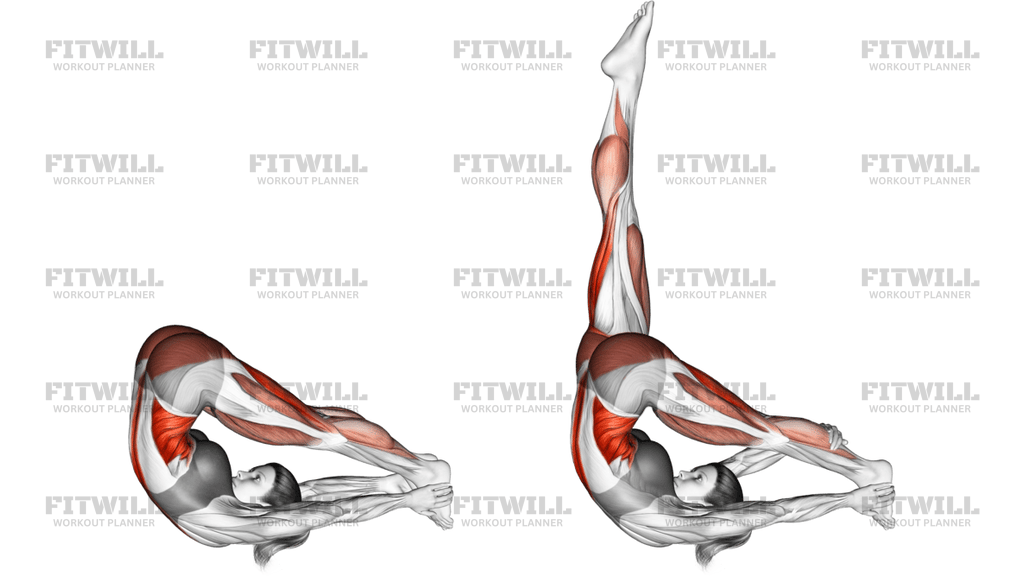
Instructions
- Lie on your back on a mat with your arms long by your sides and your shoulders relaxed away from your ears.
- Roll your hips up into a shoulder stand so your weight rests on the upper back and the base of the shoulders, not on the neck.
- Bring one leg toward the ceiling and let the other leg continue overhead until the pelvis stays stacked and controlled.
- Reach both hands to the ankle or foot of the raised leg to help steady the balance.
- Keep the supporting leg long and active as it lowers overhead; do not let the knee bend or the pelvis twist open.
- Hold the inverted position briefly while keeping the ribs drawn in and the chin softly away from the chest.
- Exhale as you change legs or deepen the stretch, then use a slow inhale to keep the torso stable.
- Reverse the motion with control and lower the spine back to the mat one vertebra at a time.
- Reset before the next repetition so every rep starts from a clean shoulder-stand position.
Tips & Tricks
- Press the upper arms and shoulders firmly into the mat so the neck stays out of the load.
- Keep the face relaxed and stop if the chin starts jamming toward the chest.
- If the legs cannot stay straight, shorten the range instead of swinging them farther overhead.
- Use your hands for balance, not to yank the leg deeper into the stretch.
- Think about lifting the ribs away from the hips so the inversion stays long rather than collapsed.
- Move slowly enough that the pelvis does not rock when you switch which leg is vertical.
- A tucked pelvis and active lower abs help keep the lumbar spine from arching under the load.
- This is an advanced mat exercise, so a smaller range with perfect control is better than a bigger range with neck pressure.
Frequently Asked Questions
What does Control Balance work most?
It mainly challenges the deep abdominals, shoulder stabilizers, hamstrings, glutes, and the muscles that control spinal position in an inversion.
Why are my shoulders so important in this movement?
The shoulders and upper back are the base of support. If they slide or collapse, the load shifts toward the neck and the balance gets unstable.
Should I hold the ankle or the foot?
Either can work if it is comfortable and gives you a steady grip. Hold the raised leg where you can stay balanced without pulling the hip out of line.
Can beginners do Control Balance?
Most beginners should build up to it with shoulder-stand work, core control, and hamstring mobility first. The inversion and leverage make it much harder than it looks.
What if I feel pressure in my neck?
Reduce the range immediately, keep more weight on the shoulders, and stop the set if the neck feels compressed. Control Balance should not feel like a neck drill.
Do I need straight legs the whole time?
Straight legs are the goal, but only if you can keep the pelvis controlled. A slight knee bend is safer than forcing the range and losing the position.
What is a common mistake with the raised leg?
A common mistake is swinging the leg to the ceiling with momentum instead of controlling the rollover from the torso and hips.
Where does this fit in a Pilates workout?
It usually belongs in the advanced portion of a Pilates mat session after you are warm, stable, and ready for an inversion-based control exercise.