Handstand
Handstand is a bodyweight inversion that asks you to stack your wrists, shoulders, hips, and ankles into one clean line while your triceps, shoulders, forearms, and core keep the position steady. It is less about moving through a big range of motion and more about creating a controlled vertical hold that teaches balance, shoulder elevation, and whole-body tension.
Because you are supporting your body weight overhead, the setup matters more than it does in most exercises. Your hands need to be planted firmly, your elbows locked, and your shoulders actively pushed away from the floor so the line of force stays stacked instead of collapsing into the joints. That overhead position is what makes Handstand useful for strength, stability, and body control.
A good Handstand starts from a predictable entry, whether you kick up, press into position, or practice against a wall. Once you are up, squeeze the glutes, keep the ribs from flaring, and hold the legs together so the shape stays tight from hands to toes. The goal is not to arch your back to save balance; the goal is to keep the body organized enough that small fingertip and shoulder adjustments can keep you upright.
This exercise is commonly used in gymnastics, calisthenics, and overhead strength work because it exposes weak links quickly. If the wrists, shoulders, or midline cannot stay stacked, the hold becomes shaky, banana-shaped, or turned into a frantic kick-up repeat instead of a true hold. Practicing Handstand with clean positions builds the shoulder endurance and trunk control that carry over to handstand push-up progressions, overhead pressing stability, and other inverted skills.
Treat Handstand as a skill plus strength drill, not as a movement to rush through. Short, high-quality holds with a straight line and calm breathing are more valuable than chasing a long hold that breaks posture. Use a wall, a spot, or a partial inversion if needed, and stop the set before the wrists cave, the neck cranks forward, or the lower back starts to overextend.
Fitwill
Log Workouts, Track Progress & Build Strength.
Achieve more with Fitwill: explore over 9600 exercises with images and videos, access built-in and custom workouts, perfect for both gym and home sessions, and see real results.
Start your journey. Download today!




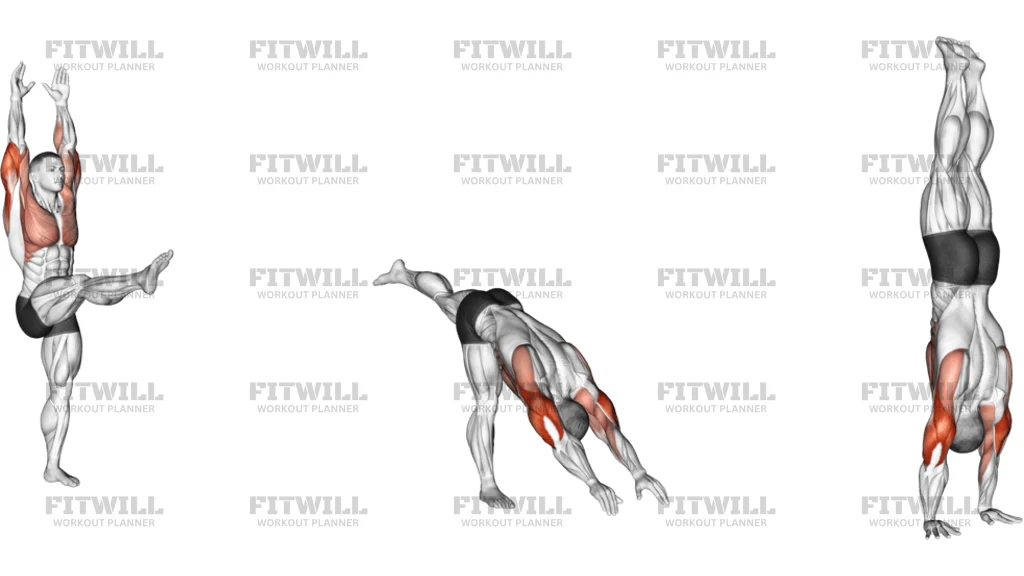
Instructions
- Place both hands on the floor shoulder-width apart, spread your fingers wide, and set your wrists directly under your shoulders.
- Kick up or walk your feet toward a wall until your body reaches an inverted position, with your arms straight and your shoulders actively pushing tall.
- Stack your hips over your shoulders and keep your legs together so your body forms one line from your hands to your toes.
- Tuck your ribs down slightly, squeeze your glutes, and keep your head neutral instead of looking forward.
- Press through your fingertips and the base of your palm to make small balance corrections instead of bending at the hips.
- If you are using a wall, let the heels touch lightly and avoid dumping your lower back into a deep arch.
- Breathe in short, controlled breaths while keeping the hold steady and the shoulders elevated.
- Lower one leg at a time or step down with control when you finish the hold, then shake out the wrists before the next attempt.
Tips & Tricks
- Spread your fingers hard into the floor so balance corrections happen through the hands, not by breaking at the waist.
- Keep the shoulders shrugged up toward the ears; a loose shoulder position makes the whole hold collapse.
- If the lower back arches, squeeze the glutes harder and bring the ribs back over the pelvis.
- Use the wall only as a light balance check, not as a place to dump your body weight.
- Think about pushing the floor away the entire time to keep the elbows straight and the shoulders active.
- Keep your gaze between your hands; looking forward usually makes the neck and ribcage drift out of line.
- Short holds with perfect shape are better than long holds with bent elbows or a banana back.
- If your wrists fatigue early, shorten the set and build time gradually instead of grinding through shaky attempts.
Frequently Asked Questions
What muscles does Handstand work?
The main demand is on the triceps and shoulders, with the forearms and core working hard to keep the line steady.
Is Handstand good for beginners?
Yes, if you start with wall-supported holds or short kick-up attempts. Beginners should focus on stacking and balance before trying long freestanding holds.
Do I need a wall for Handstand practice?
No, but a wall is the safest way to learn the body line and shoulder position before you try to balance freely.
Why do my ribs flare or my back arch in Handstand?
That usually means the core and glutes are not keeping the pelvis stacked. Tuck the ribs slightly and squeeze the glutes to bring the body back into line.
How should my hands be placed for Handstand?
Place them about shoulder-width apart with fingers spread wide and pressure through the fingertips, palms, and knuckles so you can correct balance quickly.
What is the most common Handstand mistake?
Letting the shoulders sink and the lower back arch is the biggest one. A tall shrug and a tight midline keep the hold much cleaner.
Can Handstand help with handstand push-up training?
Yes. Clean holds build the shoulder stability, line control, and wrist tolerance that carry over to handstand push-up progressions.
What should I do if my wrists hurt during Handstand?
Shorten the hold, warm up the wrists first, and stop if pain increases. Parallettes or a slight hand angle can also reduce wrist extension for some people.