Dumbbell Standing Bent-Over Two Arm Triceps Extension
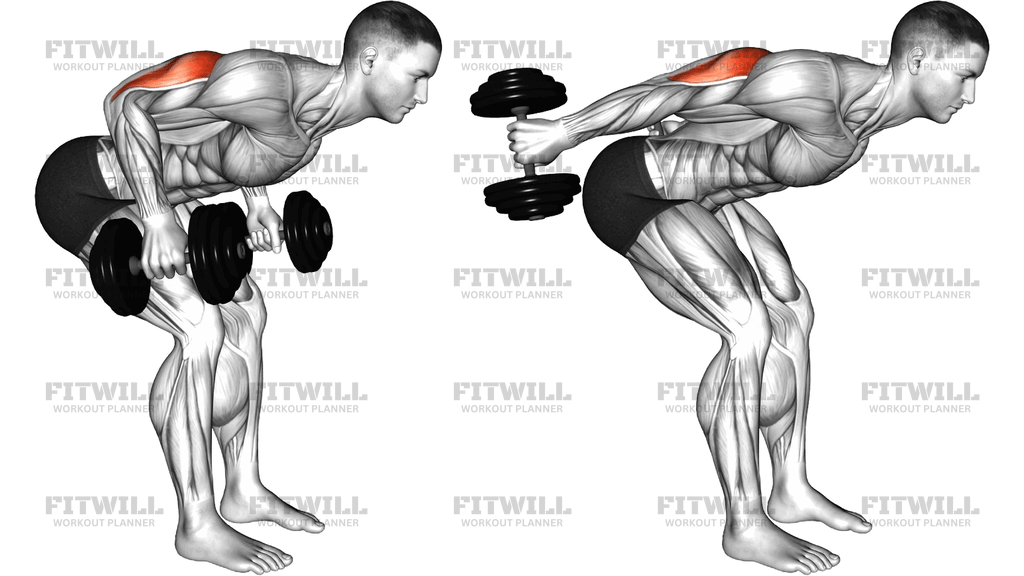
Dumbbell Standing Bent-Over Two Arm Triceps Extension is a bent-over isolation exercise that places most of the work on the back of the upper arms while the torso stays fixed in a hip hinge. With both dumbbells moving together, the exercise is useful for building triceps strength, adding arm volume, and teaching you to keep the shoulders and torso quiet while the elbows do the work.
The setup matters because the hinge turns this into a strict upper-arm movement instead of a body-swinging lift. When your torso is close to parallel to the floor, your upper arms can stay level with your body and the dumbbells can travel through a short, controlled arc that keeps tension on the triceps. The forearms, rear shoulders, upper back, and core still help stabilize the position, but they should not take over the rep.
This exercise works best when the elbows stay pinned in place and only the forearms move. From the bent-over start, the dumbbells should begin with the elbows flexed and the hands hanging under the shoulders, then press back until the elbows straighten and the triceps finish the rep. A smooth return is just as important as the press back, because lowering too fast shifts the load away from the triceps and usually turns the set into a swing.
Dumbbell Standing Bent-Over Two Arm Triceps Extension is a practical accessory movement on arm days, push days, or any program that needs direct triceps work without a bench or cable station. It also exposes weak positions quickly, so lighter weights often produce better results than forcing heavy dumbbells through a sloppy hinge. If the lower back starts to fatigue before the triceps do, the hinge is probably too deep, the load is too heavy, or the set is lasting too long.
Keep the neck long, the spine neutral, and the wrists stacked so the dumbbells stay under control throughout the set. The goal is a crisp elbow extension with a steady torso, not a bigger swing or a higher rep count at any cost. Done well, this variation gives you a very direct triceps challenge while reinforcing clean bent-over positioning.
[ Workout Log & Planner ]
Put your next workout in Fitwill
Keep your plan and training log ready when you are.


Instructions
- Stand with your feet about hip-width apart and hinge at the hips until your torso is nearly parallel to the floor, keeping a slight bend in your knees and a neutral spine.
- Hold a dumbbell in each hand with a neutral grip, palms facing each other, and let your arms hang under your shoulders.
- Pull your upper arms slightly behind your torso so your elbows are bent and fixed in place at about a right angle.
- Brace your midsection, keep your neck long, and look down at the floor a few feet ahead of you.
- Extend both elbows at the same time until your arms are straight behind you and the dumbbells line up with your hips.
- Squeeze your triceps at the top without shrugging your shoulders or swinging your torso.
- Lower the dumbbells slowly until your forearms return to the bent starting position while keeping your upper arms still.
- Breathe out as you extend and inhale as you return, then stand up carefully and set the dumbbells down when the set is finished.
Tips & Tricks
- Choose a lighter pair of dumbbells than you would for a curl; strict elbow extension breaks down quickly when the load is too heavy.
- Keep the upper arms quiet behind your torso so the movement comes from the elbow joint, not from swinging the shoulders backward.
- If your lower back starts to work harder than your triceps, raise your chest slightly and shorten the hinge instead of forcing the same position.
- Keep the wrists stacked over the forearms so the dumbbells stay stable instead of rolling toward the thumbs.
- A small pause at full extension makes the triceps do the work instead of letting momentum bounce the dumbbells back down.
- Do not let the elbows drift wide; the rep should look like two small, parallel forearm extensions behind the body.
- Slow the lowering phase to keep constant tension through the bent-elbow position, where many people lose control.
- Stop the set when your torso starts bobbing up and down, because that usually means the hinge has turned into a swing.
Frequently Asked Questions
What muscles does Dumbbell Standing Bent-Over Two Arm Triceps Extension work most?
The triceps brachii do most of the work, with the rear shoulders, upper back, forearms, and core helping you hold the bent-over position.
Is Dumbbell Standing Bent-Over Two Arm Triceps Extension the same as a kickback?
It is very similar to a dumbbell kickback, but this version usually uses a stricter bent-over hinge and both arms together.
How far should I hinge over for Dumbbell Standing Bent-Over Two Arm Triceps Extension?
Get close to parallel with the floor while keeping your spine neutral and your knees softly bent. If your lower back rounds, stand a little taller.
Why do my shoulders feel it more than my triceps?
Usually the dumbbells are too heavy or the elbows are drifting. Keep the upper arms fixed behind your torso and let only the forearms move.
Can beginners do Dumbbell Standing Bent-Over Two Arm Triceps Extension?
Yes, but start light. The bent-over position is easier to control when you can hold a stable hinge without using momentum.
Should my elbows move during the rep?
Only slightly at the bottom and top. They should stay lifted and mostly fixed so the triceps, not the torso, drive the movement.
Where should I feel this exercise?
You should feel a strong contraction along the back of the upper arms, with the core and upper back working mostly to keep your torso steady.
What can I do if my lower back gets tired first?
Use lighter dumbbells, shorten the hinge a little, or support one hand on a bench and do the movement one side at a time.