Roman Chair Sit-Up
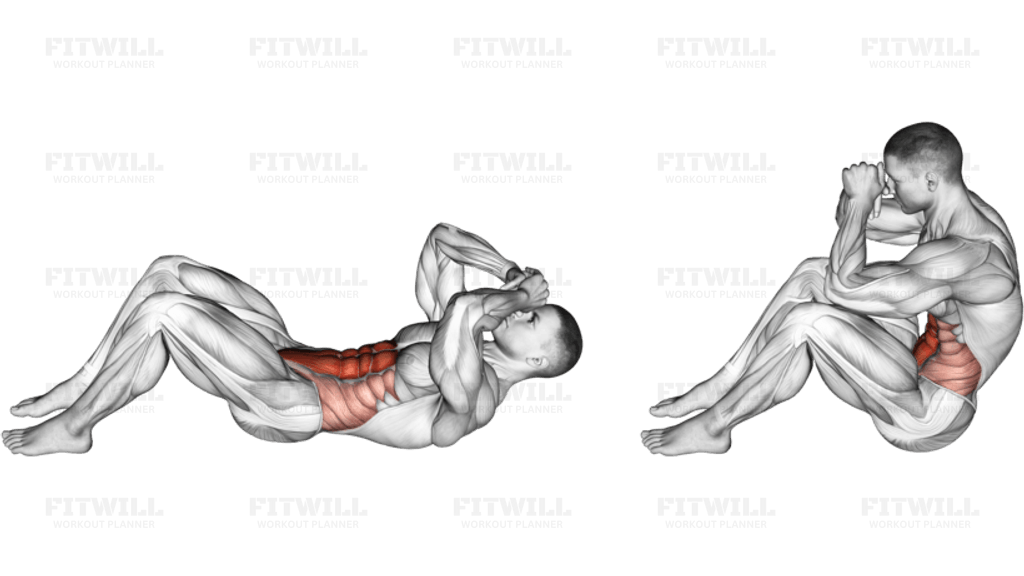
Roman Chair Sit-Up is a body-weight core exercise performed on a roman chair or hyperextension bench with the lower legs anchored under the rollers and the hips supported on the pad. The movement asks the trunk to fold from a reclined position into a strong sit-up without letting the legs, neck, or lower back take over. That setup makes it useful for building real abdominal strength while also teaching you how to control your torso against gravity.
The main emphasis is on the abs, especially the rectus abdominis, with the obliques and deep core muscles helping you stay organized as you curl up and lower back down. The hip flexors contribute too, particularly as you move through the top half of the rep, which is why the exercise can feel demanding even without added load. A clean Roman Chair Sit-Up should feel like controlled trunk flexion, not a jerky pull from the hips or a yank from the neck.
The setup matters more than most people expect. Anchor your ankles firmly under the pads, place the hips securely on the support, and start with the torso reclined enough that you can still brace without losing contact with the bench. If your feet slide, your hips drift, or the pad sits too high or too low, the rep usually turns into a hip hinge or a partial crunch instead of a true sit-up. A stable position gives the abs a consistent line of force and lets you use a repeatable range from rep to rep.
At the top, sit tall with the ribs stacked over the pelvis instead of collapsing backward or flaring the chest. Lower yourself under control until your torso is back to the starting angle, keeping tension through the midsection instead of dropping into the bench. Breathing should stay rhythmic: brace before the ascent, exhale through the crunch, then inhale as you return to the reclined position. If your lower back feels pinched, shorten the range and slow the tempo before adding any load.
Roman Chair Sit-Up works well as accessory core work, as a warm-up drill for trunk control, or as a higher-rep abdominal movement when you want less spinal loading than a weighted sit-up variation. It is also useful for athletes who need strong trunk flexion without changing the exercise into a hip-dominant movement. Use strict reps, stop before momentum takes over, and keep the chin relaxed so the abs do the work instead of the head and shoulders.
[ Workout Log & Planner ]
Put your next workout in Fitwill
Keep your plan and training log ready when you are.


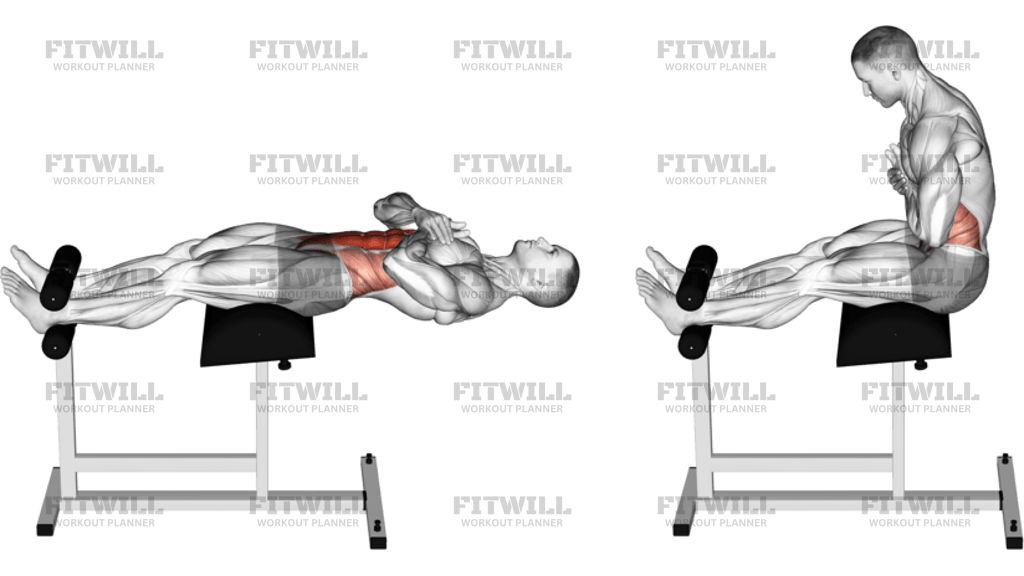
Instructions
- Sit on the Roman Chair with your hips supported on the pad and your ankles locked under the rollers.
- Place your feet flat against the footplate or ankle support and let your torso recline until your upper back can move freely.
- Cross your arms over your chest or hold your hands lightly at your shoulders without pulling on your neck.
- Brace your abs and keep your chin slightly tucked before you start the rep.
- Curl your ribs toward your pelvis and sit up by rounding through the trunk, not by swinging the hips.
- Finish the rep with your torso upright and your abs fully shortened, then pause briefly without leaning back.
- Lower yourself under control until your torso returns to the starting angle and keep the rollers and hip pad stable.
- Inhale on the way down, exhale as you sit up, and reset your brace before the next repetition.
Tips & Tricks
- If your feet lift or slide under the rollers, reset the bench position before adding reps.
- Keep the movement in your trunk; if your hips are snapping open, you are turning it into a hip-dominant raise.
- A slower descent usually makes Roman Chair Sit-Up harder and more effective than adding more speed at the top.
- Let the chin stay relaxed so you do not turn each rep into a neck-driven crunch.
- Do not arch back over the pad at the bottom; stay long enough to keep tension, but not so far that your lower back takes over.
- Crossed arms make the exercise stricter than reaching for the shins, which often shortens the load on the abs.
- If the top position feels easy, pause for a second with your ribs down before lowering again instead of using momentum.
- Stop the set when your torso starts bouncing off the bench or you can no longer control the return.
Frequently Asked Questions
What muscle does Roman Chair Sit-Up target most?
Roman Chair Sit-Up mainly targets the abs, especially the rectus abdominis, with the obliques helping stabilize the trunk.
How should I set up on the Roman Chair before the first rep?
Anchor your ankles under the rollers, place your hips on the pad, and recline just far enough that you can still brace without losing contact with the bench.
Should I cross my arms or hold my head during Roman Chair Sit-Up?
Crossing your arms over your chest is usually the cleanest option. Holding the head or pulling on the neck often turns the rep into a neck-led curl.
Is Roman Chair Sit-Up the same as a hip extension on the same bench?
No. Roman Chair Sit-Up is a trunk-flexion movement, so the torso curls up and down while the hips stay anchored on the pad.
Can I add weight to Roman Chair Sit-Up?
Yes, but only after you can control the full body-weight version. A plate or medicine ball should not change the shape of the rep or make you swing.
Why do I feel Roman Chair Sit-Up in my hip flexors too?
That is common, especially near the top of the rep. The abs should still be driving the curl, but the hip flexors assist as the torso gets closer to upright.
How low should I go on the Roman Chair before sitting up?
Lower only until you can still keep tension through your midsection. If the bottom position makes your lower back pinch or your hips shift, shorten the range.
What is the most common mistake in Roman Chair Sit-Up?
Rushing the descent and using momentum to rebound out of the bottom. The rep should stay smooth all the way down and all the way back up.