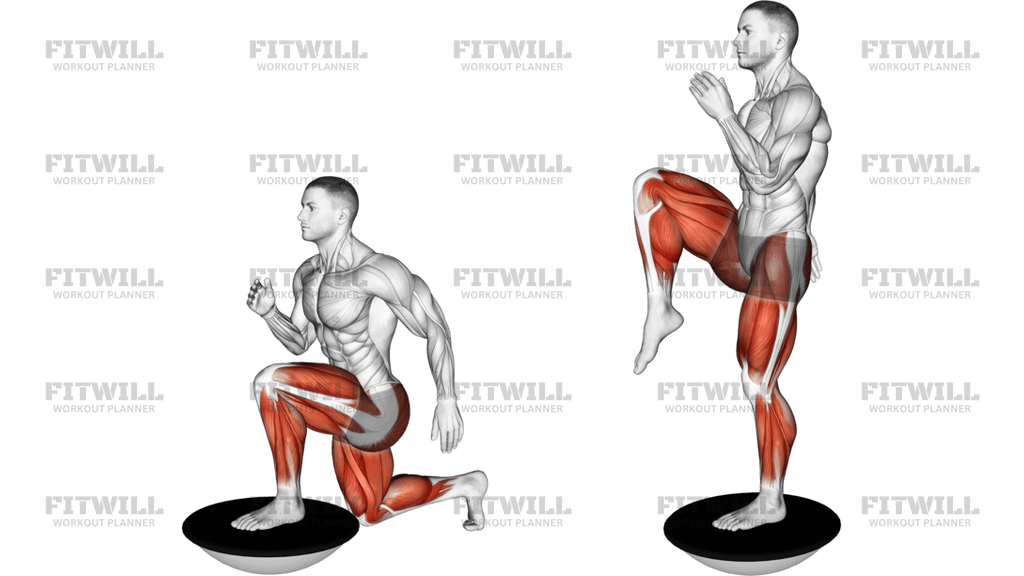
Single Leg Stand On Bosu Ball
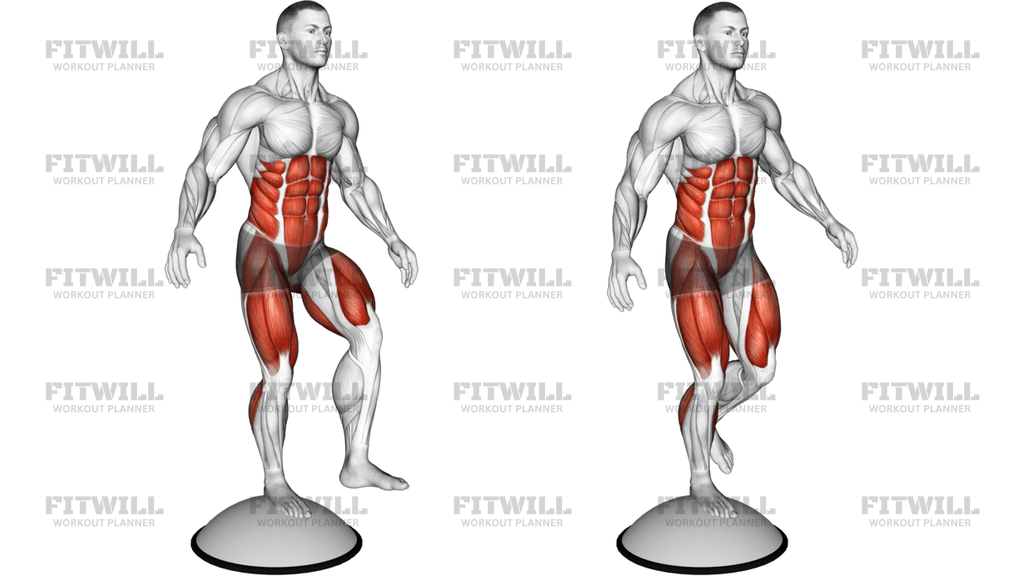
Single Leg Stand On Bosu Ball is a bodyweight balance drill performed while standing on the dome side of a BOSU ball. The exercise asks one leg to support your full body weight on an unstable surface while the free leg stays lifted, so the ankle, foot, calf, hip, and trunk all have to make small corrections to keep you steady.
Although the movement looks simple, the training effect comes from control rather than effort. The BOSU ball changes the way force travels through the foot, ankle, and knee, which makes it useful for balance training, lower-leg coordination, and preparing the body for more demanding single-leg work. It is especially helpful when you want better posture under instability without adding external load.
Setup matters because a poor first position makes the drill much harder than it needs to be. Place the working foot near the center of the dome, keep the heel and tripod of the foot active, and bring the other knee or foot off the floor without letting the pelvis tip. A slight bend in the standing knee usually gives better control than locking the leg straight.
Each repetition or hold should feel like a series of small corrections, not a fight to stay upright. Keep the ribcage stacked over the pelvis, look forward instead of down at your feet, and use the hips to stay level as you balance. If the ball starts to wobble, reduce the range of motion or shorten the hold before the knee caves in or the torso leans.
This exercise is commonly used in warm-ups, rehab-style progressions, and accessory blocks for athletes who need better single-leg stability. It is not meant to be rushed or loaded heavily. The goal is clean posture, quiet feet, and controlled breathing while the standing leg learns to stabilize the entire body on an unstable base.
[ Workout Log & Planner ]
Put your next workout in Fitwill
Keep your plan and training log ready when you are.


Instructions
- Place the BOSU ball dome-side up on a flat, non-slip floor and stand beside it with enough space to step on safely.
- Step one foot onto the center of the dome and keep the whole foot active, with pressure through the heel, big toe, and little toe.
- Lift the other foot off the floor and bring the knee slightly in front of you or beside the standing leg without leaning your torso.
- Soften the standing knee and stack your ribs over your pelvis so you are upright, not arched backward.
- Fix your gaze on a point in front of you to help steady the balance challenge.
- Hold the position and make small ankle and hip adjustments instead of letting the body sway from side to side.
- Keep breathing quietly and evenly while you maintain the single-leg stance.
- Step down with control, reset your footing, and repeat on the other side for the planned hold time or repetitions.
Tips & Tricks
- Keep the standing foot centered on the dome so the ball does not roll out from under you.
- If the ankle wobbles hard, shorten the hold before trying to make the balance more difficult.
- Do not lock the standing knee straight; a soft bend usually gives better ankle and hip control.
- Keep the pelvis level and avoid letting the hip on the free-leg side drop.
- Press evenly through the foot instead of gripping the BOSU with your toes.
- Look at one fixed point in front of you rather than staring at the floor.
- Use a nearby rack, wall, or post for light fingertip support if you need to scale the drill.
- Stop the set when the foot collapses inward or the torso starts to drift to one side.
Frequently Asked Questions
What does Single Leg Stand On Bosu Ball train?
It mainly trains balance, ankle stability, hip control, and trunk stiffness on an unstable surface.
Do I stand on the BOSU dome or the flat side?
This version uses the dome side up, which creates the unstable surface the exercise is built around.
How should my free leg be positioned?
Keep the free leg lifted without swinging it around; a small knee lift or a relaxed hover beside the body both work if your torso stays tall.
What is the most common mistake on this drill?
Most people either lock the standing knee or let the hip drift and the foot collapse inward instead of making small balance corrections.
Can beginners use a BOSU ball for this exercise?
Yes, but beginners should start with short holds and a nearby support point so they can learn the stance before removing the assist.
What muscles help keep me balanced here?
The calf, foot, glute medius, deep hip stabilizers, and core all help keep the standing leg aligned.
How long should I hold each side?
Use a hold long enough to challenge balance without shaking so much that your posture breaks down, often just a few controlled seconds at a time.
What can I do to make it harder?
You can reduce hand support, lengthen the hold, close your eyes briefly if appropriate, or move the free knee slightly without losing alignment.