Plank Push-Up Row
Plank Push Up Row is a compound floor exercise that blends a push-up with a one-arm dumbbell row from a rigid high-plank position. It challenges the chest, triceps, shoulders, lats, and deep core at the same time, so the goal is not just to move the weights but to keep the trunk and hips from twisting as each arm works.
The dumbbells matter because they lift the hands off the floor and give the row hand something to travel through. That setup creates a bigger stability demand than a standard push-up, especially when one arm leaves the base of support to row the weight toward the ribs. A wider foot stance usually helps, but the torso still needs to stay square to the floor.
The movement works best when the plank is built first. Set the dumbbells under the shoulders, stack the wrists over the handles, and lock in a straight line from head to heels before the first rep. From there, lower under control, press back up, then row one dumbbell without letting the opposite hip sag or rotate open. The rep should feel smooth and deliberate rather than rushed.
Because this exercise combines two demanding patterns, load choice matters more than ego. A pair of lighter hex dumbbells is often enough to make the movement challenging once the row starts pulling the body off center. It is especially useful for upper-body conditioning, trunk stability work, and sports training blocks where you want pressing strength and anti-rotation control in the same drill.
The safest version keeps the neck long, the ribs from flaring, and the feet planted so the body can resist the side-to-side pull. If the push-up shortens dramatically or the row turns into a shrug and twist, the set is too heavy or the stance is too narrow. Clean reps should look almost identical from side to side, with the dumbbell traveling close to the body and the plank staying firm throughout.
[ Workout Log & Planner ]
Put your next workout in Fitwill
Keep your plan and training log ready when you are.


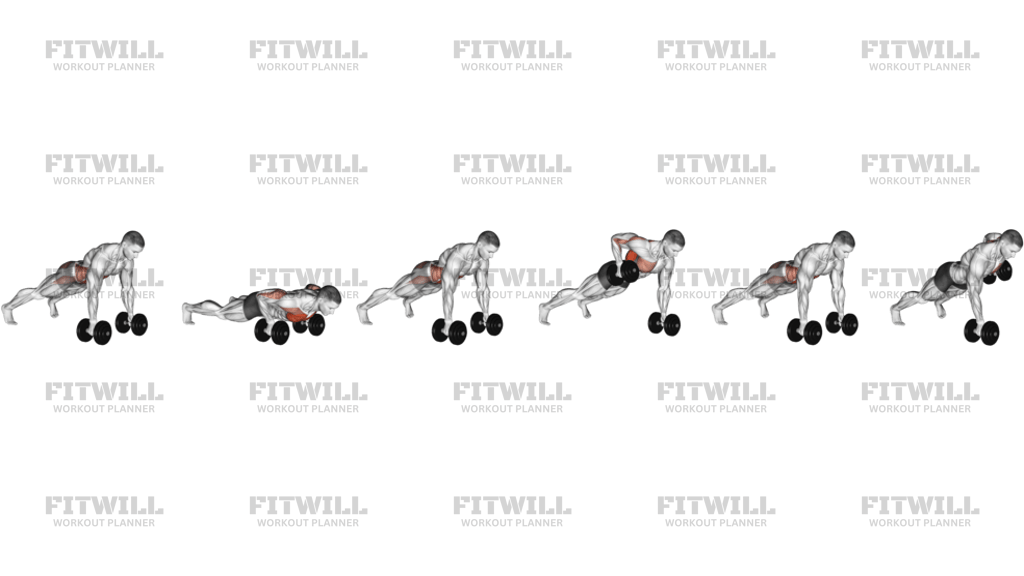
Instructions
- Place two dumbbells on the floor under your shoulders and grip the handles with your hands stacked directly above them.
- Step both feet back into a high plank so your body forms a straight line from head to heels, then spread your feet slightly for balance.
- Tighten your glutes and brace your midsection before the first rep so your hips do not sag or twist.
- Lower into a push-up by bending your elbows and bringing your chest between the dumbbells.
- Press back up until your arms are straight and your shoulders are still square to the floor.
- Shift your weight into one hand and row the opposite dumbbell toward the lower ribs without rotating your torso.
- Lower that dumbbell back to the floor with control, then repeat the push-up and row on the other side.
- Keep alternating sides for the planned reps, breathing out on the push-up and row effort.
- Reset by lowering both knees to the floor before letting go of the dumbbells if you need to stop safely.
Tips & Tricks
- Use hex dumbbells that will not roll when you load one side of the plank.
- Keep your feet wider than a normal push-up stance so the row does not spin your hips open.
- Think about pulling the row elbow toward your back pocket, not straight out to the side.
- Keep the dumbbell close to your ribs on the row so the shoulder does not shrug forward.
- If the push-up collapses after the row, shorten the range and use a lighter pair of dumbbells.
- A brief pause on top of the row makes the anti-rotation demand obvious and prevents yanking.
- Do not let your lower back arch when the weight leaves the floor; keep the ribs stacked over the pelvis.
- Keep the rep smooth instead of rushing from push-up to row, because the transition is where form usually breaks.
- If wrist comfort is an issue, turn the dumbbells slightly and keep the knuckles stacked vertically over the handles.
Frequently Asked Questions
What muscles does Plank Push-Up Row work?
It hits the chest, triceps, front delts, lats, and a lot of core and glute stabilization. The row also adds a strong anti-rotation demand through the obliques.
Do I row after every push-up in Plank Push-Up Row?
Yes, the usual rhythm is push-up first, then row one side, then repeat on the other side. The exact cadence can vary, but the image shows the row happening from a locked-in plank rather than as a separate exercise.
What kind of dumbbells work best for this exercise?
Hex dumbbells are the safest choice because they stay put when one hand is off the floor. Round dumbbells can roll and make the setup unstable.
Can beginners do Plank Push-Up Row?
Yes, but it is easier to start with a wide foot stance and lighter dumbbells. If the hips twist every time you row, reduce the load or elevate the hands on a bench.
How do I keep my hips from twisting on the row?
Widen your feet, squeeze your glutes, and row the dumbbell close to your ribs instead of pulling it out wide. A slower row also makes it easier to keep the torso square.
Should the push-up be full depth?
Only go as low as you can while keeping the plank tight and the dumbbells steady. A partial push-up with clean body position is better than a deep rep that turns into a twist.
Why are my shoulders tired before my core?
The combination of push-up plus row keeps the shoulder girdle under constant load, so that is normal. If the shoulders burn too early, use lighter dumbbells and slow the lowering phase.
Is this more of a strength or conditioning exercise?
It can be used for both, but it usually shines as a strength-endurance and core-stability drill. Heavier loads with fewer reps make it more strength focused, while lighter loads and longer sets turn it into conditioning.
What is the safest way to stop a set mid-rep?
Lower both knees to the floor first, then set the dumbbells down one at a time. That keeps you from dumping your weight forward or twisting under fatigue.