Assault Run
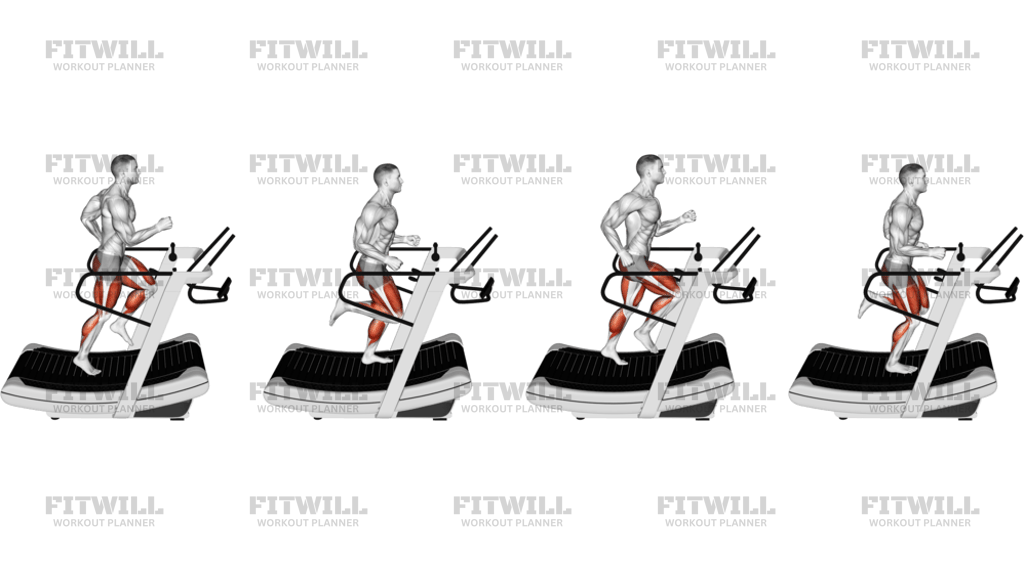
Assault Run is a sprint-style cardio exercise performed on a self-powered curved treadmill. The runner in the image is not being pulled by a motor or lifted by a weight stack; instead, each step drives the belt forward and the pace changes immediately with your own stride length, foot strike, and arm rhythm. That makes the exercise useful for building conditioning, leg drive, and repeatable running mechanics in a short, high-effort format.
The main emphasis is on the thighs, especially the quads, with the glutes, calves, hamstrings, and core helping you stay stable and keep the stride smooth. Because the machine responds to your body rather than a preset speed, setup matters a lot. A tall torso, slight forward lean from the ankles, and light hand contact on the rails or handles help you start cleanly without bouncing or overstriding.
Each repetition should feel like a controlled run, not a chaotic sprint. Begin from the side rails, step onto the moving surface with quick, short strides, and keep your feet landing under your body. Drive the knees forward, swing the arms naturally, and let the machine speed match the effort you are putting in. If the stride gets too long or the torso collapses forward, the machine starts to punish sloppy mechanics immediately.
Assault Run is often used for intervals, conditioning blocks, and athletic warmups because it lets you ramp effort up and down quickly. It is demanding, so the quality target is smooth acceleration, upright posture, and a controlled slowdown at the end of each bout. Beginners can use it, but they should start with short efforts, conservative pace, and enough recovery to keep the running pattern tidy instead of forcing a full sprint too early.
[ Workout Log & Planner ]
Put your next workout in Fitwill
Keep your plan and training log ready when you are.


Instructions
- Stand on the side rails of the curved treadmill and place one hand lightly on the handles for balance.
- Set your feet hip-width apart, lift your chest, and keep a slight forward lean from the ankles, not the waist.
- Tighten your midsection and look straight ahead before you start the belt moving.
- Step one foot onto the running surface and use that first drive to bring the belt forward.
- Begin with short, quick steps so the machine responds smoothly instead of surging.
- Keep your feet landing under your hips and drive your knees forward in a natural running pattern.
- Swing your arms in rhythm with your stride and avoid pulling hard on the handles.
- Maintain the same tall posture as you accelerate, then keep the cadence steady for the planned interval.
- Slow the pace gradually, step back onto the side rails, and stop before dismounting.
Tips & Tricks
- Shorter strides usually feel better on a curved runner; reaching too far ahead turns the drill into a brake.
- Keep your weight over the midfoot so the belt keeps moving from a quick push instead of a hard heel strike.
- A light forward lean is enough; folding at the hips makes it harder to breathe and usually shortens the stride.
- Use the handles for balance at the start, but avoid hanging on them once the belt is moving.
- If your shoulders rise toward your ears, you are sprinting too hard for the current interval.
- Breathe in a steady rhythm that matches your pace, especially during longer conditioning bouts.
- Increase effort by running faster, not by throwing your torso forward or bouncing vertically.
- Stop the interval when your steps become noisy, choppy, or uneven, because that usually means the mechanics are breaking down.
Frequently Asked Questions
What muscle does Assault Run target most?
The quads are the main driver, but the glutes, calves, hamstrings, and core all work hard to keep the stride stable.
Can beginners perform this exercise?
Yes, but beginners should start with short intervals, light effort, and a controlled step pattern before trying true sprint pacing.
How do I start the curved treadmill safely?
Stand on the side rails, lightly hold the handles, lean forward a little, and step onto the belt with quick, short strides rather than jumping on.
Should I hold the handles the whole time?
Use the handles only for balance and setup. Once the belt is moving, keep the arms free so your run stays natural and your torso does not collapse forward.
What is the biggest form mistake on Assault Run?
Overstriding is the main mistake. Landing too far in front of the body makes the belt feel harder to move and usually leads to a choppy, braking stride.
How is this different from a regular treadmill sprint?
A curved runner is self-powered, so your stride determines the speed immediately. That makes acceleration, deceleration, and running mechanics more noticeable than on a motorized treadmill.
What kind of workout uses this best?
It fits interval conditioning, athletic warmups, and short power-endurance blocks where you want fast changes in effort and a strong leg drive.
How should I progress it over time?
Progress by running a little faster, lengthening the work interval, or shortening the rest, while keeping posture and stride quality consistent.