Standing Hip Frontal Rotation Alternate Raise
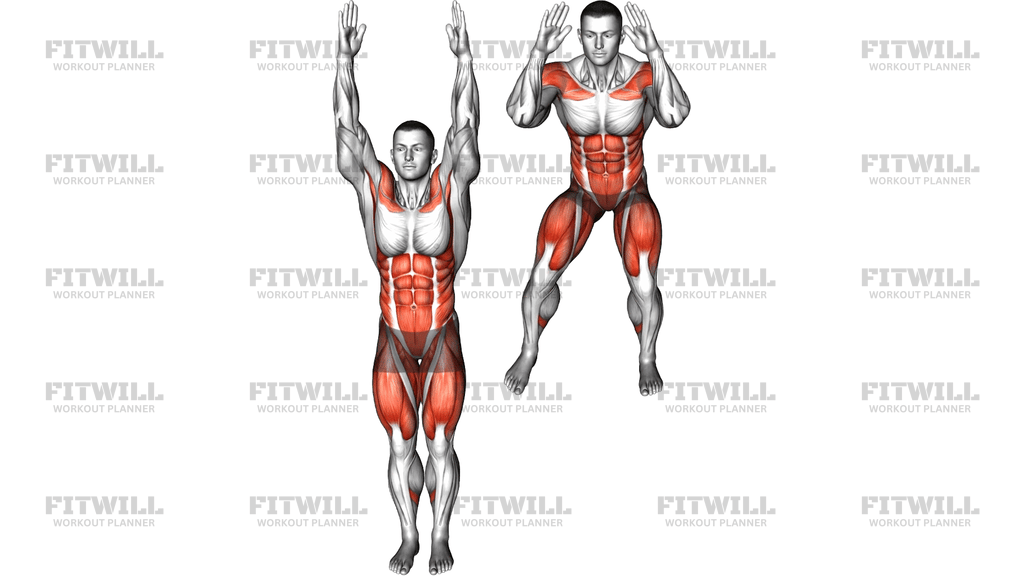
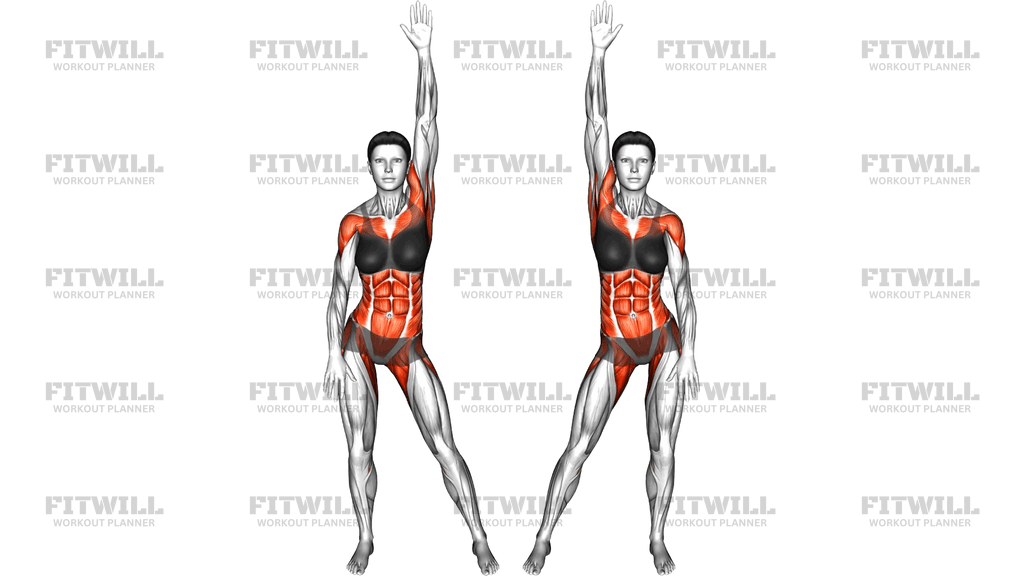
Standing Hip Frontal Rotation Alternate Raise is a bodyweight standing movement that combines a lateral hip shift in the frontal plane with an alternating overhead arm reach. From a wide stance, you drive your hips out to one side while the opposite arm sweeps straight up toward the ceiling, then switch sides in a smooth, continuous rhythm. The name breaks down exactly the way the movement works: the hips rotate through the frontal plane (side to side rather than front to back), and the arm raise alternates from one side to the other.
This exercise targets the obliques and deep core musculature that control side-to-side trunk motion, along with the gluteus medius and outer hip muscles that manage the lateral weight shift. The reaching arm adds shoulder involvement and lengthens the entire working chain from hip to hand, which is why the highlighted areas in this movement span the waist, the hip region, and the shoulder of the lifting arm. Because everything happens standing on both feet, the ankles, knees, and trunk stabilizers are all quietly working to keep you balanced as your center of gravity moves.
It is a useful drill for anyone who spends long hours sitting and has lost comfort with lateral hip motion, for warm-ups before lateral-agility or racquet sports, and for general core training that goes beyond crunches and planks. The alternating pattern also trains coordination between the lower and upper body, since the hip shift and the arm reach need to stay synchronized rather than happening as two separate, awkward motions.
Setup matters more than it looks. A stance noticeably wider than your shoulders gives the hips room to travel sideways, soft knees absorb the shift, and an upright torso keeps the work in the hips and waist instead of dumping it into the lower back. If your stance is too narrow, the knees collapse inward to fake the hip motion; if your feet are too wide, the shift becomes shallow and the range shrinks.
To execute it well, think of pushing your hips out to one side like a pendulum while the opposite arm grows long toward the ceiling, then transfer smoothly to the other side without letting your torso lean or your chest drop. Keep the movement deliberate rather than bouncy, exhale as you reach, and let the foot of the lengthening leg roll slightly toward its inner edge so the ankle is not strained. Common use cases include dynamic warm-ups, active recovery days, and low-impact core circuits at home where no equipment is available.
[ Workout Log & Planner ]
Put your next workout in Fitwill
Keep your plan and training log ready when you are.


Instructions
- Stand with your feet roughly one and a half shoulder-widths apart, toes pointing forward or turned out just slightly, and let your arms hang relaxed at your sides.
- Soften your knees a few degrees and brace your abdominals so your trunk feels supported before you start moving.
- Shift your hips out to the right side, letting your right knee bend a little more while your left leg lengthens and your left heel turns gently toward its inner edge.
- As the hips move right, sweep your left arm up in a smooth arc until it is fully extended overhead, palm facing inward, reaching long through the fingertips.
- Pause briefly at the end of the reach with your torso tall — avoid bending sideways through the spine; the arc should come from the hips and shoulder, not a waist collapse.
- Transfer back through the center and repeat on the other side, pushing your hips left while your right arm rises overhead.
- Keep the two sides connected: as one arm lowers back to your side, the other begins its ascent, creating one continuous alternating rhythm.
- Exhale as you shift and reach, inhale as you return through the center to reset.
- Keep your head neutral and eyes forward; let the raised arm pass close to your ear rather than drifting in front of your face.
- Complete your target repetitions on each side, finishing the set by returning both feet to a neutral, shoulder-width stance.
Tips & Tricks
- The most common mistake is bending sideways at the waist instead of shifting at the hips. If your ribcage is collapsing toward the bent knee, imagine your shoulders staying level and stacked over your pelvis while only the hips travel.
- If your knees cave inward during the shift, your stance is probably too narrow. Widen your feet until the hip can move sideways without the knees dumping in.
- Avoid letting the raised arm swing forward. Keep it travelling in a vertical plane close to the side of your head so the shoulder, not momentum, controls the reach.
- Do not rush the transfer through the middle. A brief, controlled pass through center is what keeps the obliques and outer hips working instead of letting momentum do the job.
- If your ankles feel pinched when the long leg's heel lifts, reduce the depth of the hip shift. The roll toward the inner edge of the foot should be small, not a full collapse.
- Keep your neck relaxed on the reaching side. If you find yourself craning upward to watch your hand, fix your gaze straight ahead at eye level instead.
- Start with a smaller range for the first few repetitions and build up once the hip and arm pattern feels synchronized on both sides.
- If one side feels noticeably stiffer or weaker, perform an extra couple of controlled repetitions on that side before finishing the set evenly.
Frequently Asked Questions
What muscles does the Standing Hip Frontal Rotation Alternate Raise work?
The primary work comes from the obliques and deep core muscles that control side-to-side trunk motion, supported by the gluteus medius and outer hip muscles during the lateral shift. The raised arm also engages the shoulder, particularly the deltoid, through the overhead reach.
Why is it called a frontal rotation?
The frontal plane is the side-to-side plane of motion, so the exercise rotates the hips laterally rather than forward and backward. The alternating arm raise happens in that same plane, which is what separates it from hip hinge or rotational twist exercises.
Is the Standing Hip Frontal Rotation Alternate Raise suitable for beginners?
Yes, it is low-impact and requires no equipment. Beginners should start with a narrower stance and a smaller hip shift, focusing on keeping the torso upright before trying to increase range or speed.
Should my torso bend sideways when I reach overhead?
A small amount of natural side bending is fine, but the main motion should come from the hips pushing out to one side. If you see your torso folding sharply toward the bent knee, reduce the reach and re-establish the hip shift as the driver.
How wide should my stance be for this exercise?
Roughly one and a half shoulder-widths works for most people. The test is whether your hips can shift sideways while your knees stay stacked over your feet; if the knees collapse inward, widen your stance.
Can I use the Standing Hip Frontal Rotation Alternate Raise as a warm-up?
It works well as a dynamic warm-up before activities involving lateral movement, such as tennis, basketball, or side lunges. Perform slower, moderate-range repetitions for about 30 to 60 seconds before training.
What can I substitute if standing balance is difficult for me?
You can perform the same hip shift and arm reach pattern with one hand lightly resting on a wall, chair back, or countertop for support. Reduce the width of the stance until you feel stable, then progress to hands-free repetitions.
How many repetitions should I do per side?
For warm-up or mobility purposes, 10 to 15 controlled repetitions per side is typical. For core conditioning, slow the tempo down and work in the same rep range, prioritizing control over speed.
Is it safe for my knees if the leg straightens during the shift?
The lengthening leg should straighten without locking, and its heel may roll slightly toward the inner edge. If you feel pinching in the knee or ankle, reduce the depth of the shift so the joint stays comfortable throughout the arc.