Resistance Band Horizontal Pallof Press
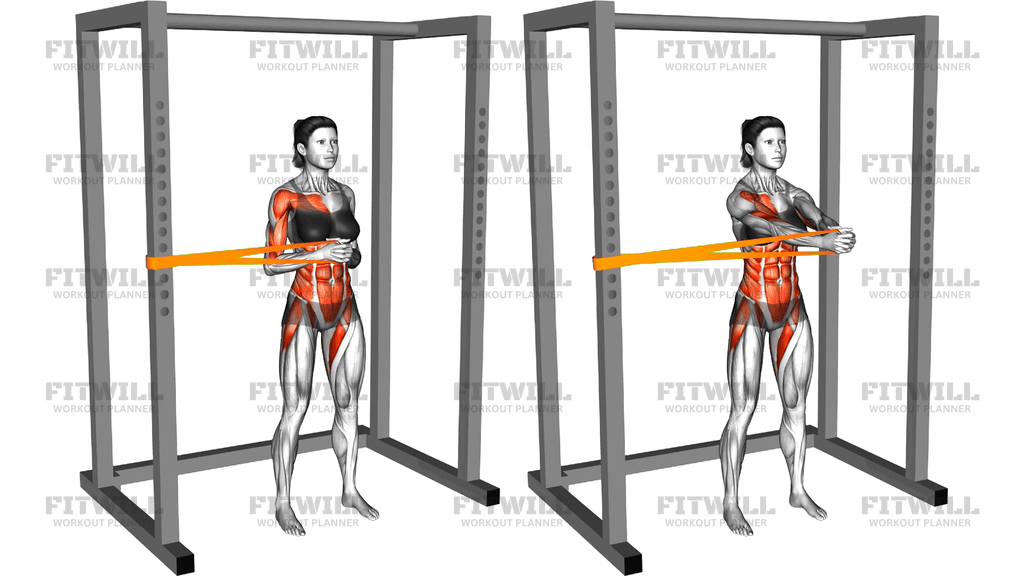
The Resistance Band Horizontal Pallof Press is an anti-rotation core exercise that trains your trunk to resist twisting rather than to create it. A band is anchored at roughly chest height to a rack or sturdy attachment point on one side of your body. You stand sideways to the anchor, hold the band with both hands at your sternum, and press your arms straight out in front of you. As the band stretches, it tries to rotate your torso back toward the anchor, and your job is to stay square and unmoved.
This exercise is useful for almost anyone. It builds the kind of midline stability that carries over to squatting, deadlifting, running, throwing, and simply standing upright without your lower back doing work it should not be doing. Because the load is horizontal and the resistance increases as you extend your arms, it challenges the deep trunk muscles, especially the obliques and transverse abdominis, in a way that crunches and sit-ups do not. It is also gentle on the spine, which makes it a good choice for people who find loaded twisting movements uncomfortable.
Setup matters more here than in most core exercises. Your distance from the anchor determines how much tension you start with, and your stance determines how honest the rep will be. A narrow stance gives you less base to hide behind, while a wider stance offers more stability for beginners. Keep the band at chest height so the pull comes straight from your side rather than angling up or down, which changes which muscles compensate.
To execute the press well, brace your trunk first, then extend both arms forward until your elbows are locked out and the band is pulling directly away from your midline. Pause for a beat at full extension, feeling the band try to turn you, and refuse to let it. Your hips and shoulders should stay facing the same direction they started. Then bring your hands back to your chest under control rather than letting the band snap them back.
You will see this movement used in warm-ups before heavy lower body days, as standalone core work in strength programs, and in rehabilitation or postpartum return-to-training settings where controlled anti-rotation strength is a priority. Common coaching points include keeping the ribs stacked over the pelvis, avoiding a side lean as you press, and breathing steadily through the hold instead of holding your breath for every rep.
For safety, check the band for tears before each session and make sure the anchor point is secure. If the band slips off the attachment mid-press, it can snap back toward your face, so stay positioned so the band path is away from your head and eyes. Start with a light band and master the pause at full extension before adding tension or longer holds.
[ Workout Log & Planner ]
Put your next workout in Fitwill
Keep your plan and training log ready when you are.


Instructions
- Anchor a resistance band at chest height to a power rack upright or another secure attachment point, and stand sideways to the anchor with the band on your left or right side.
- Grip the free end of the band with both hands, fingers interlaced or one hand over the other, and bring it to the center of your chest at sternum level.
- Step away from the anchor until you feel moderate tension with your hands at your chest, and set your feet about hip-width apart with a soft bend in the knees.
- Stack your ribs over your pelvis, squeeze your glutes lightly, and brace your trunk as if bracing for a light push to the stomach.
- Press both hands straight out in front of your chest until your arms are fully extended, keeping the band path horizontal and your shoulders level.
- Hold the extended position for two to three seconds while resisting the band's pull toward the anchor; your chest and hips should not rotate at all.
- Slowly draw your hands back to your sternum over two to three seconds, controlling the band instead of letting it pull you back.
- Exhale as you press out, keep breathing steadily during the hold, and inhale as you return to your chest.
- Complete all reps on one side, then turn around so the anchor is on the opposite side and repeat for the same number of reps.
- Reset your stance and brace before every rep, and step toward the anchor to release tension before letting go of the band.
Tips & Tricks
- If you feel the exercise in your lower back instead of your trunk, you are likely letting your ribs flare; drop the band tension slightly and tuck your ribs back over your hips before pressing.
- A common giveaway of rotation is one shoulder drifting toward the anchor at full extension. Watch yourself in a mirror from the front to check that both shoulders stay level and square.
- Do not let your wrists bend backward under the band's pull. Keep your knuckles facing forward and your wrists neutral, or your forearms will do the stabilizing instead of your trunk.
- Narrow your stance before you add a heavier band. A wide stance can mask rotation, so progress by standing narrower rather than only by increasing resistance.
- If your arms shake or your shoulders rise toward your ears at lockout, the band is too strong. The Pallof Press works best when the challenge is anti-rotation, not maximal arm effort.
- Press along a straight line from your sternum, not slightly toward the anchor side. Angling the press toward the band reduces the anti-rotation demand and shortchanges the obliques.
- Keep your knees soft rather than locked. Locked knees combined with a horizontal band pull can make you sway backward at full extension.
- Choose a band that gives you a two-to-three second hold at extension with clean form. If you cannot hold the end position without twisting, regress before you progress.
- Step toward the anchor to slack the band before releasing your grip. Letting go under full tension sends the free end whipping back toward the rack and can damage the band.
Frequently Asked Questions
What muscles does the Resistance Band Horizontal Pallof Press work?
It primarily trains the deep trunk muscles, including the transverse abdominis and the obliques, which work to keep your torso from rotating. Your shoulders, upper back, and glutes assist isometrically to hold the press position steady.
How high should I anchor the band for the Resistance Band Horizontal Pallof Press?
Anchor it at about chest or sternum height so the band pulls straight from your side in a horizontal line. Anchoring too high or too low angles the resistance and shifts the work away from pure anti-rotation.
Is the Resistance Band Horizontal Pallof Press good for beginners?
Yes, it is one of the most beginner-friendly core exercises because the load is light and the spine stays neutral throughout. Start with a thin band, a moderate stance width, and short holds at full extension before progressing.
How far should I stand from the anchor point?
Stand far enough that you feel clear tension with your hands at your chest, and the band is meaningfully stretched at full arm extension. If the band goes slack during the press, step back; if you cannot hold lockout without twisting, step in.
Why does the Resistance Band Horizontal Pallof Press use a pause at full extension?
The pause is where the anti-rotation demand peaks, because the band's pull on your side is strongest with your arms extended. Holding that position for two to three seconds teaches your trunk to resist the twist instead of just moving through it.
Can I do the Pallof Press without a rack or anchor?
You need something secure at chest height, such as a squat rack upright, a door anchor, or a sturdy pole. Without an anchor you can loop the band around a heavy fixed object, but never attach it to something that could tip or slide.
What is the most common mistake in the Resistance Band Horizontal Pallof Press?
Rotating the torso toward the anchor, usually with the near shoulder leading, often because the band is too heavy or the stance is too wide. Reduce the tension and film yourself from the front to confirm your shoulders stay square.
How many reps and sets should I do?
A typical dose is two to three sets of eight to twelve presses per side with a two-to-three second hold at extension. Treat it like a control exercise: stop the set when your torso position starts to drift, not when your arms fatigue.
Can I substitute a cable machine for the band?
Yes, a cable set at chest height works well and provides constant tension. The band version differs slightly because resistance increases as you extend, which many people find makes the lockout the most honest part of the rep.
Is the Resistance Band Horizontal Pallof Press safe for people with lower back sensitivity?
It is often well tolerated because the spine stays neutral and there is no loaded flexion or twisting, but comfort varies by individual. Use a light band, keep the range short, and stop if the movement provokes discomfort rather than muscular effort.