Biceps Curl Under Table
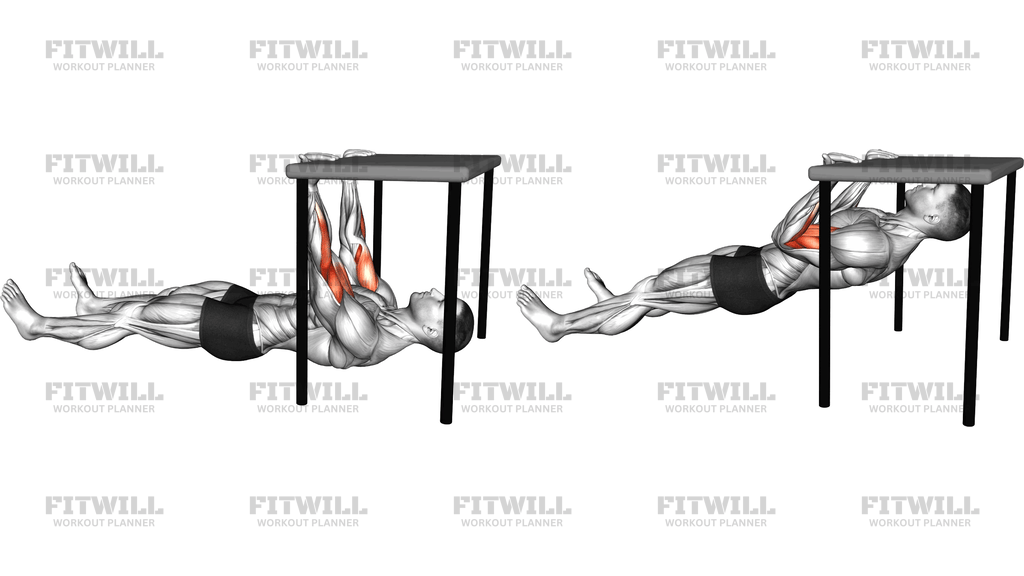
The Biceps Curl Under Table is a bodyweight curl variation performed while lying on your back beneath a sturdy table. You grip the underside or edge of the tabletop with your arms extended toward it, keep your body in a straight line from head to heels, and pull your upper body toward the table purely by flexing the elbows. Because your feet stay anchored to the floor and your torso hangs below the table, your own bodyweight provides the resistance your biceps must curl against.
What makes this movement different from an inverted row is the intent. In a row, you think about driving the elbows back and pulling the chest up. Here you think about curling: the elbows stay pointed down toward the floor and relatively fixed, and the forearms do the work as if you were performing a dumbbell curl with your body as the weight. The result is a very direct biceps contraction, with strong involvement from the brachialis and brachioradialis and a serious demand on grip strength.
This is a practical choice when you have no dumbbells or cables available, since any solid, heavy table turns into a curl station. It suits home trainees, travelers, and anyone who wants a bodyweight arm exercise with a built-in progression: the more horizontal your body, the harder the curl; the more you bend your knees and place your feet close to the table, the easier it becomes.
The setup matters more than it looks. The table must be heavy and stable enough that it cannot tip or slide when you pull on it, and your grip should be shoulder-width or slightly narrower on the edge. Keeping the hips in line with the shoulders and avoiding the urge to press the feet into the floor to cheat the rep is what keeps the tension on the biceps rather than scattering it everywhere else.
To execute it well, think slow and controlled. Curl your face and chest toward the underside of the table, pause when the elbows are fully bent, then lower yourself back down over two to three seconds until the arms are straight again. Do not rush the eccentric; lowering under control is where much of the muscle-building value lives, and it also protects the elbows from sudden stress at full extension.
A few safety points are non-negotiable. Test the table with a partial pull before committing your full weight, keep your head neutral as you rise so it does not clip the tabletop, and stop if you feel any strain in the elbow joint rather than the muscle. Because the resistance is your own bodyweight, progress by adjusting body angle, adding a slow tempo, or moving to one-arm work only once both sides feel evenly strong.
[ Workout Log & Planner ]
Put your next workout in Fitwill
Keep your plan and training log ready when you are.


Instructions
- Find a heavy, stable table and position yourself face-up underneath it with your head and shoulders under the tabletop and your legs extending out toward the far side.
- Reach up and grip the underside or edge of the tabletop with an underhand (supinated) grip, hands about shoulder-width apart, arms fully extended.
- Walk your feet out until your body forms a straight line from head to heels, or bend your knees with feet flat on the floor if you need an easier version.
- Brace your core and squeeze your glutes slightly so your hips do not sag toward the floor.
- Keeping your elbows pointed toward the floor and your upper arms relatively still, curl your body up by bending the elbows, pulling your head and chest toward the underside of the table.
- Continue until the elbows are fully bent and your forehead or upper chest is close to the tabletop, squeezing the biceps hard at the top.
- Lower yourself back down slowly over two to three seconds until the arms are completely straight and the biceps are stretched.
- Exhale as you curl up, inhale as you lower back down.
- Reset your body line between reps if your hips drift, then repeat for the target number of repetitions.
- When finished, let go one hand at a time and slide yourself out from under the table rather than dropping straight down.
Tips & Tricks
- The biggest cheat in this movement is pushing through the feet to help the pull. Keep the weight on your heels without actively pressing, and let the elbows do the work.
- If your elbows flare outward or drift toward your ears, the shoulders take over. Picture the upper arms glued in place, hinges pointing at the floor, with only the forearms moving.
- A grip that gives out before the biceps do is common here. Chalk or a towel wrapped over the table edge can help, or shorten the range slightly until your grip catches up.
- Straighten your legs to make the exercise harder and bend your knees with feet close to the table to make it easier — this is your main progression and regression dial.
- Do not bounce out of the bottom. Fully straightening the arms and pausing for a beat before each curl keeps tension consistent and protects the elbow joints.
- Keep your chin tucked slightly so the top of your head rises first and does not bump the underside of the tabletop at the top of the rep.
- Wobbling tables are a hard stop. Test the setup with a partial-effort pull and watch for any lift or slide of the legs before doing full repetitions.
- If one arm tires faster than the other, add a few single-arm reps on the weaker side only at the end of your sets to even things out.
- A two to three second lowering phase turns this into a very demanding biceps exercise — use it once you can complete your sets with strict form at normal speed.
Frequently Asked Questions
What muscles does the Biceps Curl Under Table work?
The biceps brachii is the primary mover, with strong support from the brachialis and brachioradialis in the upper forearm. Your forearms and grip work hard to hold onto the table edge, and your core helps keep the body straight.
How is the Biceps Curl Under Table different from an inverted row?
In an inverted row you drive the elbows back and think about pulling the chest to the table, which involves the back heavily. In this curl, the elbows stay pointing down and the forearms fold up, so the effort stays on the biceps.
What kind of table do I need for the Biceps Curl Under Table?
A heavy, solid table that will not tip, slide, or flex when you pull on it. Test it with a moderate pull before committing your full bodyweight, and avoid lightweight folding or glass tables entirely.
Is this exercise suitable for beginners?
Yes, as long as the easier version is used first. Bend your knees and place your feet close to the table so less of your bodyweight hangs on the arms, and master the straight-body version before progressing.
How do I make the Biceps Curl Under Table harder?
Straighten your legs so your body is fully horizontal, slow the lowering phase to three or more seconds, pause at the top of each curl, or progress toward single-arm repetitions once both sides are strong.
Why do my forearms fatigue before my biceps?
Hanging your bodyweight from your fingers is very grip-demanding, so this is normal early on. Build up gradually, consider a thicker or towel-wrapped edge for comfort, and your grip strength will improve alongside your arms.
Can I do the Biceps Curl Under Table if I have elbow discomfort?
Full elbow extension under load can aggravate sensitive elbows. Limit the range slightly at the bottom, keep the lowering phase slow, and stop the exercise if you feel joint pain rather than muscle effort.
What can I use if I don't have a suitable table?
A low, secure bar, a sturdy railing, or the edge of a heavy fixed bench set at the right height can work with the same body position. Underhand-grip inverted rows on a bar with the elbows kept low are the closest substitute.
How many reps and sets should I do?
Because the load is your bodyweight, most people do well with 3 to 4 sets of 6 to 12 controlled repetitions. Adjust your body angle so the last reps of each set are challenging but still strict.