Bodyweight Romanian Deadlift Biceps Curl Kickback
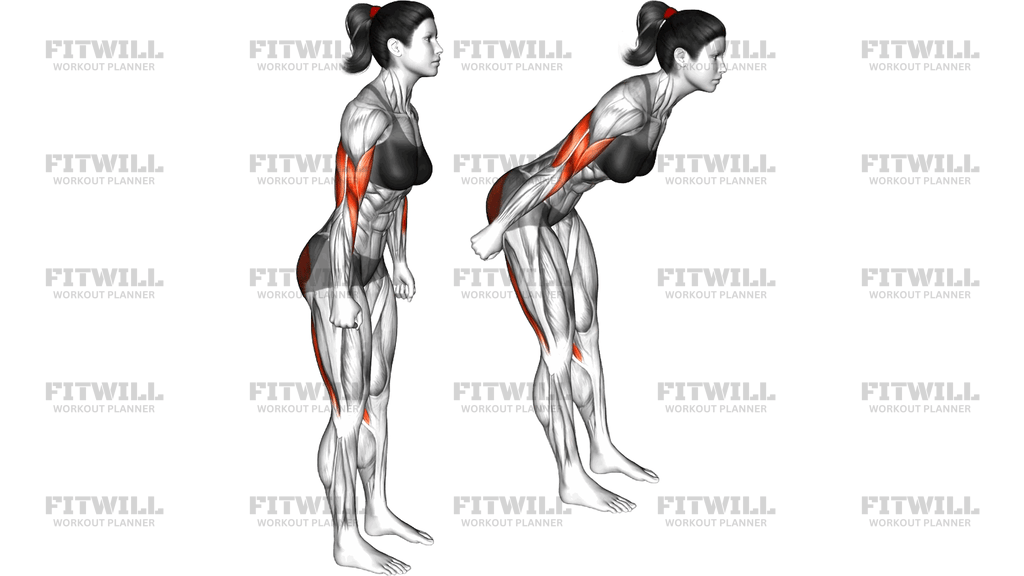
The Bodyweight Romanian Deadlift Biceps Curl Kickback is a compound bodyweight sequence that chains three familiar actions into one flow: a hip hinge, a biceps curl, and a triceps kickback. You set up in a Romanian deadlift position, hold that hinge, and then work your arms by curling your hands toward your shoulders and extending them back behind your hips. Because you have no dumbbells in hand, the challenge comes from holding the hinge posture steady while your arms move through both actions.
This movement is useful when you want to train your upper arms and your posterior chain at the same time without equipment. The isometric demand of the hinge keeps your hamstrings, glutes, and lower back engaged for the entire set, while the curl and kickback cycle your biceps and triceps through full ranges. It fits well into home workouts, warm-up circuits, or finishers on days when weights are not available.
Setup matters more here than in a standing curl, because the hinge position dictates everything else. Your torso should be angled forward with a flat back, hips pushed back, knees softly bent, and weight distributed through the middle of your feet. If the hinge collapses or rounds, the arm work becomes sloppy and your lower back takes on stress it does not need.
To execute it well, think of your torso as a fixed bridge and your arms as the only moving parts. From the hinged position with arms hanging straight down, curl your hands up toward your shoulders, then extend your arms back behind you so your hands finish near your hips in the kickback position. Reverse the path in a controlled way before the next repetition.
A common mistake is turning the hinge into a shallow bend and letting the chest lift as the arms get tired. Keep the torso angle constant, and if it drifts, reduce the range of the curl and kickback rather than standing up. Move at a moderate tempo, breathe steadily, and treat the whole set as one continuous posture challenge rather than two arm exercises stacked together.
[ Workout Log & Planner ]
Put your next workout in Fitwill
Keep your plan and training log ready when you are.


Instructions
- Stand with your feet about hip-width apart, toes pointing forward, and your weight balanced through the middle of your feet.
- Push your hips back and hinge forward until your torso is angled down roughly 45 degrees or slightly lower, keeping your back flat and your knees softly bent.
- Let your arms hang straight down from your shoulders with your palms facing forward or toward your thighs, and brace your core to lock in the hinge position.
- Curl your hands up toward the fronts of your shoulders, squeezing your biceps at the top without letting your elbows drift forward.
- From the curled position, extend your elbows to straighten your arms and press your hands back behind your hips until your arms are roughly parallel to the floor, finishing the triceps kickback.
- Reverse the path with control: bring your hands back down under your shoulders, then lower them to the hanging start position.
- Keep your torso angle unchanged throughout the entire curl and kickback cycle; your hips and spine should not move as your arms work.
- Exhale as you curl and extend back, and inhale as you return your arms to the start.
- Complete your repetitions, then stand up by driving your hips forward, resetting your stance before the next set.
Tips & Tricks
- If your back rounds when you hinge, bend your knees a little more and shorten the hinge angle; a higher torso with a flat back beats a deep hinge with a rounded spine.
- Pin your elbows close to your ribs during both the curl and the kickback. Elbows that flare outward shift work away from your biceps and triceps and strain the shoulders.
- The most common failure point is the torso rising as fatigue builds. Film yourself from the side or check your chest angle each rep to make sure the hinge holds.
- Because there is no external load, slow the tempo deliberately, especially on the way down from the curl. A one-second curl with a two-second return makes the bodyweight version meaningful.
- Squeeze your glutes and hamstrings subtly while holding the hinge. This stabilizes your pelvis and keeps the lower back from arching or rounding under arm fatigue.
- Keep your neck in line with your spine by looking at a spot on the floor a foot or two ahead of your feet, not up at the wall.
- If your hamstrings tighten before your arms fatigue, you are hinging too deep for your current flexibility. Raise the torso angle slightly.
- Do not let your hands swing past your hips at the end of the kickback; stop when the arm is straight and in line with your torso to keep tension on the triceps.
Frequently Asked Questions
What muscles does the Bodyweight Romanian Deadlift Biceps Curl Kickback work?
The biceps are the primary movers during the curl, and the triceps work during the kickback. Holding the hinge the whole time keeps the hamstrings, glutes, and lower back under continuous tension.
Why do I hold the Romanian deadlift position while curling and kicking back?
The held hinge turns the exercise into a combined movement: your posterior chain works isometrically to hold the posture while your arms move. Without the hinge, it would just be a standing bodyweight curl and kickback.
How deep should I hinge during the Bodyweight Romanian Deadlift Biceps Curl Kickback?
Hinge until your torso is around 45 degrees or a bit lower, as long as you can keep your back flat and feel a stretch in your hamstrings without rounding. Depth is less important than holding that angle consistently through every rep.
Can beginners do this exercise?
Yes, but beginners should practice the hinge by itself first, then add the curl, and finally add the kickback. Building the sequence in stages prevents the torso from collapsing once the arms start moving.
Is the order of curl then kickback important?
Curling first and then extending back keeps your elbows near your ribs for both actions and gives a smooth, continuous path. Reversing the order makes the transition awkward and usually pulls the elbows forward out of position.
Why do I feel this more in my lower back than my arms?
That usually means your hinge angle is too aggressive for your hamstring flexibility or your core is not braced, so your spinal muscles are carrying the load. Raise your torso slightly, soften the knees, and squeeze your glutes to shift the holding work back to the hips.
What can I use instead of the Bodyweight Romanian Deadlift Biceps Curl Kickback?
A hinged biceps curl with light dumbbells covers the arm work, and a separate hip hinge like a good morning covers the posterior chain. Resistance band curls and kickbacks from a bent-over position are another close substitute.
How many repetitions should I aim for?
Since the resistance is only your bodyweight, higher reps in the 12 to 20 range with a slow tempo work well. Stop the set when your torso angle starts to drift or your form on the curl or kickback breaks down.
Is it safe for my lower back?
When the hinge is performed with a flat back, soft knees, and a braced core, the position is a standard training posture. The main risk comes from rounding or letting the hinge sag as you tire, so prioritize a controlled range and stop the set if your back position deteriorates.