Standing Hip Horizontal Rotation
Standing Hip Horizontal Rotation is a body weight movement that trains rotation through the hips and trunk from a stable, wide-legged stance. You stand with the feet spread well outside shoulder width, the arms raised straight out to the sides at shoulder height, and then sweep the hips horizontally from one side to the other while the upper body and arms stay anchored facing forward. The wide base and the outstretched arms act as a reference frame, which makes it easy to tell whether the rotation is genuinely coming from the hips or whether the shoulders are cheating the movement.
This exercise is useful for anyone who needs controlled rotational mobility through the hip joints and strength in the muscles that manage it. The obliques on both sides of the waist work hard to swing the pelvis and then decelerate it at the end of each rotation, while the deep hip rotators and adductors handle the turning of the thighs against the fixed feet. Because the feet never leave the floor, the ankles, knees, and stabilizers of the lower leg are also quietly working to keep you balanced as the pelvis twists above them.
Setup matters more here than it looks. The width of the stance determines how much the adductors and hip rotators are challenged, and keeping the arms level at shoulder height gives the torso something to stay square against. If the arms drift or the chest starts turning with the hips, the exercise turns into a general spinal twist and you lose the specific hip rotation that gives it value.
To execute it well, brace the torso lightly, press the feet into the floor, and rotate the pelvis horizontally to one side as far as you can control, then reverse the sweep to the other side without letting the shoulders follow. The movement should feel like the hips are wiping side to side on a flat tabletop while the ribcage stays pointed forward. Keep the tempo slow enough that each turn is deliberate, especially the change of direction.
This movement fits well into warm-ups before lifting or field sports, as active recovery between heavier sets, or as a standalone hip mobility drill on days away from the gym. It is also a practical option for people who sit a lot and want a low-load way to keep the hips rotating freely. Because it uses only body weight, it can be done almost anywhere, and the difficulty is adjusted simply by how far and how quickly you rotate.
For safety, the main points are to stay within a rotation range that the knees tolerate comfortably and to keep the knees soft rather than locked. The feet stay flat and planted throughout; if the heels or toes start lifting to gain extra range, you have gone further than the hips currently allow. Start with a modest range and let it grow over sessions rather than forcing depth from day one.
[ Workout Log & Planner ]
Put your next workout in Fitwill
Keep your plan and training log ready when you are.


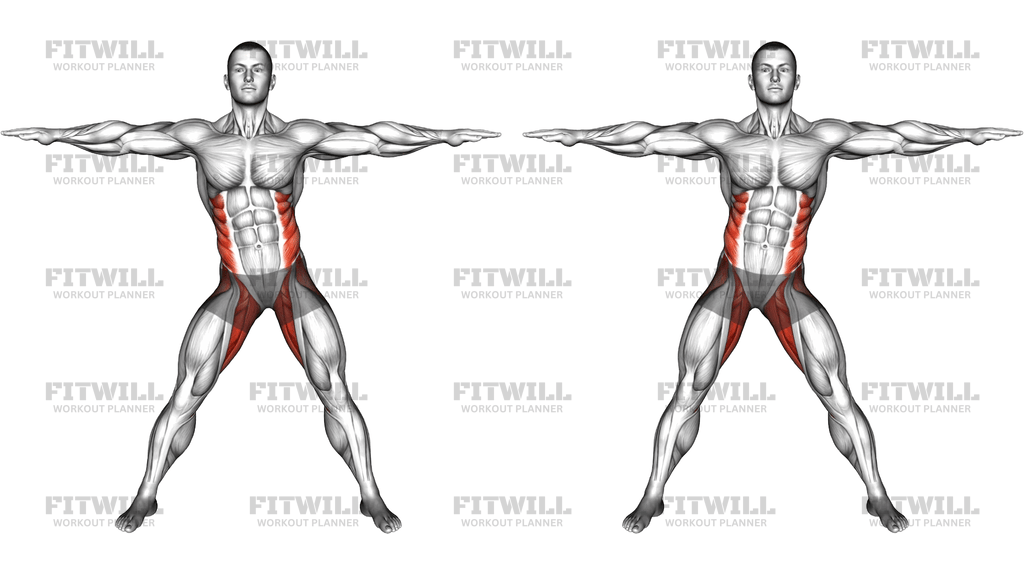
Instructions
- Stand with the feet spread roughly one and a half to two shoulder widths apart, toes turned out slightly and both feet flat on the floor.
- Raise the arms straight out to the sides at shoulder height, forming a T shape, with the palms facing down and the shoulders relaxed away from the ears.
- Brace the abdominal wall lightly and soften the knees so the legs are not locked straight.
- Keep the chest and head facing forward, then rotate the hips horizontally to the left, sweeping the pelvis as far as you can control while the feet stay planted.
- Pause briefly at the end of the rotation, feeling the obliques on the opposite side engage to stop the swing.
- Reverse the sweep and rotate the hips horizontally to the right, keeping the arms level and the upper body square the whole way.
- Continue alternating side to side in a smooth, continuous arc, as if the hips were tracing a flat horizontal circle.
- Exhale as you rotate into each side and inhale as the hips pass back through center.
- After the final repetition, bring the pelvis back to the square starting position, lower the arms, and settle the stance before stepping out of it.
Tips & Tricks
- The most common mistake is turning the shoulders along with the hips; fix it by fixing your gaze on one spot ahead and keeping the fingertips of the outstretched arms level at all times.
- If the inner thighs cramp, the stance is likely too wide for your current mobility; narrow it slightly and rebuild width over time.
- Do not let the knees snap inward or outward as the pelvis turns; keep the knees tracking loosely over the toes so the rotation comes from the hips rather than the knee joints.
- Keep the rotation horizontal rather than dropping one hip down; the pelvis should sweep flat, like a windshield wiper on a level plane.
- A locked, rigid torso kills the movement; aim for a light brace so the obliques can shorten and lengthen instead of just holding still.
- If you cannot feel the waist working, slow the tempo down and add a one-second pause at each end of the rotation before speeding back up.
- Keep the heels down throughout; lifting the heel to steal extra range only shifts stress into the ankle and knee.
- Start each session with a smaller range than your maximum and expand it gradually within the set as the hips loosen up.
- Breathe steadily rather than holding your breath; breath-holding makes the trunk stiff and turns the exercise into a strain instead of a controlled rotation.
Frequently Asked Questions
What muscles does Standing Hip Horizontal Rotation work?
The obliques on both sides of the waist drive and control the rotation of the pelvis. The deep hip rotators, glutes, and adductors assist as the thighs turn against the planted feet, and the core stabilizers keep the ribcage square.
Why are the arms held straight out to the sides during Standing Hip Horizontal Rotation?
The outstretched arms act as a fixed reference frame. If your fingertips stay level and your chest keeps facing forward, you can be confident the rotation is coming from the hips rather than the shoulders.
Is Standing Hip Horizontal Rotation suitable for beginners?
Yes, it is a low-load body weight drill, which makes it very approachable. Beginners should simply use a narrower stance and a shorter rotation range, then expand both as control improves.
How wide should my stance be in Standing Hip Horizontal Rotation?
Start around one and a half shoulder widths with the feet flat. A wider stance challenges the adductors and hip rotators more, but only go wider if you can keep the heels down and the knees comfortable.
Should my shoulders rotate with my hips in this exercise?
No. The defining feature of the movement is that the hips rotate horizontally while the upper body stays anchored facing forward. If the shoulders turn, you are doing a general spinal twist instead.
Can I use Standing Hip Horizontal Rotation as a warm-up?
It works well as a warm-up before squats, rotational sports, or any activity that demands hip mobility. Use controlled, moderate-speed rotations for ten to fifteen reps per side.
What should I do if my knees feel strained during Standing Hip Horizontal Rotation?
Reduce the rotation range, soften the knees slightly, and make sure the feet are not pinned so wide that the hips cannot actually turn. The rotation should be felt around the hips and waist, not in the knee joints.
How is Standing Hip Horizontal Rotation different from a standing torso twist?
In a torso twist the shoulders and ribcage rotate while the hips mostly stay put. In Standing Hip Horizontal Rotation the pelvis does the turning against a fixed upper body, which shifts the work to the hips and obliques in a very different pattern.
How many repetitions of Standing Hip Horizontal Rotation should I do?
Eight to twelve controlled rotations to each side per set is a solid range. Prioritize smooth direction changes and a square chest over total reps.
Can I substitute Standing Hip Horizontal Rotation if I cannot stand comfortably?
A seated hip rotation on a bench or a supine hip rotation on the floor covers a similar rotation pattern with less balance demand. Keep the same idea of rotating the pelvis while the upper body stays controlled.