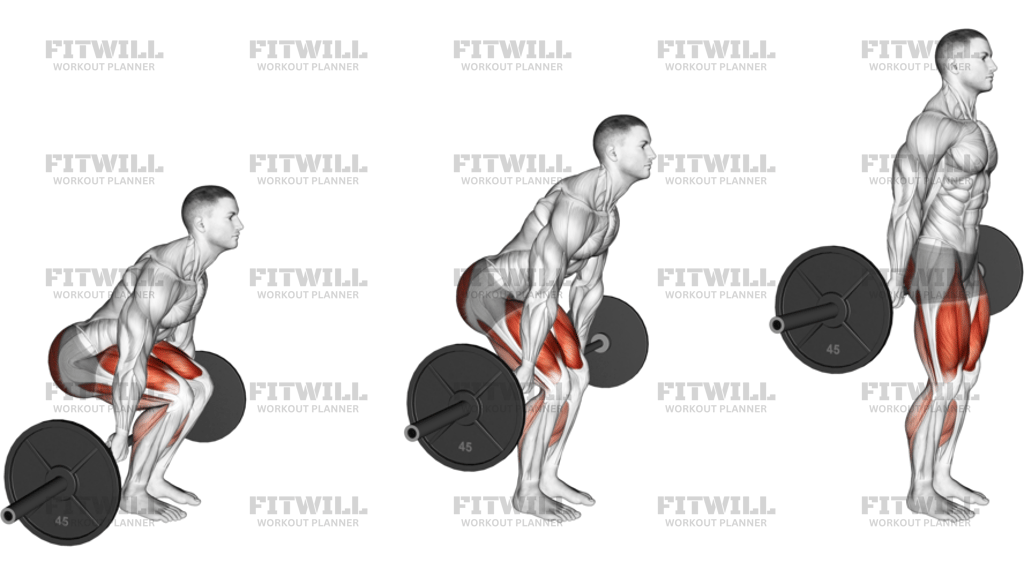
Deadlift With Barbell With Tempo 2-3
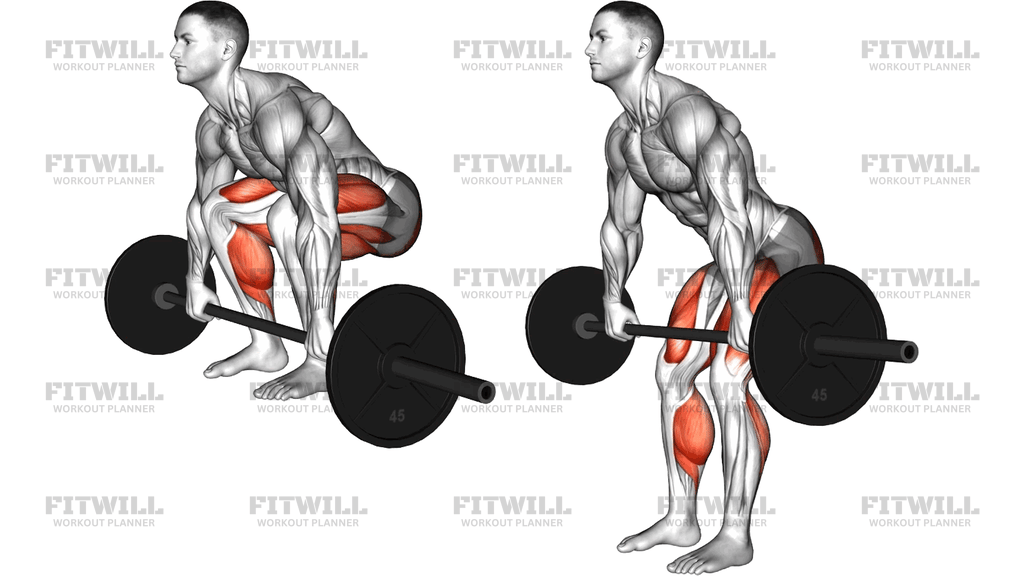
The deadlift with barbell with tempo 2-3 is a classic deadlift with barbell, performed on the floor with a standard setup: feet apart at hip to shoulder width, hands gripping the bar slightly outside of the legs, and each repetition starts from a complete stop, with the discs resting on the floor. The name comes from the tempo of two to three counts used during the lowering — instead of dropping the bar or slamming it down, you lower it under control for about two to three seconds before the next pull. This single change turns a standard deadlift into a slower, much more demanding exercise for strength.
This movement is useful for almost anyone who trains with weights. Beginners benefit, because the forced tempo makes a rushed pull impossible and they learn to keep the spine neutral, with the hips and chest rising together. More advanced lifters use it to build strength at the floor, since the slow lowering keeps the hamstrings, glutes, and lumbar under tension far longer than a fast eccentric phase and exposes the weak positions, which a quick drop would hide.
The main work is done by the posterior chain. The glutes and hamstrings extend the hips, the erector spinae hold the spine rigid, the quadriceps execute the initial push off the floor, and the traps and upper back keep the shoulders stable and the bar trajectory close to the legs. The grip and forearms work hard the whole time, because the slow lowering gives the bar far more opportunity to slip than a quick reset.
The setup matters here even more than in most exercises, because the slow tempo amplifies every positional error. The bar should start above the middle of the foot, about an inch from the shin, with the shoulders slightly ahead of the bar and the back flat, before any force is applied. If you reach for the bar with a rounded back or let your hips shoot up first, the two to three second descent will only make the mistake more obvious — and more stressful for the lumbar.
In practice, you can use this exercise as a main strength movement with heavier sets of three to six repetitions, or as a technique builder with moderate weights for five to eight repetitions. Expect your working weight to be lower than in a normal deadlift at first; the controlled eccentric phase is genuinely harder, and that is precisely the point. If you have a history of problems with the lumbar, progress gradually and prioritize a flat back over the weight on every repetition.
[ Дневник и планиране на тренировки ]
Добавете следващата си тренировка във Fitwill
Вашата програма и тренировъчен дневник винаги подръка.


Как се изпълнява
- Stand with the bar above the middle of your feet, shins about an inch from the bar, feet apart at hip to shoulder width, with the toes slightly turned out.
- Hinge at the hips and bend your knees to grip the bar with both hands slightly outside of the legs — with a grip on top or mixed, with fully straight arms.
- Lower your hips until the shoulders are slightly above and ahead of the bar, lift your chest and flatten your back in a neutral position, before applying any force.
- Tighten your core, as if bracing for a punch, take a breath into your stomach and pull the slack out of the bar, so your body and the bar tense together.
- Push the floor with your legs, keeping the bar lightly dragging on your shins and thighs, while the hips and chest rise at the same time.
- Stand fully upright at the top with extended hips and knees, shoulders back, without leaning backward or overextending the lumbar.
- Lower the bar in a slow count of two to three seconds, pushing the hips back first, as the bar tracks down the front of your legs with slightly relaxed knees.
- Keep the descent controlled until the discs touch the floor, then briefly release the tension — reset your breath and tense up again before the next pull.
- Exhale after the hardest part of the pull or once you are already upright; never hold your breath for several consecutive repetitions.
- Between sets, reset your stance and grip each time, instead of making touch-and-go repetitions, so every repetition starts from the same solid position.
Практически съвети
- If your hips shoot up before the bar leaves the floor, you are starting with them too high or your legs are not pushing — reset lower and think about driving your feet through the floor for the first inch.
- Rounding during the two to three second lowering phase is the most common mistake; if your back rounds during the descent, reduce the weight by 10 to 20 percent before loading it again.
- A slow eccentric phase punishes a weak grip. If the bar rolls toward your fingers during the lowering, switch to a mixed grip or use chalk, instead of fighting with an overhand grip.
- Keep the bar in contact with your legs throughout the entire pull. If the bar drifts forward around the knees, you are pulling with your arms, instead of letting the hips and legs do the work.
- Do not bounce the discs off the floor between repetitions — the complete stop is exactly what makes this variation valuable and keeps your setup honest.
- Pulling the slack out of the bar before the push prevents the jerky start, which drops your chest down and suddenly loads the lumbar.
- Finish with the glutes, not with the lumbar. If you finish each repetition by leaning back and a strong arching, squeeze your glutes at the top instead.
- Your working weight here should be noticeably below your normal maximum in the deadlift; chasing the same load with a forced eccentric phase is the fastest way to a stall or strain.
- Wear shoes with flat and firm soles or lift barefoot style, so the push into the floor remains stable — a soft, cushioned sole shifts your balance forward as the weight increases.
- If your grip gives up long before the posterior chain, add separate exercises for grip or forearms, instead of turning every deadlift training session into a grip test.
Често задавани въпроси
Which muscles does the deadlift with barbell with tempo 2-3 work?
It mainly trains the glutes, hamstrings, and lumbar, with strong support from the quadriceps, traps, upper back, and forearms. The slow two to three second lowering phase keeps the posterior chain under tension longer than a standard deadlift.
Why should I lower the bar slowly instead of dropping it?
The controlled two to three second descent builds strength during the lowering portion of the movement and forces you to stay tense the whole way down. It also makes technical mistakes, like a rounded back, immediately obvious and harder to hide.
Is the deadlift with barbell with tempo 2-3 suitable for beginners?
Yes, as long as the weight stays moderate. The forced tempo actually teaches good habits, because you cannot yank the bar or lose your position without feeling it, but beginners should start light and master a flat back before adding significant weight.
Should I use an overhand or mixed grip in the deadlift with barbell with tempo 2-3?
Start with an overhand grip and switch to a mixed grip when the bar starts slipping during the slow descent. Since the eccentric phase lasts longer here, the grip usually gives up earlier than in a regular deadlift.
How heavy should I lift compared to my normal deadlift?
Expect to use approximately 10 to 20 percent less weight than in your standard working sets. The controlled lowering phase adds significant fatigue, and the exercise works as intended only if the descent remains smooth and controlled.
How many repetitions and sets should I do?
For strength, work in sets of three to six repetitions with heavier weights and a full reset between repetitions. For technique and muscle mass, five to eight repetitions with moderate weight work well, keeping every descent in the two to three second count.
My lower back gets more tired than my legs in this movement — what am I doing wrong?
This usually means your hips are rising too fast during the pull or your back is slightly rounding during the slow descent. Lower the weight, reset with your chest lifted and shoulders above the bar, and make sure the glutes and legs are driving the movement.
Can I use dumbbells or a trap bar instead of a barbell?
Yes, the same slow two to three second lowering tempo works great with a trap bar or heavy dumbbells if you don't have access to a barbell. The version with a trap bar is somewhat easier for the lumbar, because the weight sits closer to your center of gravity.
Do I need to fully reset between repetitions?
Yes. Let the discs settle on the floor, release your tension, and tense up again before each pull. Touch-and-go repetitions defeat the purpose of the controlled lowering phase and usually cause your starting position to drift from repetition to repetition.
Is the deadlift with barbell with tempo 2-3 safe for people with problems in the lumbar?
Anyone with an existing condition in the lumbar should first get clearance from a qualified professional, before loading this movement pattern. For healthy lifters, a neutral spine, moderate weights, and honest technique make it a safe and effective builder for the posterior chain.