Kettlebell Alternating Renegade Row
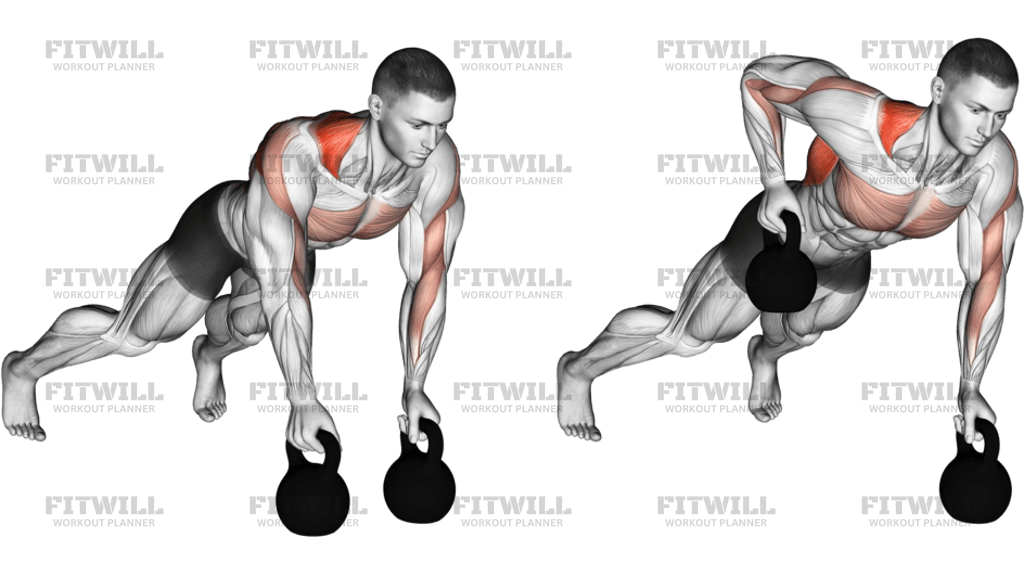
Kettlebell Alternating Renegade Row is a loaded plank row that trains the upper back, lats, traps, shoulders, arms, and the anti-rotation core work needed to keep the torso square while one arm moves. The image shows a high plank with both kettlebells set under the shoulders and the feet placed wide enough to keep the base stable while one hand rows.
This exercise is useful when you want back strength without losing the bracing demand of a plank. The support arm, shoulder blade, trunk, and glutes all have to stay organized while the working arm pulls the bell toward the lower ribs or hip. That combination is why it feels more demanding than a standard row: the row itself is only part of the task, and the rest comes from resisting twist and hip shift.
The setup matters more here than on a simple row. The hands need to be directly under the shoulders, the kettlebells should sit flat and not wobble, and the feet usually need to be wider than hip width so the body can stay level. If the stance is too narrow or the hips drift, the exercise turns into a rotation drill instead of a controlled alternating row. A steady plank position lets the back muscles work through a clean pulling path.
Use this movement when you want a strength-focused accessory exercise, core-and-back pairing, or a kettlebell variation that punishes sloppy body control. Row one bell at a time, lower it without dropping the shoulder, then switch sides and repeat with the same trunk position. The goal is not to twist to get a longer pull; it is to keep the chest, pelvis, and head as quiet as possible while the row happens underneath them.
Load it lightly enough that the plank stays firm and the kettlebell can be lifted without rocking the torso. If the wrists, shoulders, or low back start compensating, the set is too heavy or the stance is too narrow. Clean reps, even pacing, and a stable base make this a productive upper-back and core exercise rather than a sloppy conditioning drill.
[ Workout Log & Planner ]
Put your next workout in Fitwill
Keep your plan and training log ready when you are.


Instructions
- Place two kettlebells on the floor under your shoulders and set up in a high plank with your hands gripping the handles and your feet wider than hip width.
- Stack your shoulders over your wrists, squeeze your glutes, and keep your hips level before you start the first row.
- Shift a little more weight into the hand that is staying on the floor so the working bell can come up without the torso twisting.
- Row one kettlebell toward your lower ribs or hip by driving the elbow back close to your side.
- Pause briefly at the top without shrugging the shoulder or letting the rib cage open to the side.
- Lower the kettlebell under control until it returns to the floor and the arm is fully extended again.
- Keep the plank firm, then repeat on the other side so the rows alternate evenly.
- Exhale as you row and inhale as the bell comes back down, keeping the pace smooth and controlled throughout the set.
Tips & Tricks
- Set the kettlebells far enough apart that each handle sits directly under its own shoulder; crowding them makes the row feel cramped and unstable.
- Use a wider foot stance than you would for a normal row so the pelvis has room to stay level when one bell leaves the floor.
- Keep the free hand pressing hard into the handle instead of hanging passively; that support hand is what keeps the body from spinning.
- Pull the elbow toward the back pocket or lower ribs rather than flaring it straight out to the side.
- Do not chase a higher bell path by rotating the torso; a smaller, cleaner row is the correct rep here.
- If your hips sway with every rep, shorten the set or reduce the load until the plank stays quiet.
- Keep the neck long and the eyes on the floor a few feet ahead so the head does not lead the twist.
- Choose a bell that lets you keep the support shoulder packed and the wrist stacked instead of collapsing toward the floor.
Frequently Asked Questions
What muscle does Kettlebell Alternating Renegade Row target most?
The main targets are the upper back, lats, traps, and the core muscles that resist rotation while you row.
Why are the kettlebells spaced under each shoulder?
That setup gives you a stable base and keeps the row path short and controlled instead of forcing the torso to twist.
Do I need to keep my feet wide?
A wider stance usually helps. It reduces rocking through the hips and makes it easier to alternate rows without losing plank position.
Where should I pull the kettlebell?
Pull it toward your lower ribs or hip with the elbow traveling back close to your side, not flaring out.
Can I do this exercise if my wrists bother me?
Sometimes a neutral kettlebell handle feels better than a straight-bar plank, but the position still needs a firm wrist and stacked shoulder. Stop if the wrist pain increases.
Is this a back exercise or a core exercise?
It is both. The row works the back and arms, while the plank position heavily challenges the abs, obliques, and glutes.
What is the biggest form mistake?
The most common error is letting the hips rotate or rise on the row instead of keeping the torso square.
How can I make this harder without using a heavier bell?
Slow the lowering phase, pause at the top, or narrow the foot stance slightly while still keeping the plank stable.