Seated Side Crunch Wall
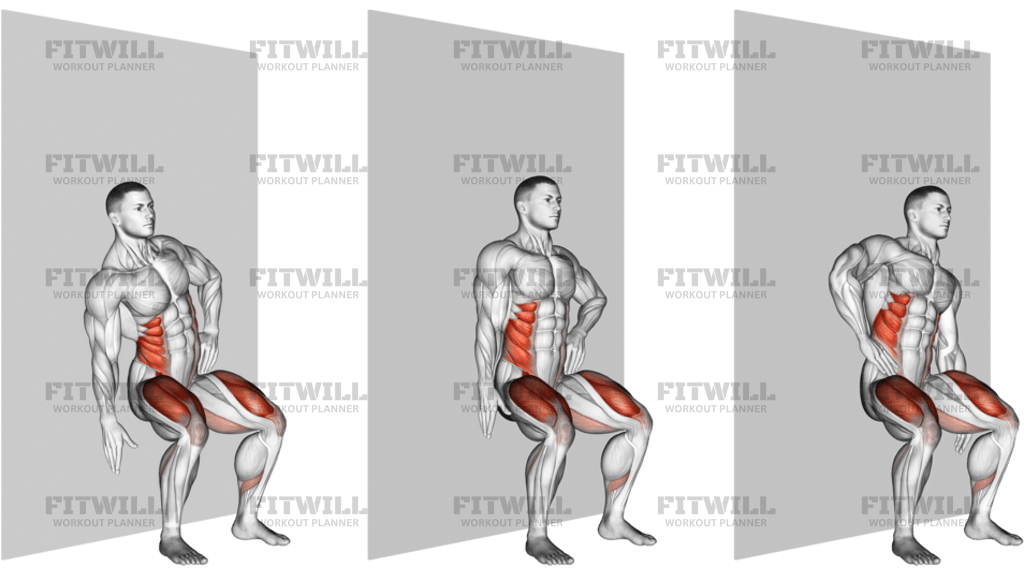
Seated Side Crunch Wall is a bodyweight oblique exercise built around a short, controlled side-bending crunch while you stay seated and use the wall as a position reference. The wall keeps the torso from drifting backward or rotating too far, which makes this a useful option when you want to train the waist with cleaner form and less momentum. It is especially valuable for anyone who wants a simple core drill that makes the ribs, pelvis, and breathing pattern easy to monitor.
The main work comes from the obliques, with the rectus abdominis, transversus abdominis, and spinal stabilizers helping keep the trunk organized. In practice, the exercise should feel like the rib cage is sliding toward the same-side hip instead of the whole body collapsing or twisting. That distinction matters because the goal is not to shove the shoulders around; it is to create a controlled lateral crunch through the side of the abdomen while the lower body stays quiet.
A good setup starts with a tall seated position, bent knees, and feet planted so the pelvis feels stable. Keep the back lightly supported by the wall or close enough to use it as a reference, then stack the ribs over the hips before the first rep. That starting position should let you brace without hunching. If you begin crooked, the rep usually turns into a twist, a shrug, or a hip shift instead of a clean side crunch.
During each repetition, exhale as you shorten the working side and pull the bottom ribs toward the hip on that side. The shoulders should stay down, the neck should stay relaxed, and the hips should stay grounded. Pause briefly in the shortened position, then return slowly until you are tall again without losing wall contact or control. The range is small on purpose. A crisp, repeatable contraction is better than forcing a larger bend that makes the lower back or neck take over.
This exercise fits well in a core accessory block, a warm-up for trunk control, or a light abdominal finisher. It is a good choice for beginners because the bodyweight setup is simple, but it still rewards precision, breath control, and patience. Use it when you want to build oblique awareness, improve side-bending control, or train the waist without loading the spine aggressively. The best reps look calm and exact rather than big and fast.
[ Workout Log & Planner ]
Put your next workout in Fitwill
Keep your plan and training log ready when you are.


Instructions
- Sit tall with your back lightly against the wall, knees bent, and feet flat so your pelvis feels grounded.
- Stack your ribs over your hips, relax your shoulders, and place your hands at your sides or lightly at your head if needed.
- Brace your midsection before you move so the torso stays tall instead of collapsing backward.
- Exhale and side-bend toward one hip, letting the rib cage travel down on the working side.
- Keep both hips and feet planted while the crunch happens through the waist, not by twisting the torso.
- Stop when the working side is fully shortened and the neck still feels long and relaxed.
- Pause for a brief squeeze at the bottom without bouncing or shrugging.
- Inhale and return slowly to the tall starting position with the same control you used on the way down.
- Complete all reps on the same side if programmed that way, then switch sides and repeat.
Tips & Tricks
- Keep the wall contact light; do not press yourself so hard into it that the crunch turns into a shove.
- Think of bringing the lower ribs toward the hip, not the elbow toward the knee.
- If your shoulders start to rotate, shorten the range and make the side bend more vertical.
- Keep the feet quiet so the hips do not help by shifting or lifting.
- Use a small range if your lower back starts to arch or if the rep becomes jerky.
- Exhale through the crunch to help the obliques shorten and keep the brace honest.
- Do not pull on the head; the hand position is only there to support the neck if needed.
- Choose a tempo that makes the return slower than the crunch so the waist stays under tension.
Frequently Asked Questions
What muscle does Seated Side Crunch (Wall) target most?
The obliques do most of the work, especially the side of the waist that shortens during the crunch.
How should my body be positioned against the wall?
Sit tall with bent knees, flat feet, and a neutral torso so the wall can help you stay organized without forcing a backward lean.
Do I need to twist during the rep?
No. The rep should be a side bend through the waist, with the hips and feet staying mostly still.
Should I pull on my head when I crunch?
Only lightly support the head if needed. Pulling on the neck usually turns the movement into a neck exercise instead of an oblique one.
What should I feel at the bottom of the rep?
You should feel the working side of the waist shorten with a brief squeeze, not a pinch in the low back or a strain in the neck.
Is this exercise good for beginners?
Yes. The bodyweight setup is simple, and the wall makes it easier to keep the torso stable while you learn the side-bending pattern.
How can I make the exercise harder without adding weights?
Use a slower return, a cleaner pause at the bottom, or a slightly longer range only if you can keep the ribs and pelvis controlled.
What is the most common mistake with the wall setup?
People often lean back too far or lose rib position. Stay stacked so the crunch comes from the waist rather than from a sloppy torso collapse.