Weighted One Leg Hip Thrust
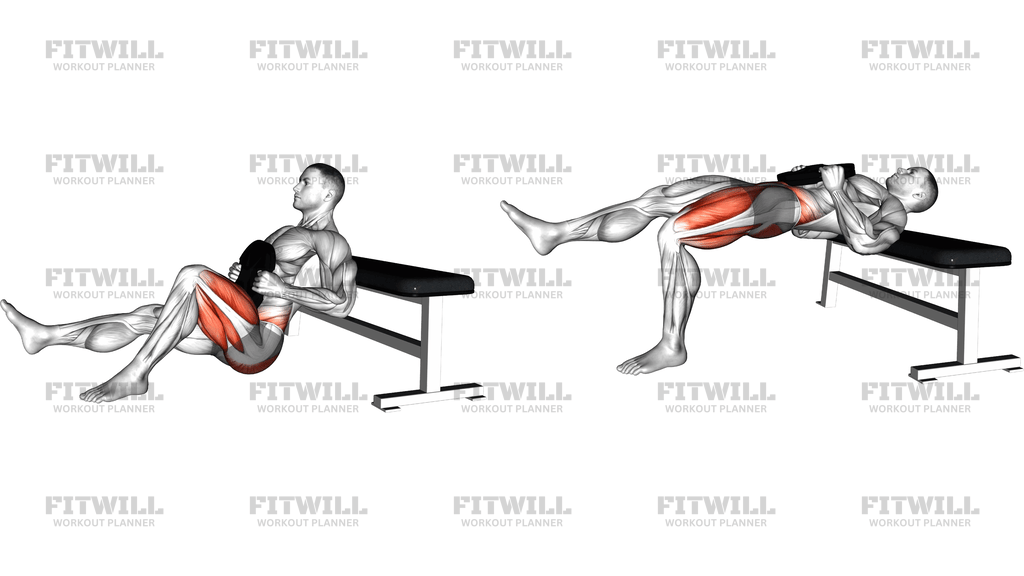
Weighted One Leg Hip Thrust is a bench-supported unilateral hip extension exercise that loads one glute at a time with a dumbbell or similar weight across the hips. One shoulder blade or upper back is anchored on the bench while the working foot stays planted on the floor and the other leg stays lifted or extended out of the way. The setup makes the exercise look simple, but the bench, foot position, and pelvic control decide whether the rep stays on the glute or shifts into the lower back.
The main training goal is strong hip extension on one side while keeping the pelvis level. That makes this a useful builder for the gluteus maximus, with the hamstrings and trunk muscles helping to stabilize the body through the lift. Because one leg is doing all the work, small setup errors are easier to notice than in a two-leg version. If the working foot is too far away, the hamstrings can dominate; if it is too close, the knee and quad may take over; and if the ribs flare, the lumbar spine usually steals the finish.
A good rep starts with the shoulders settled on the bench, the weight centered over the hip crease, and the planted shin close to vertical near the top position. From there, the hips rise in a straight line until the torso and working thigh are aligned. The top position should feel like a hard glute squeeze with the ribs stacked and the pelvis square, not like an aggressive back arch. On the way down, lower under control until the glute stretches, then reset before driving the next rep.
Use this movement for accessory glute work, unilateral strength training, or as a lower-body finisher when you want a focused contraction without heavy spinal loading. It works well for lifters who need more single-leg stability or want to even out side-to-side differences. Start with a light load that stays stable on the hips and only increase resistance when you can keep the bench contact, pelvis position, and range of motion consistent from the first rep to the last.
Fitwill
Log Workouts, Track Progress & Build Strength.
Achieve more with Fitwill: explore over 9600 exercises with images and videos, access built-in and custom workouts, perfect for both gym and home sessions, and see real results.
Start your journey. Download today!




Instructions
- Sit on the floor with your upper back against the edge of a flat bench and place the dumbbell across the crease of the working hip.
- Plant one foot flat on the floor and extend the other leg forward or slightly lifted so it does not help the drive.
- Roll your shoulders onto the bench, hold the dumbbell steady with both hands, and brace your ribs down before you lift.
- Set the planted foot so your shin is close to vertical when the hips are fully extended.
- Drive through the heel and midfoot of the planted leg to lift the hips until your torso and working thigh form a straight line.
- Squeeze the glute at the top without twisting the pelvis or overarching the lower back.
- Lower the hips slowly until you feel a controlled stretch in the working glute, then reset the brace.
- Complete all repetitions on one side before switching to the other leg.
Tips & Tricks
- Center the dumbbell in the hip crease; if it slides, the load is probably too heavy or not held securely enough.
- Keep the free leg long and quiet so it does not help the drive or change your pelvis angle.
- A near-vertical shin at the top usually gives the best glute tension; adjust the foot before adding load.
- Press through the heel and midfoot rather than the toes so the hip can extend without sliding forward.
- Finish with the ribs stacked over the pelvis; if you need to arch your back to reach lockout, shorten the range.
- Lower under control instead of bouncing off the bottom, especially when the dumbbell wants to rock side to side.
- If the hamstring cramps, move the planted foot slightly closer and reduce the range until the glute takes over again.
- Keep both hands on the weight until the set is finished so the load stays level across the hips.
Frequently Asked Questions
What muscle does Weighted One Leg Hip Thrust target most?
The glutes are the main target, especially the gluteus maximus on the working side.
Can beginners perform this exercise?
Yes, but beginners should start with a light dumbbell or even bodyweight and master the bench setup before adding more load.
Where should my upper back sit on the bench?
The edge of the bench should sit across your upper back or lower shoulder blades, not on your neck.
How do I know if my foot placement is right?
At the top, your planted shin should be close to vertical and your pelvis should stay level instead of rotating.
Should the free leg bend or stay straight?
Keep it long and out of the way; a slight bend is fine if it helps balance, but it should not help drive the rep.
Why do I feel this more in my hamstrings than my glutes?
Your planted foot is probably too far from the bench, or you are stopping before the hip is fully extended. Move the foot in a little and recheck the top position.
What is the most common mistake with this exercise?
Letting the lower back arch to finish the rep instead of driving the hip up with the glute.
Can I use this as a warm-up or only as a strength exercise?
It can work as either, depending on the load. Light weight makes it a strong activation drill, while heavier loading turns it into a real strength accessory.