Weighted Hip Thrusts
Weighted Hip Thrusts is a bench-supported glute exercise built around a short, powerful hip extension. You load the hips with a dumbbell, plate, or barbell and drive the pelvis upward while the upper back stays anchored on the bench. The movement is simple on paper, but the setup matters: if the feet are too far away, the lower back takes over; if they are too close, the knees do most of the work. The goal is to keep the load centered over the hips and create tension where the glutes can do the majority of the work.
This exercise is especially useful for building glute strength, improving lockout power, and training hip extension without needing a deep squat or hinge. It also recruits the hamstrings, adductors, and core as stabilizers, but the rep should still feel like a deliberate squeeze from the glutes rather than a bounce off the bench. Because the range is compact, Weighted Hip Thrusts are often used for hypertrophy work, accessory strength work, or as a bridge between lower-body compound lifts and isolation work.
The bench position should let the shoulder blades rest near the edge while the torso can hinge freely. From there, the feet stay planted and the shins are usually close to vertical at the top. That position lets you press through the heels or midfoot without drifting into the toes. Keep the chin tucked slightly, ribs down, and pelvis controlled so the top position comes from the hips extending rather than the low back arching. A brief squeeze at the top is useful if it does not turn into hyperextension.
The descent is just as important as the lift. Lower the hips under control until you feel the glutes lengthen and the weight settles back into a stable start position, then drive up again with the same path on every rep. If the weight shifts on your lap, the feet slide, or the shoulders move around on the bench, the load is probably too heavy or the setup needs to be adjusted. Clean reps should look and feel repeatable from the first to the last rep.
Weighted Hip Thrusts are a strong choice for lifters who want more glute involvement than a squat variation gives them, or for athletes who need stronger hip extension without extra spinal loading. They are also friendly to shorter ranges of motion when the hips or back are irritated by deeper lower-body patterns, as long as the bench height, foot placement, and load are chosen carefully. Use them when you want the glutes to finish the rep hard, not when you want to chase momentum or a bigger arch.
Fitwill
Log Workouts, Track Progress & Build Strength.
Achieve more with Fitwill: explore over 9600 exercises with images and videos, access built-in and custom workouts, perfect for both gym and home sessions, and see real results.
Start your journey. Download today!




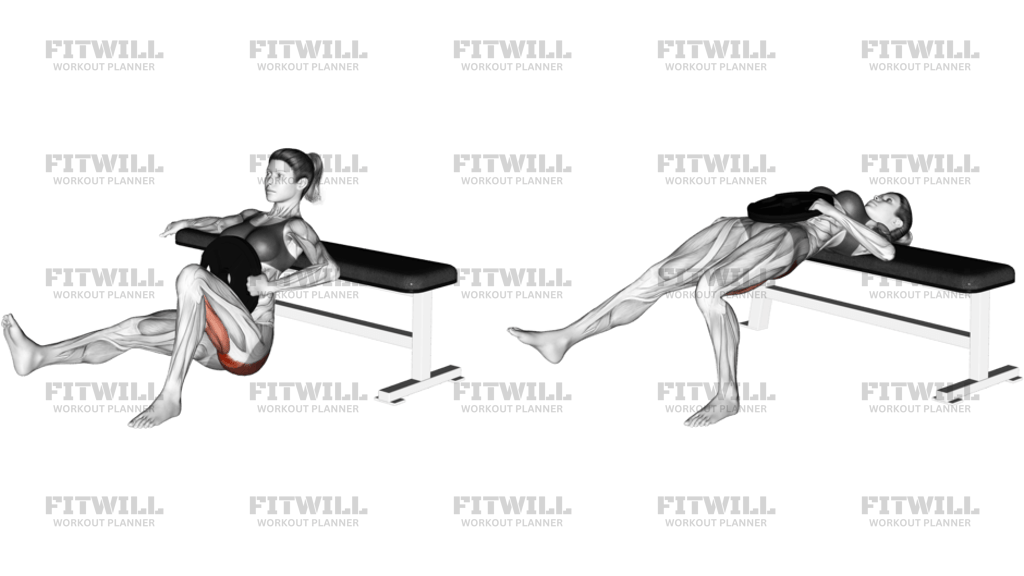
Instructions
- Sit on the floor with your upper back against the edge of a flat bench and a loaded weight centered across your hips.
- Bend both knees and walk your feet in until they are about hip-width apart, with your heels flat and shins close to vertical at the top position.
- Brace your torso, tuck your chin slightly, and keep your ribs down before you start the lift.
- Drive through your heels and lift your hips until your torso is roughly parallel to the floor.
- Squeeze your glutes at the top without over-arching your lower back or flaring your ribs.
- Lower your hips under control until the weight settles back into the start position and your glutes are stretched.
- Keep the weight stable on your lap and the bench contact steady through every rep.
- Breathe in as you lower and exhale as you drive the hips up.
- Repeat for the planned number of repetitions, then set the weight down carefully.
Tips & Tricks
- Set the bench edge just below your shoulder blades so the upper back can pivot without the neck or lower back doing the work.
- If your knees drift far past your toes at the top, move your feet slightly farther away to shift tension back into the glutes.
- If you feel the movement mostly in your hamstrings, bring your feet a little closer and keep your shins more vertical at lockout.
- Keep the chin tucked and eyes forward instead of looking up, which helps stop the ribs from popping and the lumbar spine from overextending.
- A padded barbell, dumbbell, or plate should sit in the hip crease, not high on the stomach where it can shift and bruise.
- Pause for a second at the top only if you can hold the pelvis level; a shaky hold usually means the load is too heavy.
- Lower the hips slowly enough to feel the glutes lengthen, but do not turn the bottom position into a full rest on the floor.
- Choose a load that lets every rep finish with the same hip height and the same bench contact.
Frequently Asked Questions
What muscles do Weighted Hip Thrusts work most?
They primarily target the glute max, with the hamstrings, adductors, and core helping stabilize the lift.
Where should the bench hit during Weighted Hip Thrusts?
The edge of the bench should sit just below your shoulder blades so your torso can hinge without the neck or low back taking over.
Where should the weight sit on Weighted Hip Thrusts?
Place the load across the hip crease and keep it centered so it does not roll toward one side during the rep.
How do I know if my foot position is right?
At the top, your shins should be close to vertical and your heels should stay planted. If you feel mostly quads or hamstrings, adjust your feet a few inches.
Can beginners do Weighted Hip Thrusts safely?
Yes, if they start with light load and learn the bench position, bracing, and hip path before adding weight.
What is the biggest mistake in Weighted Hip Thrusts?
Overextending the lower back at the top instead of finishing with a true glute squeeze is the most common error.
What is a good substitute if I do not have a barbell?
A dumbbell or loaded plate across the hips works well as long as the weight stays centered and does not shift during the set.
Should Weighted Hip Thrusts be done fast or slow?
Use a controlled lower and an intentional drive up. The top can be explosive, but the rep should never turn into a bounce.