Shin Box Switch
The Shin Box Switch is a seated hip mobility drill where you move from a 90/90 position on one side to the same position on the other side without letting your hands touch the floor. You start sitting with one shin folded in front of you and the other folded out to the side behind you, both bent to roughly right angles, with your arms held straight out in front of your chest. From there, you lift or glide your knees across the floor and settle into the mirror image of the starting shape on the opposite side, then repeat the flow back and forth.
What makes this drill valuable is the way it combines hip external rotation on the front leg with internal rotation on the back leg at the same time, then reverses those roles every rep. That means each switch trains both directions of hip rotation through a meaningful range, rather than working one side at a time. Because you are not allowed to lean on your hands, your trunk also has to stay organized and upright, which quietly challenges your core and teaches you to move from the hips instead of collapsing through the lower back.
This movement is especially useful for anyone whose hips feel tight or restricted from long hours of sitting, and for lifters who want to prepare their hips for squats, lunges, or deadlifts. It is also a common screening and warm-up tool in functional training because the switch exposes side-to-side differences very clearly. If one direction feels much harder or your knee cannot settle comfortably on one side, that asymmetry is useful information, not something to force through.
Setup matters more here than in most seated drills. Your front shin should sit roughly parallel to the front of your mat, your back shin roughly parallel to the side wall, and your weight distributed evenly between both hips rather than slumped onto one side of your pelvis. If the pelvis starts tilted or rotated, the switch becomes a compensation mess where the lower back and knees do the work the hips should be doing. Take a moment at the start of each set to square yourself before you begin moving.
To execute the switch well, think of driving the movement from the knees and hips while your chest stays tall and your arms stay quietly extended forward for balance. The transition is the heart of the exercise: your weight passes over the middle of your body as both knees travel across the floor, and you should be able to pause briefly in the new position before flowing back. Slow, deliberate reps with a short pause at each end will do far more for your hips than rushing through the switch.
A mat or soft surface makes this comfortable, since the outside of the knee and the inner thigh stay in contact with the ground throughout. If the position pinches your front knee or hip rather than feeling like a stretch through the back of the hip or inner thigh, reduce the angles of your shins and work with a smaller box until the position improves. The goal is smooth, controlled hip rotation, not depth at any cost.
[ Workout Log & Planner ]
Put your next workout in Fitwill
Keep your plan and training log ready when you are.


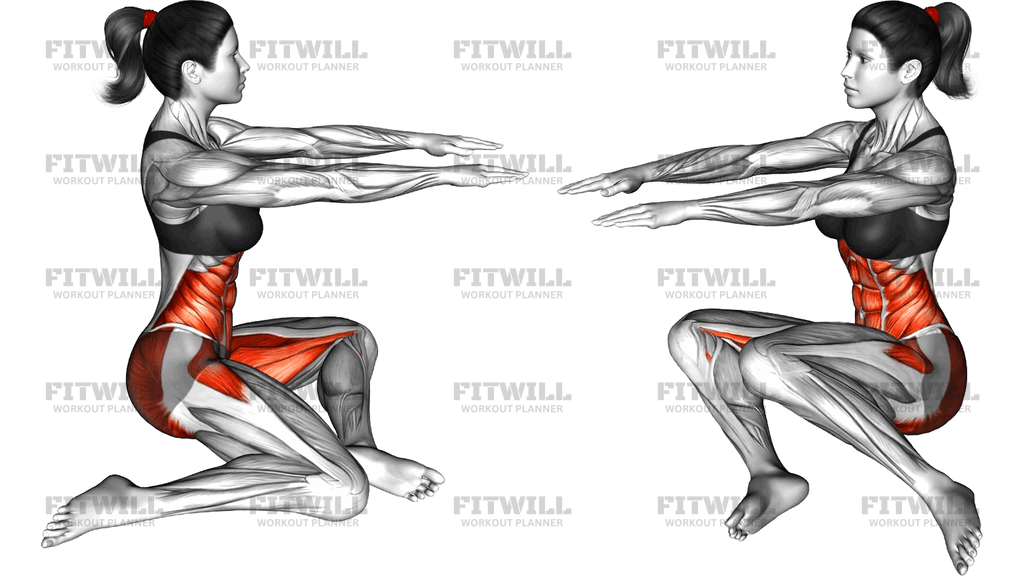
Instructions
- Sit on an exercise mat with your torso upright and your arms extended straight forward at chest height, palms facing down, without resting your hands on the floor.
- Position your right shin on the floor in front of you, bent about 90 degrees and roughly parallel to the front edge of the mat, with your left shin folded out to your left side behind you, also bent about 90 degrees, so both legs form the box shape.
- Distribute your weight evenly across both hips and lengthen your spine so you are sitting tall, not slumped to one side of your pelvis.
- Brace your trunk lightly and keep your chest facing forward as you prepare to move.
- Exhale and begin lifting or sliding both knees toward each other across the midline of your body, letting your weight pass over the center as your legs trade positions.
- Continue the travel until your left shin is now folded in front of you and your right shin is folded behind you, settling into the mirrored 90/90 box position with your torso still upright.
- Pause briefly in the new position with your hips squared and your arms still extended forward, feeling the external rotation in the front hip and the internal rotation in the back hip.
- Reverse the path with the same control, switching back to the original right-leg-in-front position to complete one full repetition.
- Keep your breathing steady throughout: exhale on each switch, inhale as you settle and reset your posture in the new box.
- Flow back and forth for your desired repetitions, and if your hands need to touch down to keep balance at first, use them lightly rather than pushing off the floor.
Tips & Tricks
- If your front knee lifts off the floor during the switch, your shin angle is too aggressive; rotate the front leg slightly inward so the shin sits less parallel to the mat until mobility improves.
- The most common mistake is dumping the chest forward and using your hands to drag yourself across. Keep your fingertips hovering above the floor and treat any hand contact as feedback that you are relying on your arms instead of your hips.
- Move the pelvis with the legs, not against them. If your lower back starts twisting to help the knees across, slow down and let the hips lead the rotation.
- Do not let the back foot go dead behind you. Press the top of the back foot into the mat slightly to keep the back hip actively rotating instead of passively hanging out.
- Expect one side to feel smoother than the other. Give the stiffer side one extra controlled rep or a few extra seconds in its end position rather than matching reps at maximum speed.
- A pinch in the front of the hip or knee is a position warning, not a stretch signal. Shrink the box by reducing both shin angles and rebuild the range gradually.
- Keep your arms extended forward at chest height for the whole set. Letting them drift down or widen usually means your trunk is leaning and the hips are dodging work.
- Imagine drawing a shallow arc with your knees across the floor rather than lifting them high into the air. The switch is a glide, not a hop.
- Practicing a static 90/90 hold with slow breathing before adding switches makes the transition far cleaner if the position is new to you.
Frequently Asked Questions
What muscles and joints does the Shin Box Switch work?
It primarily targets hip rotation, training external rotation in the front leg and internal rotation in the back leg, with the glutes and deep hip rotators doing most of the work. Your core and obliques stay active to keep the trunk upright since your hands are not available for support.
Is the Shin Box Switch suitable for beginners?
Yes, as long as you adjust the shin angles to what your hips allow. Beginners can start with a narrower, less squared box and lightly touch the floor with the fingertips for balance, then progress toward full 90-degree shins with hands hovering.
Why should my arms stay extended forward instead of resting on the floor?
Keeping the arms forward forces the hips and trunk to control the transition instead of letting the arms drag you across. Even light hand contact can hide limitations in hip rotation and remove the core challenge.
How does the Shin Box Switch differ from a regular 90/90 stretch?
A 90/90 stretch holds a static position on one side, while the Shin Box Switch dynamically moves between both sides. This trains the hips to actively change rotation direction, which makes it a better warm-up and mobility drill rather than only a flexibility hold.
My front knee hurts when I fold it in front of me. What should I change?
Pinching or pain at the knee usually means the shin angle is too aggressive for your current hip rotation. Rotate the front leg slightly inward, sit on a small cushion to tilt the pelvis, and build the range gradually; the discomfort should come from the hip, never the knee joint itself.
Can I use the Shin Box Switch before squats or lower body training?
Yes, it works well as a hip primer in a warm-up because it opens both internal and external rotation in a few minutes. Two to three sets of five to eight controlled switches is usually plenty before a lifting session.
How many reps should I do per side?
A practical dose is 5 to 10 full switches per set, where one rep is a switch to each side. Because one direction is often stiffer, adding a short pause on the harder side helps balance the range without needing extra reps.
What can I substitute if sitting on the floor is uncomfortable?
Elevate your hips on a yoga block, cushion, or folded mat to tilt the pelvis and reduce strain, or work on a softer surface. If floor sitting is not possible at all, standing hip circles and controlled 90/90 holds against a wall are reasonable alternatives.
Why is one side of the Shin Box Switch much harder than the other?
Side-to-side differences in hip rotation are extremely common, often from habitual sitting posture, sport history, or previous injuries. Work both sides but give the restricted side extra time and control, and if a side is painful rather than just tight, get it assessed before pushing the range.