Resistance Band Side Plank Clamshell
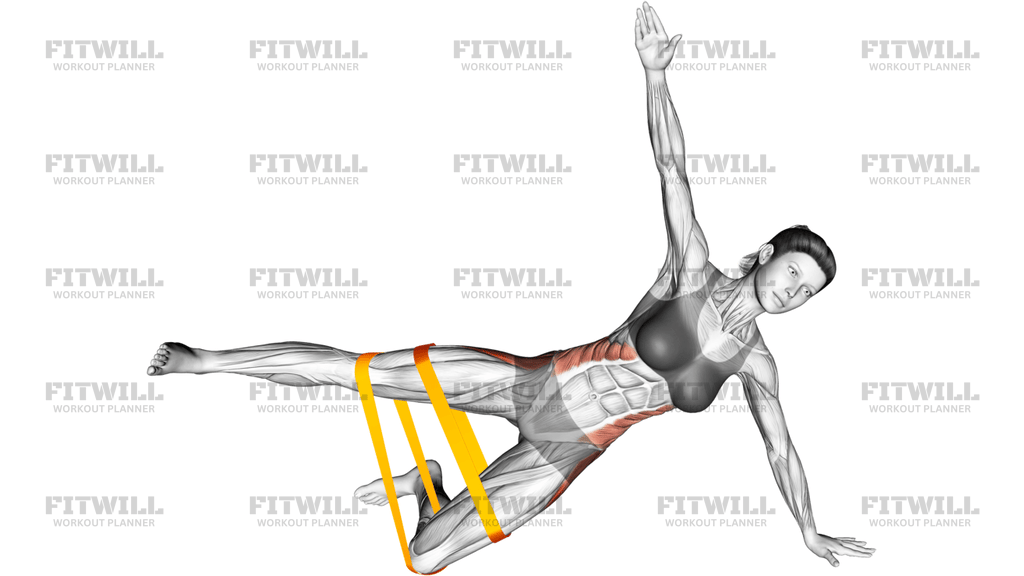
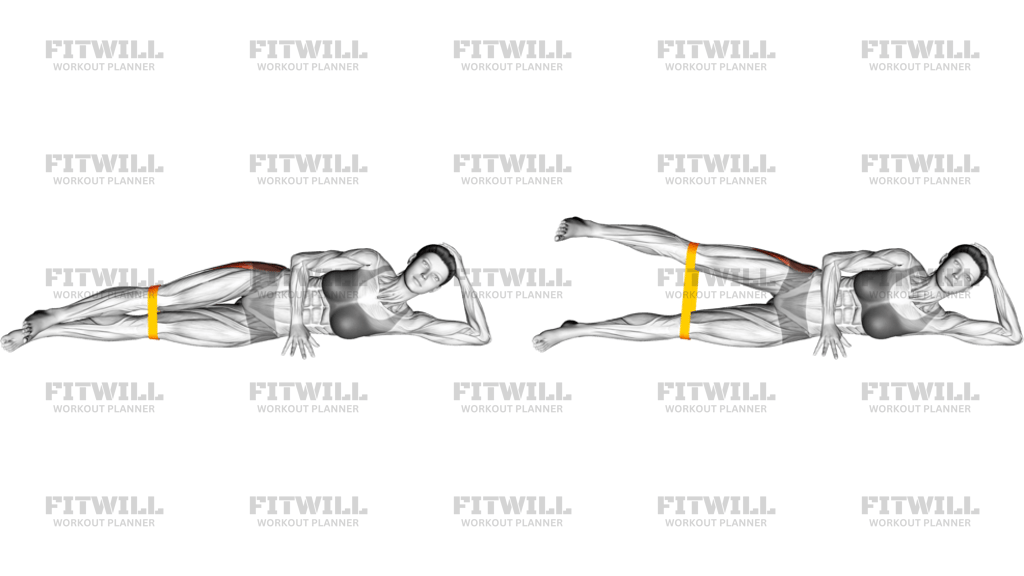
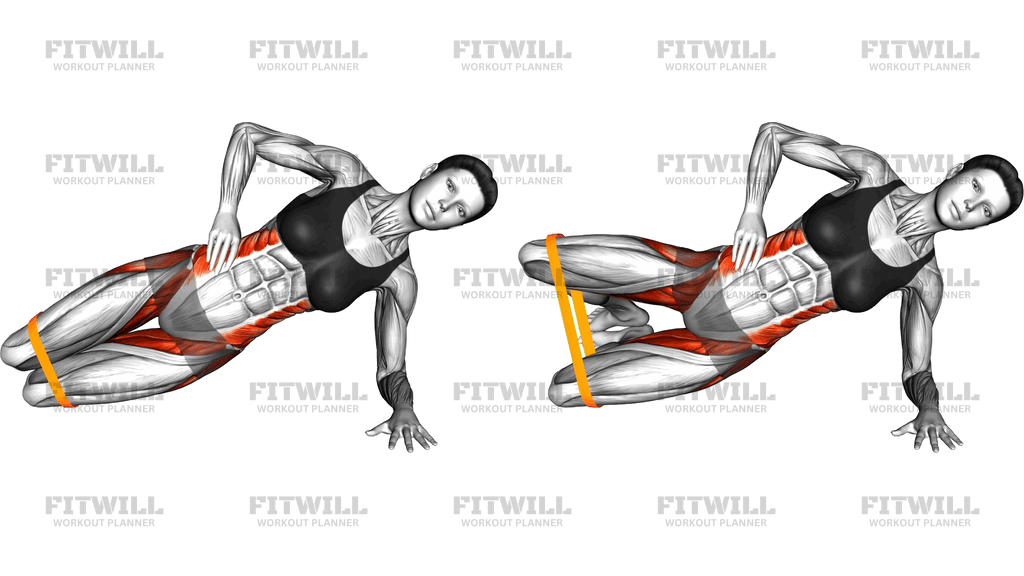
The Resistance Band Side Plank Clamshell combines two proven exercises into one: the side plank holds your trunk steady while the clamshell drives your top knee open against the pull of a loop band placed just above your knees. Because you are balancing on a straight supporting arm with bent knees stacked, your obliques and deep core have to work overtime to keep your hips from sagging while the side of your bottom hip fights the band. It is a compact movement that trains two things people usually train separately.
This exercise is especially useful for anyone building lateral hip strength. Runners, cyclists, and lifters often develop weak gluteus medius muscles, which shows up as knees caving inward during squats, lunges, or running. The clamshell motion isolates that exact muscle, and doing it from a side plank adds a trunk stability demand that makes the whole pattern more transferable. It is also a favorite in rehab and prehab settings because the load is light, the range is short, and the spine stays neutral.
Setup matters more here than in most floor exercises. Your supporting elbow or hand should sit directly under your shoulder, your knees should be bent to roughly 45 degrees with heels in line with your hips, and the band needs to sit snugly above both knees. If your shoulder drifts behind or in front of your hand, or if your hips roll backward as the knee opens, the tension leaks away from the hip and the set loses its value. Lifting the hips into a straight line from head to knees before starting the clamshell keeps the core engaged the entire time.
To execute it well, brace your trunk, lift your hips so your body forms one long line, and then rotate only at the top hip. The top knee opens like a clamshell against the band while your feet stay pressed together. Pause for a beat at the top, feel the burn along the side of your top hip, and lower the knee back down with control. The torso should not roll backward to cheat the knee higher, and the supporting shoulder should stay packed and stable throughout.
You will see this exercise used in warm-ups before lower body training, in glute-focused finishers, and in routines aimed at knee or hip mechanics. It pairs well with banded walks, side-lying leg raises, and side planks without the clamshell. If you want more challenge, use a stiffer band, slow the tempo, or extend the pause at the top of each rep. If you want less challenge, drop the hips to the floor and perform the clamshell from a resting side-lying position until the hip strength builds.
A few practical points keep this safe and effective. Use a mat to protect your supporting hand, forearm, and the side of your knee. If your shoulder or wrist complains before your hip does, shorten the hold or support yourself on your forearm instead of a straight arm. Keep breathing steadily through every rep rather than holding your breath, and switch sides only after completing all reps on the first side so the workload stays balanced.
[ Workout Log & Planner ]
Put your next workout in Fitwill
Keep your plan and training log ready when you are.


Instructions
- Loop a resistance band around both thighs just above your knees and lie on your right side on an exercise mat with your knees bent to about 45 degrees and your feet stacked together.
- Place your right hand flat on the mat directly under your right shoulder, arm straight, and rest your left hand on your top hip or on the mat in front of you for balance.
- Brace your abdominal muscles and lift your hips off the floor until your body forms a straight line from your head through your knees.
- Keep your heels touching and press your feet firmly into each other so the band stays tensioned above your knees.
- Rotate at the top hip and lift your left knee upward against the band, opening your legs like a clamshell while your pelvis stays facing forward and does not roll back.
- Pause for one to two seconds at the top of the movement and squeeze the side of your top hip.
- Slowly lower your knee back to the starting position with control, keeping tension in the band rather than letting your knees fall apart.
- Exhale as you open the knee and inhale as you return it, keeping your hips lifted and your breathing steady the entire set.
- Complete all reps on the right side, then lower your hips to the mat, shake out your shoulder, and repeat on your left side.
Tips & Tricks
- If your hips sag toward the floor mid-set, drop out, rest briefly, and restart with fewer reps rather than holding a compromised side plank.
- A common cheat is rolling the torso backward to lift the knee higher; imagine a cup of water balanced on your top hip and keep it level as the knee opens.
- If the band slips down toward your knee joints, move it back up so it sits across the middle of both thighs where it has leverage and stays put.
- Wrist discomfort from the straight-arm support is common; spread your fingers, press the floor away, and shift some weight into your knees so the hand is not carrying everything.
- Do not let the top foot lift away from the bottom foot, as that turns the rep into a leg raise and takes the work off the gluteus medius.
- Keep the opening range small and controlled; a two-inch lift with tension beats a big swing that lets the band snap the knee back.
- Stack your shoulders and hips vertically at the start so the band pulls across the thighs evenly instead of twisting your pelvis.
- If the combination is too demanding at first, rest your bottom hip on the floor and just do the banded clamshell, then add the hip lift once your side plank is solid.
Frequently Asked Questions
What muscles does the Resistance Band Side Plank Clamshell work?
The main work comes from the gluteus medius on the side of your top hip as it rotates the knee open against the band. Your obliques and deep core stabilize the side plank position, and the supporting shoulder and hip also work isometrically.
Why is the band placed above the knees instead of at the ankles?
Above the knees gives the band the best leverage against the femur, which is exactly where the gluteus medius acts. Placing it lower turns the movement into more of a hip abduction exercise and reduces the rotational clamshell feel.
Is the Resistance Band Side Plank Clamshell good for beginners?
Yes, as long as you scale it. Start with a light band and perform the clamshell from a side-lying position with hips resting on the floor, then add the lifted side plank position once you can hold your hips up for 20 to 30 seconds.
Should I support myself on my hand or my forearm?
The straight-arm version shown here places more demand on the shoulder and core, while a forearm support is easier on the wrist and lets you focus purely on the hip. Choose based on comfort; the clamshell benefit stays the same either way.
How many reps and sets should I do?
Two to three sets of 10 to 15 controlled reps per side works well for most people. Because the hip muscles involved are built for endurance, higher reps with a light band and a short pause at the top are more productive than heavy, fast reps.
My knees keep falling apart on the way back down. What am I doing wrong?
You are likely losing concentration on the return or using a band that is too heavy, so the band yanks the knee closed instead of you controlling it. Slow the lowering phase to two or three seconds and switch to a lighter band if needed.
Can I use this exercise to help with knee stability?
Strengthening the gluteus medius supports better control of the thigh and knee alignment during walking, running, and squatting, which is why this exercise appears in many knee-focused routines. It is a training tool, not a treatment, so see a professional if you have pain.
What can I substitute if I do not have a resistance band?
You can perform a plain Side Plank Clamshell with just body weight, though the resistance will be much lower. Looping a light mini band is the simplest way to get the same stimulus, so a small band set is worth having for this movement.
Should my hips stay lifted the whole time?
Yes, the side plank position is half the exercise. Holding a straight line from head to knees while the knee opens trains the obliques and hip stabilizers together, so lower your hips only when the set is finished or your form breaks down.
How far should I open my top knee?
Open only as far as you can keep your heels together, your pelvis square, and your hips lifted. For most people that is a modest range of 20 to 40 degrees, and the quality of the squeeze at the top matters far more than the distance.