Resistance Band Standing Balance Bent Leg Hip Abd
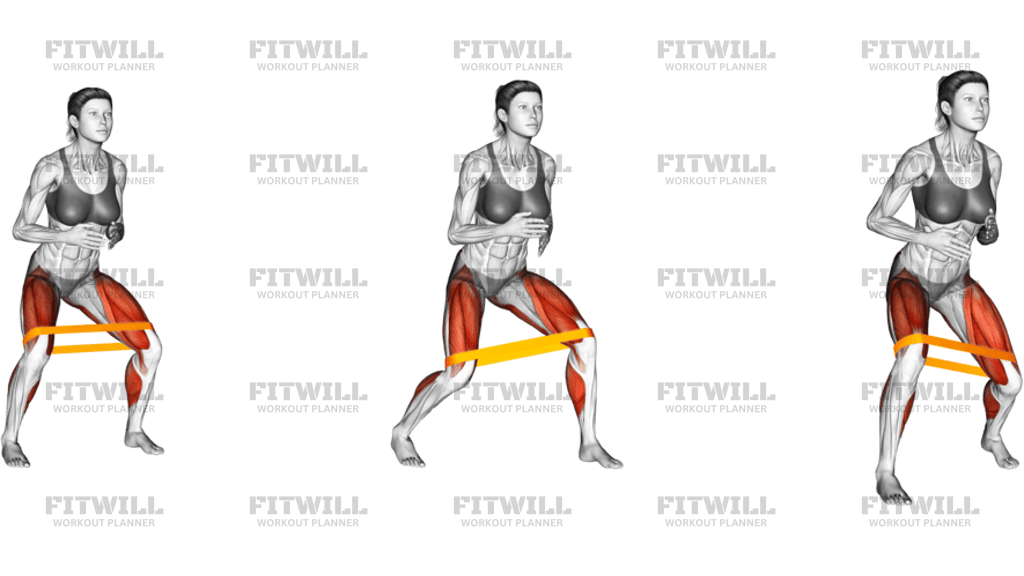
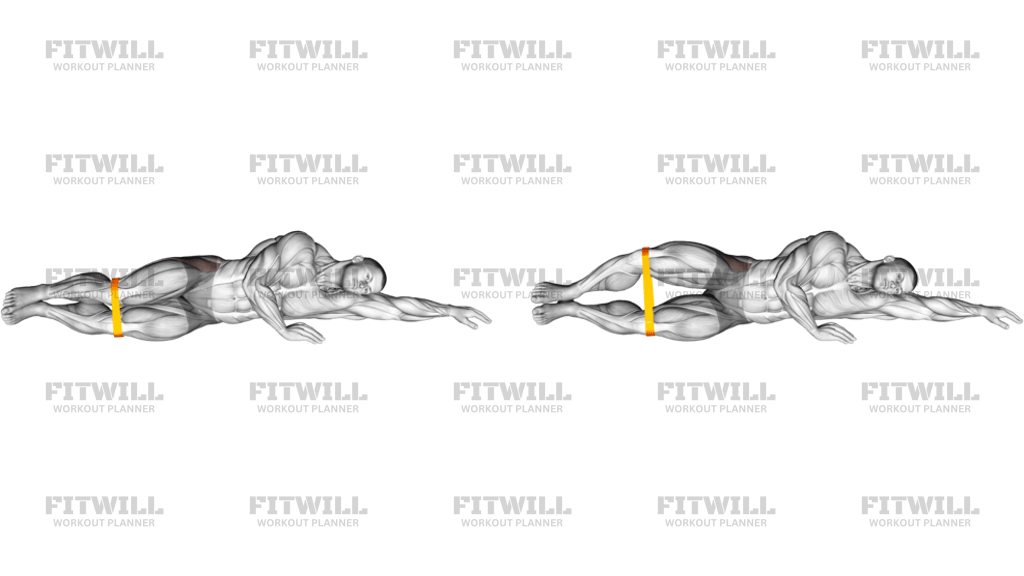
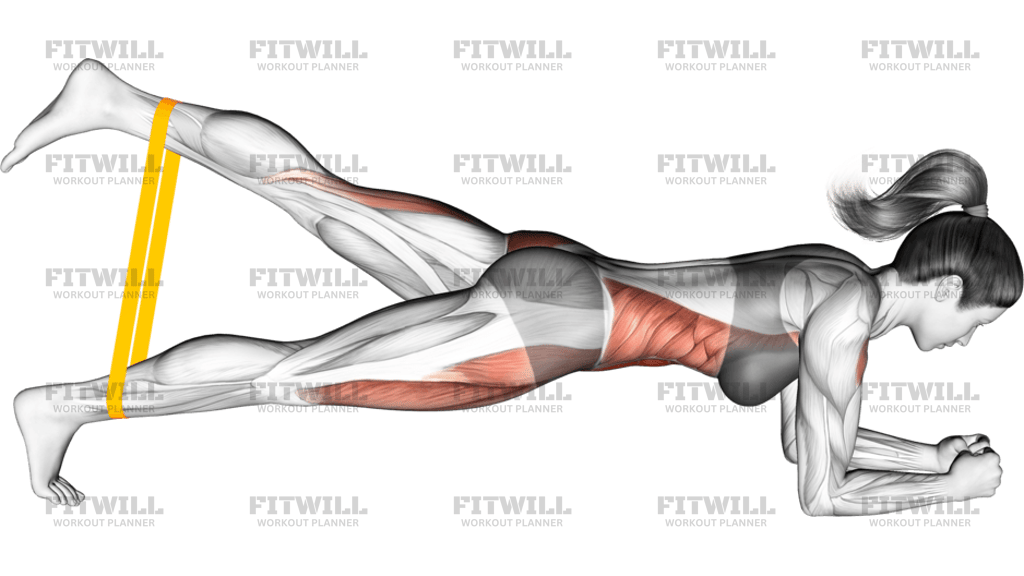
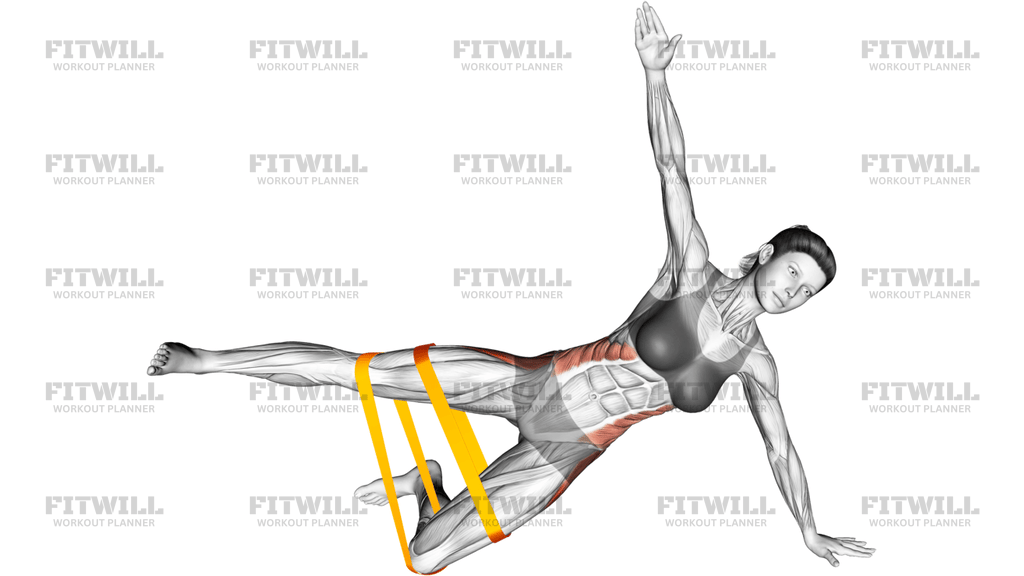
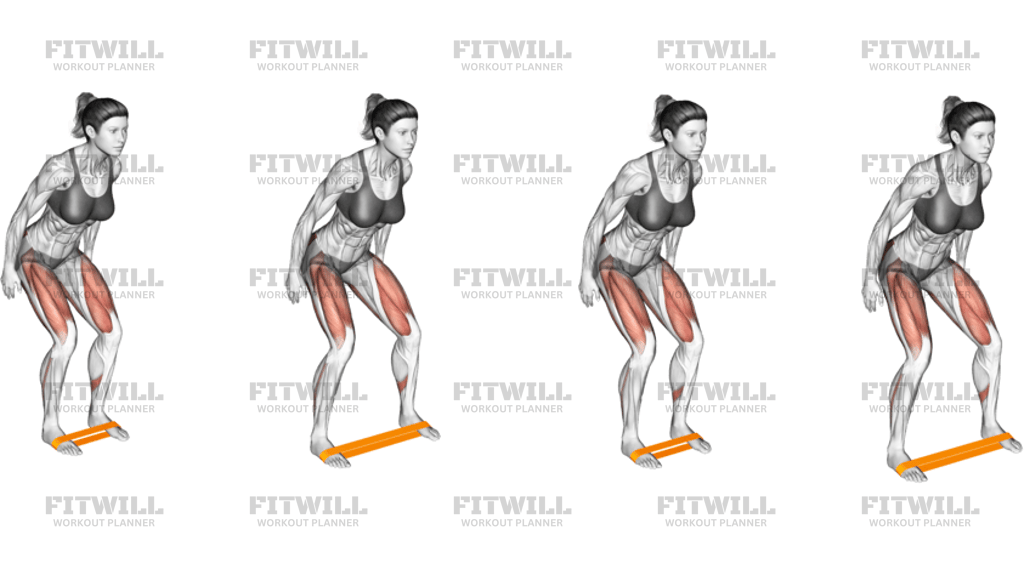
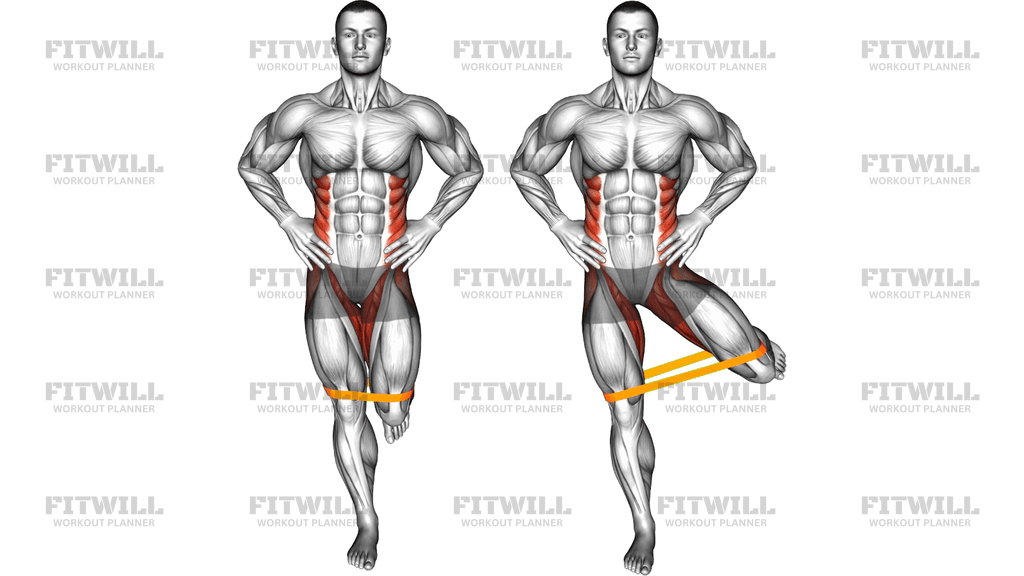
The Resistance Band Standing Balance Bent Leg Hip Abd is a single-leg hip abduction exercise performed with a loop band wrapped around both legs just above the knees. You balance on one standing leg while the other knee stays bent at roughly 90 degrees, then lift that bent leg out to the side against the band's tension before lowering it back in with control. Because the moving leg stays flexed at the knee rather than straight, the hip does the work in a shortened position, which shifts the demand onto the upper glute and outer hip area instead of letting the hamstring and calf assist with a long sweeping leg motion.
This movement trains the gluteus medius and other hip abductors, which are responsible for pulling the leg away from the midline and, just as importantly, keeping your pelvis level every time you stand on one leg. Your standing-side hip stabilizers work hard throughout, and the hands-on-hips position means your trunk cannot lean on anything for help, so the obliques and deep core muscles stay engaged to stop your torso from tipping sideways as the leg lifts.
The bent-knee position is what makes this variation worth doing. With the knee flexed, the leg is shorter and lighter than a straight-leg raise, so you can focus on feeling the abduction at the hip itself rather than swinging the leg upward with momentum. It also closely resembles how the hip actually works during walking, running, and stair climbing, where the swing leg is bent while the stance leg holds you steady.
Setup matters more than most people expect. The band needs to sit snugly above both knees with light tension even at the start, your weight distributed evenly across the standing foot, and your pelvis squared to the front. If the band sits too low near the calves, the leverage changes and the hips rotate; if you start with the feet too far apart, the first rep has almost no resistance and the last one has too much. A stable, hip-width base with even band tension gives you clean reps from start to finish.
This exercise fits well into warm-ups before squats, lunges, or running, into rehab-style programming for weak or underactive hip abductors, and into general lower body sessions for people who want better single-leg control. It is also a practical choice for home training since a single loop band is the only equipment needed and no anchor point is required.
Keep the movement small and honest. A controlled lift of a few inches with a level pelvis does more for the outer hip than a big leg swing where the trunk leans away and the band does the work. If you wobble badly at first, that is a sign the stabilizing demand is exactly what you need, not a reason to rush past it.
[ Workout Log & Planner ]
Put your next workout in Fitwill
Keep your plan and training log ready when you are.


Instructions
- Place a loop resistance band around both legs just above your knees and stand upright with your feet about hip-width apart so the band sits with light tension.
- Shift your weight onto one leg, letting it become the standing leg, and bend your other knee to roughly 90 degrees so that foot hovers just off the floor behind or beside your stance leg.
- Place both hands on your hips, stand tall, and brace your abdominals as if preparing for a light push to the side.
- Keeping the knee bent at the same angle, lift the bent leg out to the side against the band, leading with the knee and the outer hip rather than the foot.
- Stop at the highest point where your pelvis stays square to the front and your torso stays upright, usually a lift of around 30 to 45 degrees.
- Pause for a beat at the top and feel the contraction in the outer hip of the moving leg.
- Lower the bent leg back in slowly, resisting the band's pull until the foot returns near the floor without slamming down.
- Exhale as you lift the leg out and inhale as you lower it back in.
- Complete all reps on one side, then set the foot down, reset your stance and band position, and switch to the other leg.
- Keep your gaze forward and your standing knee soft but not caving inward throughout every rep.
Tips & Tricks
- Watch for the classic cheat: leaning your torso away from the lifting leg to buy extra height. Fix it by keeping both hands firmly on your hips and stopping the lift the moment you feel your ribs start to tilt sideways.
- If your standing knee drifts inward as the other leg lifts, the stance-side glutes are switching off. Think about gently spreading the floor with your standing foot to keep the knee tracking over the toes.
- A band placed too low, near the calves, changes the leverage and invites hip rotation. Keep it just above the knees where the picture of the setup puts it.
- Avoid letting the bent knee creep forward as you lift, which turns the abduction into a hip flexion. Aim the knee directly out to the side, not diagonally toward the front.
- Do not let the moving foot touch down and rest between reps if your goal is continuous tension; hover it a centimeter off the floor and keep the band loaded.
- If balance is the limiting factor rather than hip strength, brush the toe of the moving leg along the floor for the first few sessions instead of holding it fully airborne.
- Choose a band tension you can control for slow reps; a band that is too strong forces torso lean and pelvis rotation before the hip abductors are actually challenged.
- Breathe steadily rather than holding your breath on the lift, since breath-holding makes the balance component noticeably harder.
- Keep reps slower on the way in than the way out; the band pulling the leg back is where most people lose control and let momentum take over.
Frequently Asked Questions
Which muscles does the Resistance Band Standing Balance Bent Leg Hip Abd work?
The main movers are the hip abductors on the outer hip, especially the gluteus medius, with the gluteus maximus assisting. The standing leg's hip stabilizers and the obliques and deep core work continuously to keep your pelvis and torso level.
Why is the knee bent instead of kept straight in this exercise?
Bending the knee shortens the leg, which reduces momentum and shifts the effort onto the hip abduction itself. It also mirrors how the hip works during walking and running, where the swing leg is flexed while the stance leg stabilizes.
Where exactly should the resistance band sit?
Just above both knees, snug enough that there is light tension when your feet are hip-width apart. Placing it near the calves changes the leverage and makes it harder to keep your hips square.
Is the Resistance Band Standing Balance Bent Leg Hip Abd suitable for beginners?
Yes, provided the band tension is light and the lift stays small. Beginners can let the toes of the moving leg brush the floor for balance until standing fully on one leg feels secure.
How many reps and sets should I do?
Two to three sets of 10 to 15 controlled reps per side works well for strength and stability. Since the goal is quality hip movement, stop the set when your pelvis starts tilting or your balance gets sloppy.
What is the most common mistake in this exercise?
Leaning the torso away from the lifting leg and hiking the hip to gain height. This steals work from the gluteus medius and turns it into a side-bending motion, so keep both hands on your hips and lift only as far as your pelvis stays level.
Can I do this exercise without a band?
Yes, the unweighted version is a reasonable starting point and still challenges balance. The band adds outward resistance at exactly the point where the hip abductors are strongest, which is why it is worth adding once the bodyweight version feels easy.
Should I feel this in the front of my hip?
A little hip flexor involvement is normal since the leg is held up, but the main sensation should be on the outer hip of the moving leg. If the front of the hip dominates, lower the leg slightly and focus on leading the lift with the knee out to the side.
When is the best time to use this exercise in a workout?
It works well as an activation drill before squats, lunges, or running, and as a finisher on lower body days. Doing it early also exposes left-right differences in hip strength and balance that are easy to miss with bilateral lifts.
Is it safe if I have knee problems?
The bent-knee, non-weight-bearing position of the moving leg keeps load off the knee joint, and the standing knee stays soft rather than locked. If any position causes sharp pain, reduce the band tension or the lift height and consult a qualified professional before continuing.