Pilates Machine Long Spine
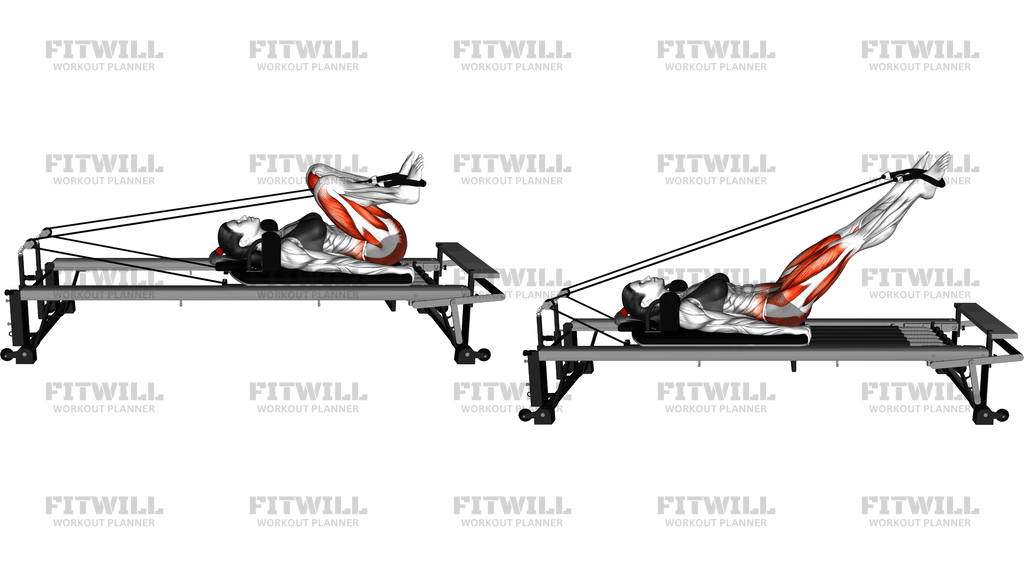
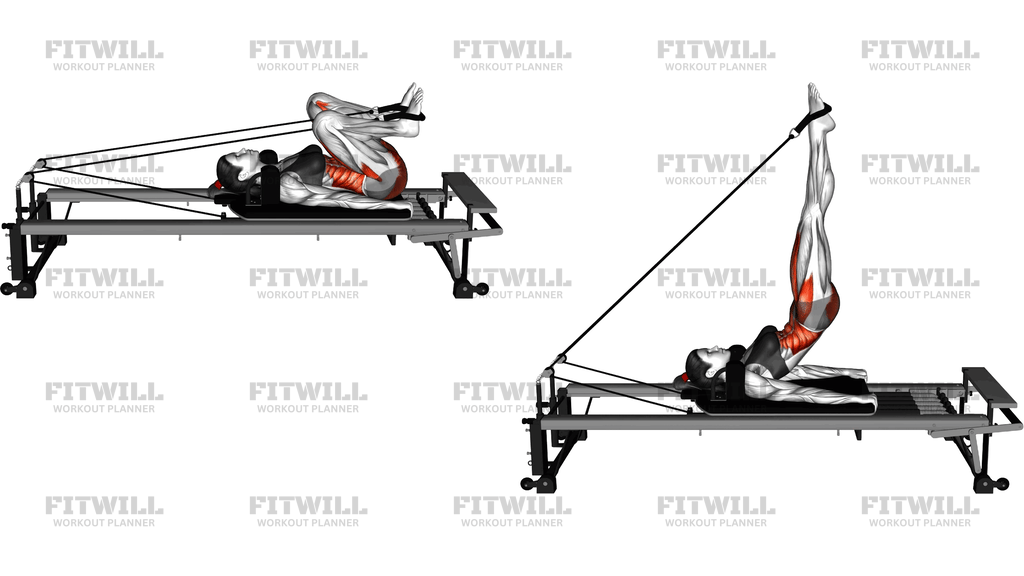
Pilates Machine Long Spine is an advanced reformer exercise performed lying supine on the carriage with the feet secured in the ankle straps attached to the pulley ropes. From a supine position with the knees drawn toward the chest, you extend the legs up and away from the body, then articulate the spine off the carriage one vertebra at a time until the hips are lifted and the legs reach overhead toward the pulleys. The return is just as deliberate: the spine peels back down onto the carriage with the same segment-by-segment control, finishing with the legs either overhead in a controlled hover or drawn back to the start.
This movement earns its advanced reputation honestly. Because the legs are tethered to the springs, the moment your hips lift, the resistance is pulling you toward the head of the machine while gravity pulls your lower body down. Your deep core, lower abdominals, and spinal flexors have to manage that tension through every inch of the roll, and the erector spinae, glutes, and hamstrings work to control the descent. The springs also assist on the way up, which is exactly why pacing matters more here than effort — moving too fast lets momentum do the work your spine is supposed to be doing.
Long Spine is most useful for experienced practitioners who already own a solid Hundred, Roll Over, and Short Spine, since it demands both hamstring flexibility and the ability to articulate the lumbar spine under load. Dancers and gymnasts often take to it naturally, but the real beneficiaries are anyone building control through the posterior chain and looking to refine spinal articulation beyond basic mat work. It appears late in classical reformer sequences for a reason.
Setup is not a formality here — it is the safety system. Your head should rest against the headrest or shoulder pads, and your hands stay flat on the carriage beside your hips the entire time. Those hands are your brakes: if the springs ever feel like they are dragging you, pressing them down gives you immediate control. Spring load is typically light to moderate, since heavier settings make the descent surge forward and harder to manage.
The most common fault is using a hip thrust to heave the pelvis up instead of peeling the spine away gradually. That turns a controlled articulation into a momentum-driven jackknife, which loads the neck and loses the point of the exercise entirely. Keep the reach of the legs moderate — around sixty degrees rather than straight to the ceiling — so the straps maintain tension and you, not the springs, decide when the hips lift.
As with any loaded spinal flexion drill, work within a range your back tolerates comfortably and stop if you feel pinching or strain. It is worth learning this one alongside a qualified instructor before adding it to solo sessions.
[ Workout Log & Planner ]
Put your next workout in Fitwill
Keep your plan and training log ready when you are.


Instructions
- Set a light-to-moderate spring load, raise the headrest, and lie supine on the carriage with your head against the shoulder pads and your hands flat on the carriage beside your hips.
- Place your feet in the ankle straps with the ropes running from the pulleys, then draw your knees in toward your chest so the straps are taut before you begin.
- Inhale to brace, then press the legs away from your body, extending the knees until the legs reach roughly sixty degrees — high enough to stay clear of your torso, low enough to keep the straps pulling.
- Exhale and begin peeling the spine off the carriage, starting at the pelvis and lifting one segment at a time rather than hinging at the hips all at once.
- Continue until your hips are fully lifted and your legs reach overhead toward the pulleys, with your weight supported across the shoulders and upper back, hands pressed into the carriage.
- Pause briefly at the top, keeping the legs long and reaching so the springs stay engaged and the position stays controlled.
- Inhale at the top, then exhale as you roll back down, articulating the spine onto the carriage from the upper back toward the tailbone and resisting the pull of the springs the whole way.
- Once the pelvis is back on the carriage, either keep the legs hovering overhead under control or bend the knees and draw them back to the chest to reset.
- Breathe out on every lifting and lowering effort, and complete 5 to 8 repetitions before dismounting one leg from the straps at a time.
Tips & Tricks
- Keep the leg reach at about sixty degrees instead of vertical — if the straps go slack at the top, the springs stop assisting and the hips can drop back onto the carriage abruptly.
- Do not press the legs past your head with force; the hands on the carriage exist to regulate the springs, so keep them flat and actively pressing, not relaxed at your sides.
- If you feel yourself hinging at the hips instead of articulating the spine, slow the lift down by half and think about initiating from the tailbone curling under.
- A common mistake is letting the carriage slide forward as you descend; resist by pulling the heels slightly back toward the pulleys so the springs stay under your control.
- Tight hamstrings will shorten the roll — if your legs pull your pelvis around before you are ready, bend the knees slightly and work on hamstring flexibility separately before forcing the full version.
- Keep the neck neutral and the jaw soft; if your chin juts or the back of the neck feels loaded, you have rolled too far onto the shoulders.
- Start with fewer springs than feels natural — a heavier load makes the return lurch toward the head of the machine, which is where most loss of control happens.
- Move at a pace where you could stop at any point mid-roll; if you cannot, the movement is being driven by momentum rather than your abdominals.
Frequently Asked Questions
What muscles does Pilates Machine Long Spine work?
The primary work comes from the abdominals, especially the lower fibers of the rectus abdominis and the deep transverse abdominis, which control the spinal roll. The glutes, hamstrings, and erector spinae assist on the lift and work eccentrically on the way down.
Is Pilates Machine Long Spine suitable for beginners?
It is generally considered an advanced exercise because it loads spinal articulation against spring resistance. Beginners should build proficiency with the Hundred, Roll Over, and Short Spine first, ideally under an instructor's eye.
Why do my feet go in straps for Pilates Machine Long Spine?
The ankle straps connect your legs to the pulley ropes, so the springs assist the lift and resist the descent. This lets you focus on segment-by-segment spinal control rather than holding your legs up against gravity.
How high should my legs reach during Pilates Machine Long Spine?
Aim for roughly sixty degrees rather than straight up to the ceiling. If the legs go fully vertical, the straps lose tension and the springs stop assisting, which makes the hips harder to control.
Why does my lower back arch or feel strained in Pilates Machine Long Spine?
That usually means the pelvis is being pulled by tight hamstrings or the descent is being driven by the springs instead of your abdominals. Slow the lowering phase, keep the hands pressing into the carriage, and reduce the spring load if the return surges.
What can I substitute for Pilates Machine Long Spine on the mat?
A controlled Roll Over or a mat jackknife trains a similar spinal flexion pattern, though without the spring assistance and resistance. Expect the mat version to feel harder through the neck and shoulders since nothing supports the legs.
Where should my hands be during Pilates Machine Long Spine?
Flat on the carriage beside your hips for the entire exercise. Pressing down through the hands lets you brake the springs if the roll starts to run away from you.
How many repetitions of Pilates Machine Long Spine should I do?
Five to eight slow, controlled repetitions is typical, since quality of articulation matters far more than volume. Stop the set as soon as you cannot lift or lower without hinging at the hips.
Is it safe to do Pilates Machine Long Spine with a history of back problems?
Loaded spinal flexion is not appropriate for every back, so check with a qualified instructor or healthcare professional before attempting it. If you do proceed, work within a pain-free range and stop immediately if you feel pinching or sharp discomfort.