Pilates Machine Chest Expansion
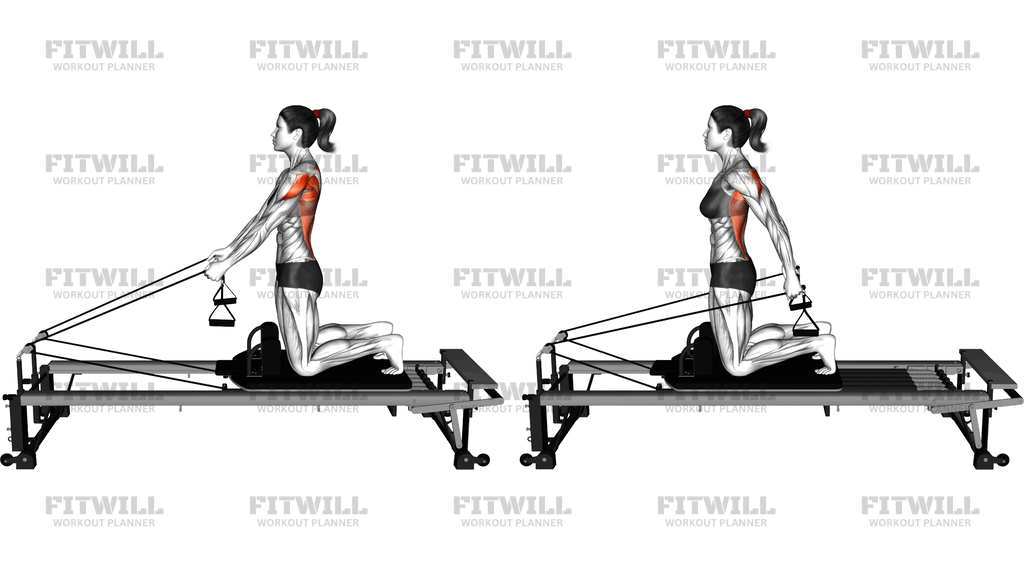
Pilates Machine Chest Expansion is a reformer exercise performed in a tall-kneeling position on the carriage, facing the pulley end of the machine. You hold a strap handle in each hand with your arms extended alongside your body, then press your straight arms back behind your hips while the carriage glides slightly away from the pulleys. The finishing position opens the chest and lifts the sternum, which is where the exercise gets its name, even though the working effort comes mainly from the rear shoulders and upper back rather than the chest itself.
This movement is a staple in classical and contemporary Pilates programming because it trains shoulder extension in a body position that removes almost every opportunity to cheat. Because you kneel with hips stacked over knees, your legs cannot push or absorb the load, so the rear deltoids, lats, and mid-trapezius do the actual work while the deep core and hip stabilizers hold you upright on a moving carriage. The triceps work isometrically to keep the elbows straight under tension.
It is especially useful for people who spend long hours sitting, since the press-back and chest lift directly counteract rounded shoulders and a forward-head posture. It also balances out all the pressing and pushing movements in a general strength program by training the often-neglected shoulder extension and retraction pattern. In Pilates sessions it usually appears in the middle of a reformer sequence, after the body is warm and before more demanding arm work.
Setup determines everything here. Choose a light spring setting, kneel facing the ropes with your shins grounded and your weight even over both knees, and take the handles with just enough tension that the straps are taut before the carriage moves. Your spine should be tall, your head neutral, and your shoulders relaxed away from your ears before you initiate any movement.
To execute well, exhale as you sweep your straight arms back behind the line of your hips, letting the carriage travel a short distance. At the end of the press, lift your chest and draw the shoulder blades gently together without flaring the ribs or tipping the head back. Pause briefly, then inhale as you resist the straps on the way forward, keeping the return just as controlled as the press.
The main safety considerations are simple: keep the spring load modest so the arms do the work instead of momentum, keep the wrists neutral rather than bent back against the strap tension, and place a pad under the knees if they are sensitive. If you feel pinching in the front of the shoulder or strain in the lower back, reduce the range and recheck that your ribs are stacked over your pelvis before continuing.
[ Workout Log & Planner ]
Put your next workout in Fitwill
Keep your plan and training log ready when you are.


Instructions
- Set the reformer to a light spring load and kneel on the carriage facing the pulley end, shins grounded, hips stacked directly over your knees.
- Take one strap handle in each hand with your arms hanging straight down at your sides, adjusting your distance so the straps are taut before the carriage moves.
- Lengthen your spine into a tall kneeling posture, relax your shoulders down away from your ears, and let your head sit neutral with your gaze forward.
- Brace your deep core gently to steady your torso, keeping your ribs stacked over your pelvis.
- Exhale and press both straight arms back behind your hips, letting the carriage glide a short distance toward the pulleys as the straps sweep past your thighs.
- At the end of the press, lift your chest and draw your shoulder blades lightly together so your arms sit slightly behind the line of your torso.
- Hold the open position for a breath without flaring your ribs, shrugging, or tipping your head back.
- Inhale and slowly resist the straps as your arms travel forward along your sides, controlling the carriage back to the starting distance.
- Complete your repetitions with the same press-and-return rhythm, then sit back toward your heels and release the handles to finish.
Tips & Tricks
- Use a lighter spring than feels intuitive — the arms are extending against resistance, not lifting heavy weight, and an overloaded spring pulls you forward off your kneeling alignment.
- The most common fault is shrugging as the arms press back; keep the space between your ears and shoulders long throughout the press.
- When you lift your chest at the end range, lift the sternum rather than pushing the lower ribs forward — rib flare turns the back extension into lower-back strain.
- Keep the wrists in line with the forearms; letting the straps bend your hands back shifts tension into the forearms and wrists instead of the shoulders.
- Do not let the carriage snap you back on the return — the eccentric control forward is where much of the rear-shoulder and upper-back work happens.
- Check that your hips stay stacked over your knees the whole time; sitting back toward your heels turns this into a different, much easier movement.
- If your knees complain on the carriage, fold a towel or pad under them rather than shortening the hold or rushing the reps.
- Grip both handles evenly and keep your weight centered on the carriage; leaning toward one side means one strap is carrying more tension than the other.
- Keep the press just behind your hips — throwing the arms excessively far back usually comes with an arched lower back and a lost chest lift.
Frequently Asked Questions
What muscles does Pilates Machine Chest Expansion work?
The main effort comes from the rear shoulders as they extend the arms behind the body, supported by the lats and mid-trapezius. The triceps hold the elbows straight, and the core and hips stabilize you in the kneeling position on the moving carriage.
Does Pilates Machine Chest Expansion actually train the chest?
Despite the name, the chest muscles are not the prime movers here — the chest opens and stretches while the rear shoulders and upper back do the work. The name refers to the expansive, open-chested finishing position.
Is Pilates Machine Chest Expansion suitable for beginners?
Yes, as long as the spring load is kept light and the range is modest. Newer users should first be comfortable kneeling on a moving carriage and controlling the straps before adding the full chest lift.
Why is Pilates Machine Chest Expansion done in a kneeling position instead of sitting?
Kneeling with hips over knees removes the legs from the movement, so the shoulders and back must generate the press. It also demands more from the core and hip stabilizers to keep the torso tall on a sliding carriage.
How much spring resistance should I use for Pilates Machine Chest Expansion?
Start with one light spring or the lightest available setting. You should be able to press and return slowly without the straps pulling your torso forward or your hips drifting back.
What are the most common mistakes in Pilates Machine Chest Expansion?
Shrugging the shoulders, flaring the ribs when lifting the chest, arching the lower back to press farther, and letting the carriage rebound on the return. All of these are fixed by slowing down and reducing the spring load.
Can I substitute Pilates Machine Chest Expansion if I do not have a reformer?
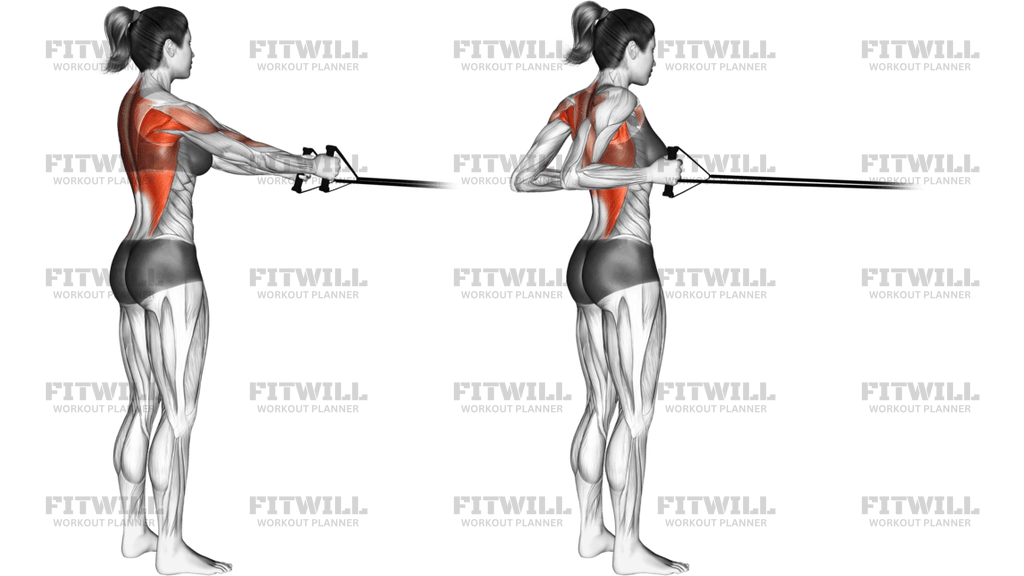
You can approximate it standing or kneeling with a resistance band anchored behind you, pressing straight arms down and back, or with a cable machine set low behind the body using a straight-arm pull-back. The kneeling tall posture is worth recreating because it is part of the challenge.
How should I breathe during Pilates Machine Chest Expansion?
Exhale as you press the arms back and lift the chest, then inhale as you control the return forward. Keeping the breath steady helps you avoid gripping through the neck and shoulders.
Is Pilates Machine Chest Expansion safe for sensitive shoulders?
Generally yes when the range stays pain-free and the load is light, since it trains a controlled extension pattern. If you feel pinching at the front of the shoulder, shorten the press so the hands stay closer to your hips and rebuild from there.