Cable High Pulley Overhead Tricep Extension Sz Ba
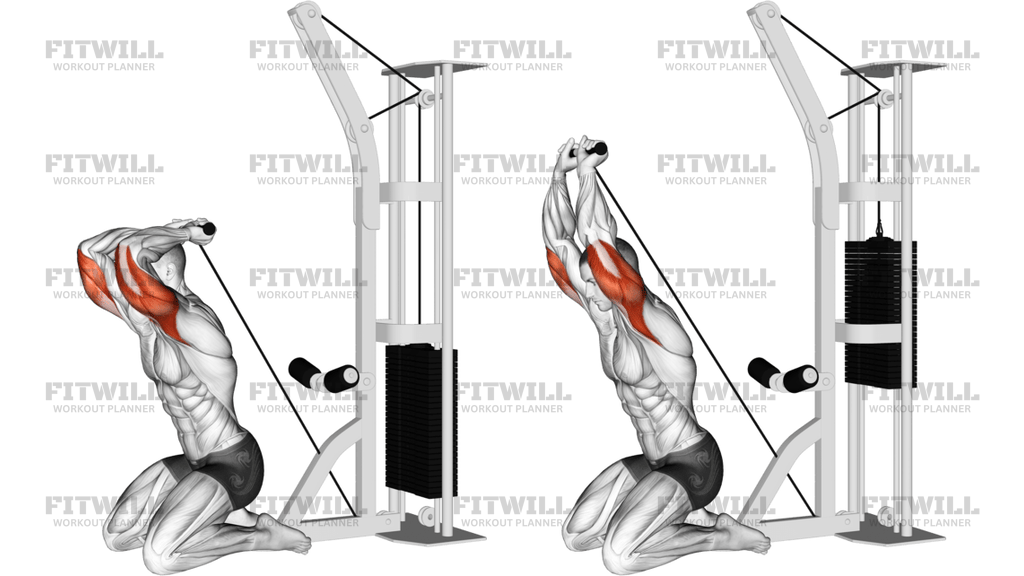
The Cable High Pulley Overhead Tricep Extension is a bent-forward triceps exercise performed standing, facing away from a cable machine with the handle attached to the highest pulley. You lean your torso forward, bring the handle up behind your head with bent elbows, and press it forward and away in a wide arc until your arms extend in line with your torso. Because you are hinged over rather than standing tall, the movement finishes with your arms reaching forward at roughly shoulder height instead of straight overhead, which is what separates it from the classic standing overhead cable extension.
The main muscle at work is the triceps, with particular emphasis on the long head. Overhead and forward-reaching positions place the long head in a stretch that pushdowns and press-style extensions never reach, since those keep the shoulder in a neutral or extended position. Your shoulders and core work isometrically to hold the hinged stance and stabilize the arm path, so you get a small amount of trunk conditioning without it ever becoming the point of the exercise.
The bent-over setup matters because it changes the resistance direction and the joint angle at lockout. With your torso pitched forward and the cable running down from the high pulley behind you, tension stays on the triceps through the entire arc, including the fully extended position where free-weight overhead extensions tend to lose resistance. The cable also pulls you slightly backward and upward, so a staggered stance and a braced trunk are not optional details — they are what keep the exercise feeling smooth instead of pulling you off balance.
This is a good choice for lifters who already handle pushdowns comfortably and want a version that trains the long head through a longer range. It fits well as a second or third triceps movement on an arm or upper-body day, typically for moderate weights in the 10 to 15 rep range. Because the cable provides smooth, even tension, it is also a reasonable step up for intermediates who find dumbbell overhead extensions awkward on the elbows.
Execute it by keeping the elbows high and fixed near your head, moving only at the elbow joint. Common errors include letting the elbows drift forward and down as you press, turning the movement into a partial pushdown, or losing the hinge and standing upright as fatigue sets in. Keep the weight modest enough that you control both directions of the rep — the stretch back behind your head is where the long head does its best work, and yanking through it is where most people get sloppy or aggravate their elbows.
[ Workout Log & Planner ]
Put your next workout in Fitwill
Keep your plan and training log ready when you are.


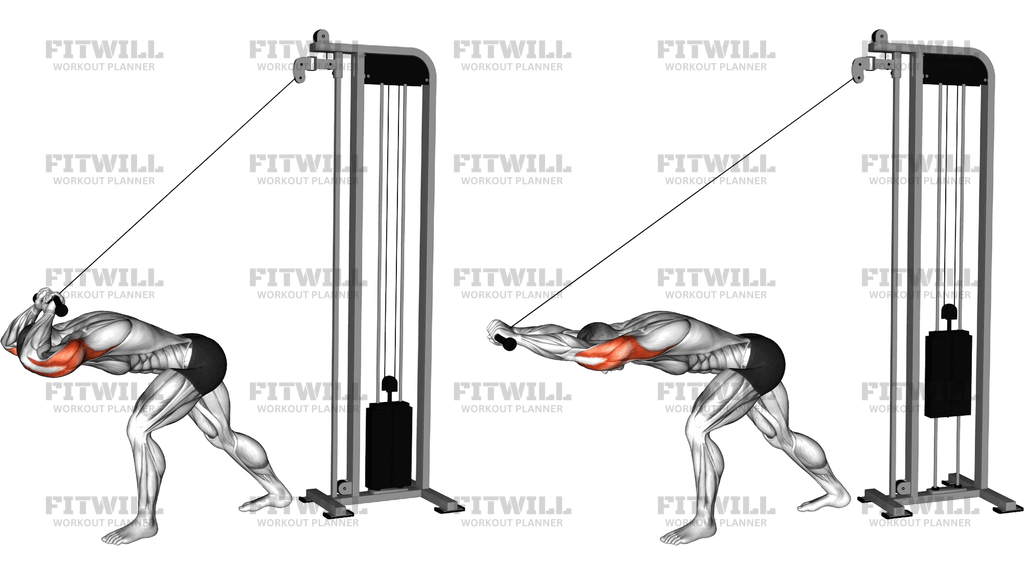
Instructions
- Attach a single handle to the highest pulley of a cable machine and set the weight stack to a light starting load.
- Grab the handle with both hands and step forward, facing away from the machine, into a staggered stance with one foot ahead of the other and a soft bend in both knees.
- Hinge forward at the hips so your torso is angled well above the floor, roughly facing down, and let the handle ride up behind your head with your elbows bent and pointed forward.
- Brace your core and squeeze your glutes slightly to hold the hinge; your back should stay neutral rather than rounded.
- Press the handle forward and away from your head in a smooth arc, extending your elbows fully until your arms reach out in front of you at about shoulder height, in line with your torso.
- Pause briefly at full extension with your elbows locked out and the handle clearly away from your body, keeping tension on the cable.
- Reverse the arc with control, bending only at the elbows and letting the handle travel back behind your head until you feel a solid stretch in the triceps.
- Exhale as you press forward, inhale as you return behind your head.
- Complete all reps, then release the handle carefully and let the weight stack settle before stepping away from the machine.
Tips & Tricks
- If the cable drags you upright mid-set, you are either hinging too shallow or going too heavy — drop the load and deepen the forward lean until your torso position holds for every rep.
- The most common fault is the elbows lowering toward your chest as you press, which shortens the arc and turns this into a weak pushdown; cue yourself to keep the upper arms glued beside your ears and near your head throughout.
- Use a staggered stance, not a square one — the split stance gives you a wider base against the backward pull of the high cable and makes bracing much easier.
- Do not chase depth on the stretch behind your head at the cost of shoulder comfort; shorten the range slightly if your shoulders complain, and work within a pain-free arc.
- Fully straighten the elbows at the front of each rep — the whole point of the cable is that tension does not vanish at lockout, so a soft, hurried lockout wastes the best part of the movement.
- Keep your wrists neutral and grip firm but not crushing; a bent-back wrist under load is a common source of forearm and elbow irritation on this exercise.
- Warm up your shoulders and elbows with a lighter triceps pushdown or band extension first — going straight into a stretched overhead position with cold elbows is asking for trouble.
- If your lower back fatigues before your triceps, press your front foot slightly firmer into the floor and reduce the lean a touch; you want the hinge, not a full bend-over.
Frequently Asked Questions
Which head of the triceps does the Cable High Pulley Overhead Tricep Extension target?
The overhead arm position puts the triceps long head on stretch, so it takes the largest share of the work. The lateral and medial heads assist, and your shoulders and core stabilize the bent-over stance.
Why is my torso bent forward instead of standing upright like a normal overhead extension?
The forward hinge changes the finish angle so your arms extend in line with your torso at about shoulder height, keeping tension constant and matching the cable's pull from the high pulley behind you. Standing upright would shorten the arc and shift stress differently.
Is the Cable High Pulley Overhead Tricep Extension suitable for beginners?
Yes, but start with a light weight and prioritize holding the hinged, staggered-stance position before adding load. Beginners often struggle with balance before their triceps fatigue, so a few sessions of groove work pays off.
What should I do if my elbows hurt during this exercise?
Reduce the weight, avoid bouncing out of the stretched position behind your head, and make sure your wrists stay straight. If discomfort persists, switch to a rope attachment or a shorter-range version and build up gradually.
Can I use a rope instead of a single handle?
Yes, a rope attachment works well and allows your hands to spread slightly at lockout, which some lifters find more comfortable on the wrists. The setup, stance, and path stay the same.
How is this different from a cable tricep pushdown?
A pushdown keeps your arms at your sides with the shoulder in a neutral position, which underloads the long head. This extension moves your arm through a stretched overhead arc, hitting the long head across a much longer range.
How many sets and reps should I use?
Two to four sets of 10 to 15 reps works well as a secondary triceps movement. Because the stretched position is demanding on the elbows, moderate loads with controlled tempo beat heavy, sloppy reps here.
My lower back gets tired before my triceps — what should I change?
Check that you are hinging at the hips with a braced core rather than rounding over, and confirm your staggered stance is stable. If fatigue persists, reduce the load or lean slightly less far forward, since the exact depth of the hinge is adjustable.
What is the biggest form mistake to avoid on this movement?
Letting the elbows drop and drift forward as you press, which collapses the movement into a partial pushdown and loses the long-head stretch. Keep the upper arms fixed near your head and move only at the elbow joint.