Standing Biceps Curl Door Frame
The Standing Biceps Curl Door Frame is a bodyweight biceps exercise that turns an ordinary doorway into your training station. Instead of lifting a dumbbell or barbell, you use your own bodyweight as the load: you stand beside an open door frame, hold the frame with one hand, lean your body back and away until your arm is straight, and then curl yourself back upright by flexing the elbow. Because the resistance comes from your body leaning away from the anchor point, the harder you lean and the more upright you pull yourself, the more demand lands on the biceps.
This movement is a great fit for people training at home with no equipment, travelers who want an arm exercise in a hotel room, or anyone whose grip gives out before their biceps during regular curls. Since the load scales with your bodyweight and lean angle, it also works well as a high-repetition finisher after dumbbell or barbell curl work, or as a way to learn what a true biceps contraction feels like without worrying about balancing a weight.
The primary muscles worked are the biceps brachii on the front of the upper arm, with strong support from the brachialis and the brachioradialis in the forearm. Your forearm flexors and grip work the entire time to keep the hand glued to the frame, and the shoulder and core stabilize your torso as you pivot around the arm. It is essentially a single-joint pulling pattern, so keep the focus on the elbow bending and straightening rather than on hauling yourself with the back or shoulder.
Setup matters more here than in most curls. The height of your hand on the frame, the distance of your feet from the frame, and how far you lean all determine the resistance and the path of the elbow. A lower hand position with a deeper lean makes the movement harder; a higher hand with a slight lean keeps it manageable. Your elbow should stay pinned near your ribs throughout, so the biceps do the work instead of the shoulder drifting forward.
To execute it well, think of the door frame as fixed and your body as the moving part. Curl by driving your elbow down and back while your torso swings up toward the frame, squeezing hard at the top where the elbow is fully bent. On the way down, resist the lean-back rather than falling into it, letting the arm lengthen under control until it is nearly straight. That slow, deliberate return is where most of the muscle-building value lives in a bodyweight curl like this.
A few practical points: use an open door frame that is solidly anchored and will not swing or slide, keep the working arm on the frame side so nothing blocks your path, and stop short of locking the elbow hard at the bottom. If your grip or wrist complains before your biceps do, adjust your hand placement or reduce the lean angle rather than forcing through discomfort.
[ Workout Log & Planner ]
Put your next workout in Fitwill
Keep your plan and training log ready when you are.


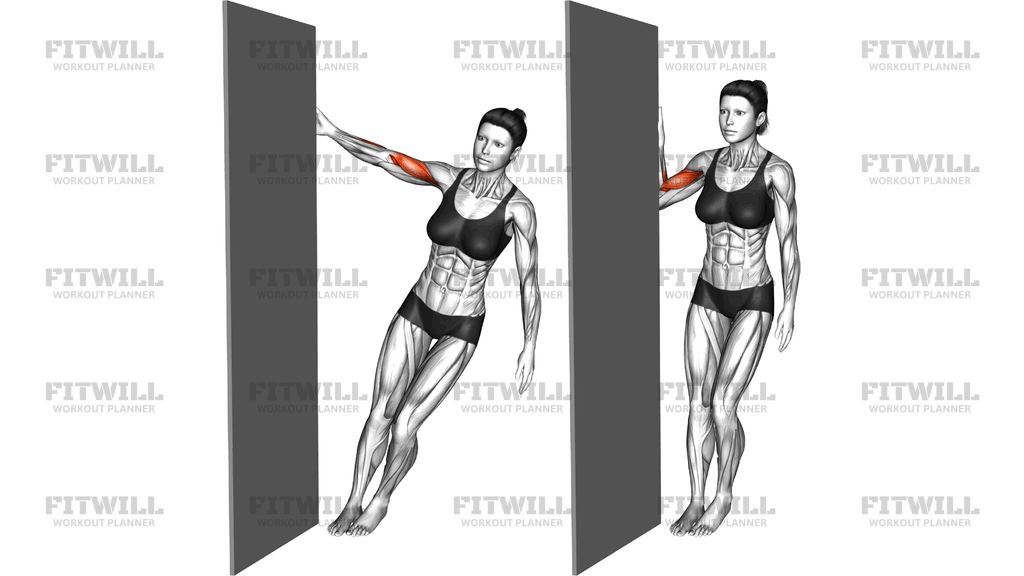
Instructions
- Stand facing the hinge side of an open door frame and place your right hand flat against the frame at roughly hip to waist height, thumb side or palm against the surface.
- Walk your feet back and toward the center of the doorway until your right arm is almost straight and your body leans away from the frame at an angle, weight on both feet.
- Press your palm firmly into the frame and squeeze your grip so the hand will not slip during the pull.
- brace your core and keep your shoulders level so your torso moves as one solid piece.
- Bend your right elbow and pull your body up and toward the frame, keeping the elbow pinned close to your ribs as your torso swings upright.
- Pause at the top with the elbow fully bent and your body close to the frame, squeezing the biceps for a beat.
- Slowly lean back away from the frame, letting the elbow extend under control until the arm is nearly straight and you are back at the starting angle.
- Exhale as you pull yourself up to the frame and inhale as you lower back into the lean.
- Complete all repetitions on the right arm, then switch sides, gripping the frame with the left hand and leaning away to the opposite side.
- Reset your foot position and lean angle between sides so both arms get the same range and resistance.
Tips & Tricks
- If your hand slides on the frame, dry it and the contact surface first, or hook your fingers lightly over the edge of the frame instead of pressing a flat palm.
- Adjust difficulty with foot placement: stepping the feet further from the frame deepens the lean and makes the curl heavier, while standing closer unloads it.
- The most common mistake is letting the elbow drift forward or out to the side, which turns it into a shoulder pull. Keep the upper arm glued to your ribs for every rep.
- Do not drop into the lean on the way down. Catching your bodyweight with the biceps as the arm lengthens is the part most people skip and the part that makes this exercise work.
- Keep your shoulders square to the frame rather than rotating the torso toward the working arm to cheat the bodyweight closer.
- Aim to straighten the arm fully at the bottom but stop just short of a hard elbow lockout, especially if the frame sits low and the lean is deep.
- If the biceps stop working and your lat or back takes over, reduce the lean angle; the pull should feel like it happens at the elbow, not the armpit.
- Warm up the elbows and wrists with a few light dumbbell curls or arm circles first, since bodyweight curls load the joint through a long lever.
- Match the effort between sides by counting reps and checking your lean angle in a mirror rather than guessing.
Frequently Asked Questions
Which muscles does the Standing Biceps Curl Door Frame work?
The biceps brachii is the prime mover, supported by the brachialis and brachioradialis. Your forearms and grip work continuously to hold the frame, and the core stabilizes your torso as you lean and pull.
How do I make the Standing Biceps Curl Door Frame harder or easier?
Move your feet further from the frame and place your hand lower to increase the lean and the load; move closer with a higher hand to make it easier. A slower lowering phase also raises the difficulty without changing your position.
Is this exercise suitable for beginners?
Yes, it is one of the most approachable biceps exercises because the resistance scales instantly with your lean angle. Beginners should start nearly upright with a slight lean and focus on keeping the elbow pinned to the ribs.
Why does my hand keep slipping off the door frame?
Sweaty or dusty surfaces are usually the cause. Dry both your hand and the frame, press the palm firmly rather than resting it lightly, or lightly hook your fingers over the frame edge for extra security.
Can the Standing Biceps Curl Door Frame replace dumbbell curls?
It can train the biceps effectively, but the resistance curve differs because the load comes from your bodyweight and lean angle rather than a fixed weight. It pairs well with dumbbell or band curls rather than fully replacing them if you have access to equipment.
How many sets and reps should I do?
Two to four sets of 8 to 15 controlled reps per arm works well for most people. If you cannot manage 8 clean reps, reduce the lean; if 15 feels easy, deepen the lean or slow the return.
What is the most common form mistake in this movement?
Letting the elbow travel away from the body or swinging the torso to generate momentum. Both shift work from the biceps to the shoulders and back, so keep the upper arm still and let the elbow joint do the bending.
Is it safe to lean my full bodyweight on a door frame?
It is safe when the frame is solid, well anchored, and part of an open door that cannot swing shut. Check that the frame does not flex or creak under a light test pull first, and never use a loose or lightweight door.
Should I keep my arm completely straight at the bottom of each rep?
Extend the arm fully to train the biceps through a long range, but stop just short of forcefully locking the elbow, especially when leaning back at a steep angle. This keeps tension on the muscle and protects the joint.
What can I use if I do not have a suitable door frame?
Any sturdy vertical post works, such as a squat rack upright, a solid railing, or a strong tree branch at the right height. The key requirements are that the anchor cannot move and your hand can press or grip it securely at hip height.