Dumbbell Burpee
Dumbbell Burpee is a fast-paced conditioning exercise that combines a squat, plank, push-up, and return to standing while using the dumbbells as stable hand placements. It is built for total-body effort rather than isolated muscle loading, so the goal is smooth transitions, solid body positions, and a repeatable rhythm from the first rep to the last.
The dumbbells give you a fixed place to put your hands and can make the floor contact feel more natural on the wrists than a flat-palmed burpee. That setup still demands control: the shoulders have to stay stacked over the handles, the trunk has to resist sagging in the plank, and the hips have to drive the body back underneath you on the way up. Most of the training effect comes from the coordination of the whole sequence, not from any single muscle.
The main work is shared across the chest, triceps, shoulders, core, glutes, and legs while the heart rate climbs quickly. If your version includes a push-up, the chest and arms handle the lowering and pressing phase; if you step or jump the feet back and forward, the hips and midsection control the change in direction. Clean reps matter because rushing the transition usually shows up as a rounded back, soft plank, or unstable landing.
Set the dumbbells in a symmetric position, brace before you kick the feet back, and keep the handles planted when you move into and out of plank. The best dumbbell burpees feel crisp and repeatable, not chaotic. They fit well in HIIT circuits, metabolic finishers, and athletic conditioning blocks, especially when you want a compact exercise that combines strength endurance, coordination, and cardio in one movement.
Choose a load that stays stable on the floor and does not force you to fight the equipment. A light pair of dumbbells is usually better than heavy ones, and stepping back instead of jumping is a smart option when you want less impact or more control. If you cannot maintain the same torso position and landing pattern every rep, the set is too hard for the goal.
Fitwill
Log Workouts, Track Progress & Build Strength.
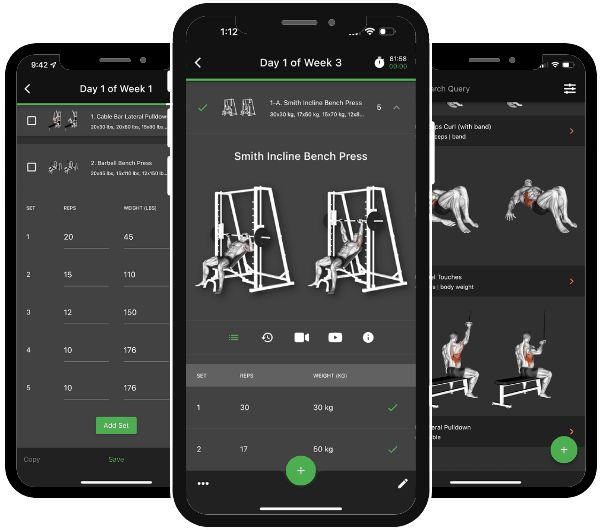
Achieve more with Fitwill: explore over 5000 exercises with images and videos, access built-in and custom workouts, perfect for both gym and home sessions, and see real results.
Start your journey. Download today!


Instructions
- Place a dumbbell in each hand and stand with the handles on the floor just in front of your toes, feet about hip-width apart.
- Set your feet evenly so the dumbbells are parallel and stable, then hinge and squat down until your shoulders are over the handles.
- Grip the dumbbells firmly, brace your midsection, and keep your chest proud instead of collapsing toward the floor.
- Kick or step both feet back into a straight plank, landing with your shoulders stacked over your hands and your hips level.
- If your version includes a push-up, lower your chest under control until it is just above the floor.
- Press back up to plank without letting your lower back sag or your elbows flare hard to the sides.
- Jump or step both feet forward to the outside of the dumbbells so you can load your legs under your torso.
- Drive through your feet to stand tall, keeping the dumbbells under control and returning to the starting stance for the next rep.
Tips & Tricks
- Choose dumbbells that stay flat and do not wobble when you load your hands onto them.
- Keep the handles just outside shoulder width so your plank feels balanced instead of twisted.
- Step the feet back if jumping makes your hips bounce or your landing gets noisy.
- Treat the plank as a hard body line: ribs down, glutes on, and neck long.
- If you add a push-up, lower under control instead of dropping straight through the shoulders.
- Let the feet land quietly outside the dumbbells before you stand so the transition stays organized.
- Breathe out as you push the floor away and stand up from the burpee.
- End the set when your hands start drifting, the dumbbells slide, or the jump-back turns into a collapse.
Frequently Asked Questions
What does a dumbbell burpee train most?
It is a conditioning movement that heavily taxes the legs, chest, shoulders, core, and lungs at the same time.
Do I keep my hands on the dumbbells for the whole rep?
Yes, the dumbbells usually act as your hand supports on the floor, so keep them planted and stable through the plank and push-up.
Should I jump the feet back or step them back?
Either works. Jumping is faster and more intense, while stepping back keeps the rep quieter and easier to control.
How low should I go in the push-up?
Lower until your chest is just above the floor or until your version's range stays strict, then press back to plank without losing body tension.
What are the most common dumbbell burpee mistakes?
Typical errors are letting the dumbbells drift, collapsing the hips in plank, bouncing the chest off the floor, and standing up with a rounded back.
Can beginners use this exercise?
Yes, beginners can start with light dumbbells, step back instead of jumping, and skip the push-up until the transition feels solid.
How heavy should the dumbbells be?
Use light-to-moderate dumbbells that you can place confidently on the floor and move around without losing balance or grip control.
Where does this fit in a workout?
It works well in HIIT circuits, metabolic finishers, or conditioning blocks where you want a short, demanding full-body drill.