Wheel Pose Yoga Pose
Wheel Pose Yoga Pose is a deep bodyweight backbend that lifts the whole front of the body into a supported arch from the floor. The hands and feet stay planted while the spine, shoulders, hips, and thighs work together to create the shape. It is more than a passive stretch: done well, it combines shoulder opening, spinal extension, hip extension, and active support from the arms and legs.
The image shows the classic full wheel position with the palms on the floor beside the head, the feet grounded hip-width apart, the hips elevated, and the chest driven up and back. That position asks a lot from the wrists, shoulders, triceps, glutes, hamstrings, quadriceps, and spinal extensors, while also lengthening the hip flexors, abdominal wall, and chest. The primary purpose is to create a strong, even arch rather than collapsing into the low back.
Setup matters because the quality of the bridge is determined before you leave the floor. The hands need to be close enough to the shoulders to let the arms help push, the feet need to be stable so the knees do not drift outward, and the weight should spread across both palms and both feet. If the hands are too far away or the feet are too far from the hips, the pose usually turns into a wrist strain or a low-back hinge instead of a controlled full-body backbend.
Use steady breathing and a gradual lift. Start from the floor, set the hands and feet, then press the chest up by driving through the palms and heels together. Keep the elbows tracking in, open the sternum, and let the thighs stay active so the arch is supported from the legs as well as the shoulders. The best repetitions look smooth and balanced, with no neck compression and no dumping into the lumbar spine.
This pose fits yoga practice, mobility work, and advanced bodyweight strength training when the goal is to improve overhead shoulder function, backbend tolerance, and full-chain control. It is also useful as a benchmark for how well the shoulders and hips tolerate extension. Regress it if the wrists, shoulders, or lower back feel pinchy, and prioritize a shorter, cleaner bridge over forcing a bigger shape.
Fitwill
Log Workouts, Track Progress & Build Strength.
Achieve more with Fitwill: explore over 9600 exercises with images and videos, access built-in and custom workouts, perfect for both gym and home sessions, and see real results.
Start your journey. Download today!




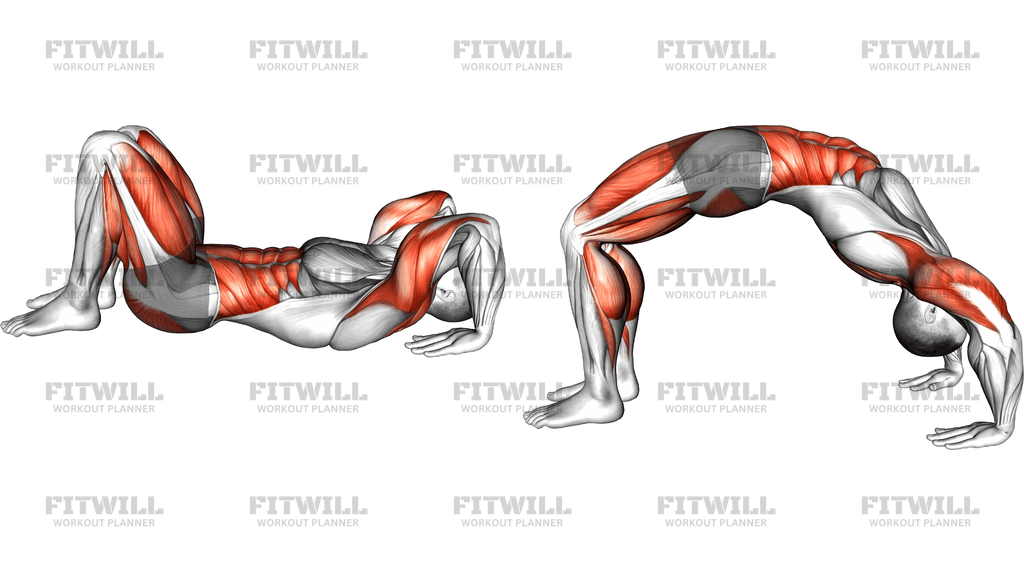
Instructions
- Lie on your back with your knees bent, feet flat on the floor hip-width apart, and your heels close enough to touch your fingertips when your arms are beside your head.
- Place your hands on the floor beside your ears with your fingers pointing toward your shoulders and your elbows bent so the forearms are close to vertical.
- Press the feet down first, then root through the palms to lift the hips and ribs off the floor into a high bridge.
- Keep the knees tracking over the feet and avoid letting them flare wide as you shift more weight into the hands.
- Continue pressing the chest backward and upward while straightening the arms as much as your shoulders and wrists allow.
- Stack the shoulders over or slightly behind the wrists and keep the elbows pointing forward rather than splaying out to the sides.
- Breathe into the sides of the ribs while maintaining active glutes and thighs so the arch stays supported instead of collapsing into the low back.
- Hold the top position for the planned time or reps, then lower by bending the elbows and bringing the upper back, middle back, and hips down under control.
Tips & Tricks
- If your feet are too far from your hips, the pose usually turns into a low-back hinge; walk them slightly closer before you lift.
- Keep pressure through the base of the index finger and thumb so the wrists do not dump inward when you press up.
- A small outward turn of the hands can help if your shoulders are stiff, but do not let the elbows flare wide.
- Think about pushing the floor away to create length through the shoulders instead of just throwing the hips higher.
- Keep the knees parallel or only slightly separated; if they drift open, the glutes and adductors stop supporting the arch well.
- Squeeze the glutes enough to protect the lower back, but do not clamp so hard that the rib cage pops forward uncontrollably.
- If the crown of your head touches the floor during the transition, keep it light and do not load the neck.
- Lower out of the pose the same way you entered it: slowly and with control, not by collapsing onto the mat.
Frequently Asked Questions
What does Wheel Pose work the most?
It strongly challenges the shoulders, triceps, spinal extensors, glutes, and hamstrings while opening the chest, hip flexors, and abdominal wall.
Is Wheel Pose beginner-friendly?
Not usually as a full pose. Most beginners do better with bridge pose, a hands-elevated version, or a wall-supported backbend before trying the full floor version.
Where should my hands and feet be in Wheel Pose?
Place the palms beside the ears with fingers pointing toward the shoulders, and set the feet hip-width apart close enough to help you press into a high bridge.
Why do my elbows flare out when I press up?
The hands are often too wide or the shoulders are tight. Narrow the setup slightly and keep the elbows pointed forward as you lift.
Should I feel Wheel Pose in my low back?
You should feel extension through the whole front of the body, but sharp low-back pinching means the pose is turning into a lumbar hinge instead of an even backbend.
What should I do if my wrists hurt in this pose?
Reduce the range, place the hands a little closer or slightly wider to find a better angle, and stop if the wrist pain feels sharp or persistent.
How do I make Wheel Pose safer for my neck?
Keep the head lightly out of the way during the lift, avoid dumping weight into the crown, and come down slowly instead of dropping the upper back onto the floor.
What is a good regression for this exercise?
Bridge pose is the easiest regression, followed by a higher bridge or wall-assisted backbend that lets you keep the chest open without forcing a full wheel.