Barbell Split Jump
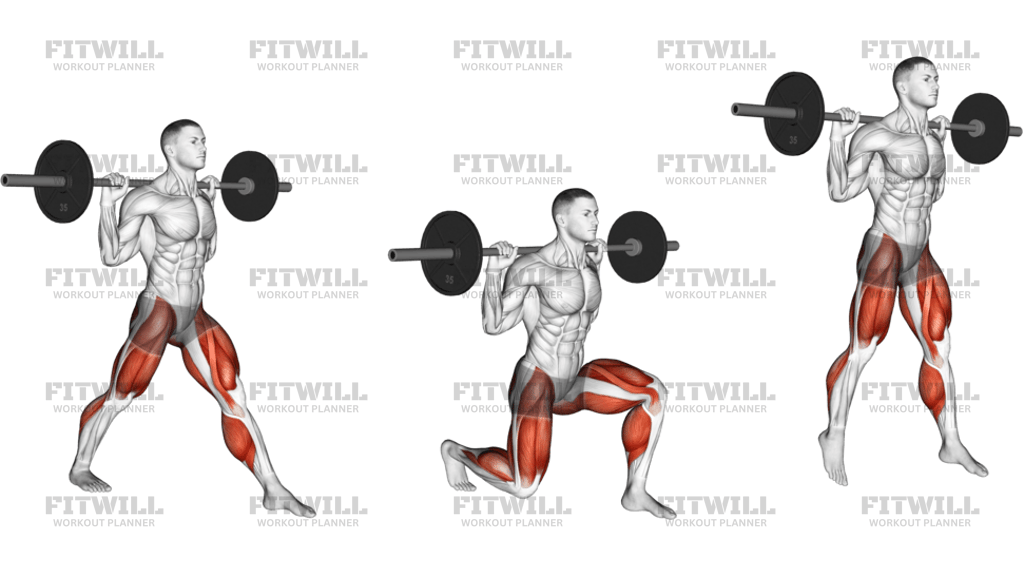
Barbell Split Jump is a loaded plyometric drill for developing lower-body power, reactive control, and single-leg coordination. The barbell sits across the upper back while you work from a split stance and explode off the floor to switch legs in the air. Because the bar adds balance and landing demand, this is a much more advanced jump than a bodyweight split jump and it should be treated as a power exercise, not a grind-for-reps strength move.
The main training effect comes from the legs and hips producing force quickly while the trunk keeps the bar steady. Quads, glutes, calves, adductors, and the deep core all contribute to the jump and landing. The goal is not to rise as high as possible or to chase fatigue. The goal is to stay organized through the torso, keep the bar path quiet, and land in a stable opposite split stance with enough control to repeat the next rep.
Setup matters because the start position determines the quality of every landing. The front foot should be flat and far enough forward that the front knee can track over the middle toes without collapsing inward, while the back heel stays lifted with the rear knee dropping under the hip. The chest stays tall, the ribs stay stacked, and the bar rests securely on the upper traps so the jump comes from the legs rather than from swinging the torso or yanking the bar.
On each rep, sink into the split stance, brace before you drive, and push through the floor with both legs to leave the ground. Switch the legs in the air, then land softly into the opposite split stance with the knees bent and the feet set in the same lane they started in. The landing should be quiet, balanced, and immediate enough that you can own the position before the next jump.
Use Barbell Split Jump when you want a demanding athletic accessory for power, conditioning, or sport preparation and you already have solid split-squat and jump-landing mechanics. Light loading is usually enough. If the bar starts wobbling, the torso leans, or the landings get loud and unstable, the set is too heavy or too fast for the current level.
Fitwill
Log Workouts, Track Progress & Build Strength.
Achieve more with Fitwill: explore over 9600 exercises with images and videos, access built-in and custom workouts, perfect for both gym and home sessions, and see real results.
Start your journey. Download today!




Instructions
- Set a barbell across your upper traps and step into a split stance with one foot forward, the other back on the ball of the foot.
- Keep your front foot flat, your back heel lifted, and your torso tall with the ribs stacked over the pelvis.
- Lower into a shallow split squat until both knees are bent and the front knee tracks over the middle toes.
- Brace your core, then drive hard through both legs to jump straight up from the split stance.
- Switch your legs in the air so you land with the opposite foot forward and the other foot back.
- Absorb the landing softly through the hips, knees, and ankles without letting the bar bounce on your shoulders.
- Reset your balance in the new split stance before starting the next rep.
- Inhale on the way down and exhale as you explode off the floor.
- Stop the set if the bar shifts, the torso tips forward, or the landing gets noisy and unstable.
Tips & Tricks
- Treat this as a power drill: a light barbell is usually enough, and heavy loading quickly turns the jump into a sloppy lunge.
- Place the bar high and secure on the traps so it does not roll when you leave the floor or land.
- Keep the front knee tracking in line with the toes; if it caves inward, shorten the stance or reduce the load.
- Jump just high enough to switch feet cleanly. Extra height usually means extra impact and less control.
- Land in the same lane you took off from instead of letting the feet cross or widen out.
- Keep your torso stacked over the hips rather than folding forward to chase more distance.
- Make the landing quiet. Loud foot contact usually means you are dropping too hard or bracing too late.
- Use a controlled dip before each jump; do not bounce repeatedly at the bottom of the split stance.
- If balance is limiting the rep, practice bodyweight split jumps first before adding the barbell.
Frequently Asked Questions
What muscles work hardest in Barbell Split Jump?
The quads, glutes, calves, and adductors drive the jump, while the core and upper back stabilize the bar.
Is the barbell supposed to stay on my back or in my hands?
It should rest across the upper traps on your back, like a back squat, so the legs can produce the jump without the arms doing the work.
How deep should I lower before jumping?
Only lower as far as you can keep the torso tall and the front knee aligned. This is a short, athletic dip, not a full lunge.
What is the biggest mistake with this exercise?
Using too much weight and turning the movement into a noisy, forward-leaning hop instead of a clean split jump.
Can beginners do Barbell Split Jump?
Most beginners should start with bodyweight split jumps or split squats first. The barbell version is better once landing and balance are solid.
How do I know if the load is too heavy?
If the bar shifts on your shoulders, the landing gets loud, or you cannot switch legs cleanly in the air, the load is too high.
Where should I feel the landing?
You should feel the force absorbed through the front foot, back toes, hips, and calves, not in the lower back or neck.
What can I use instead if I want a safer variation?
A bodyweight split jump, dumbbell split jump, or reverse lunge jump will give a similar pattern with less barbell demand.