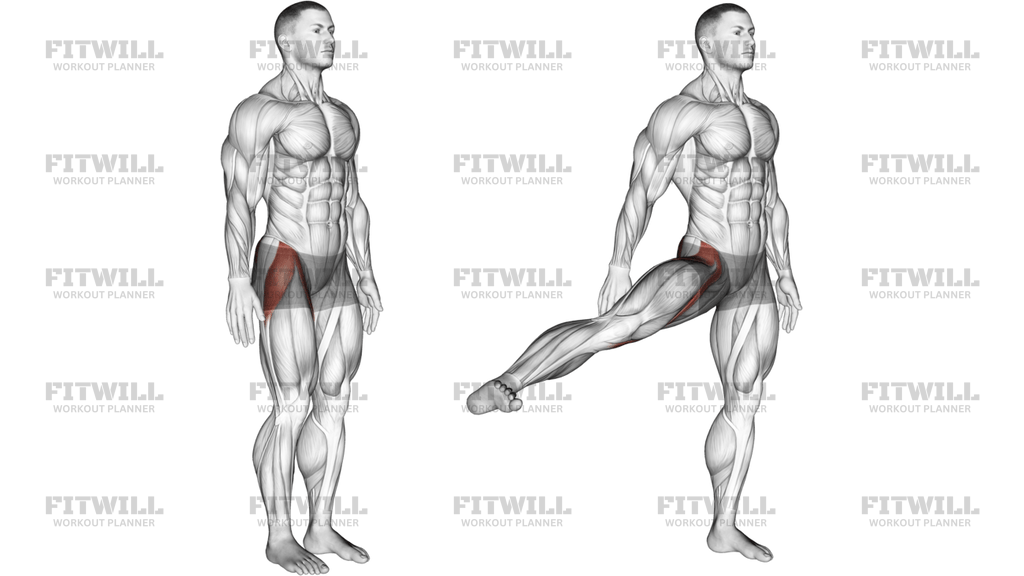
Standing Lateral Side Stretch
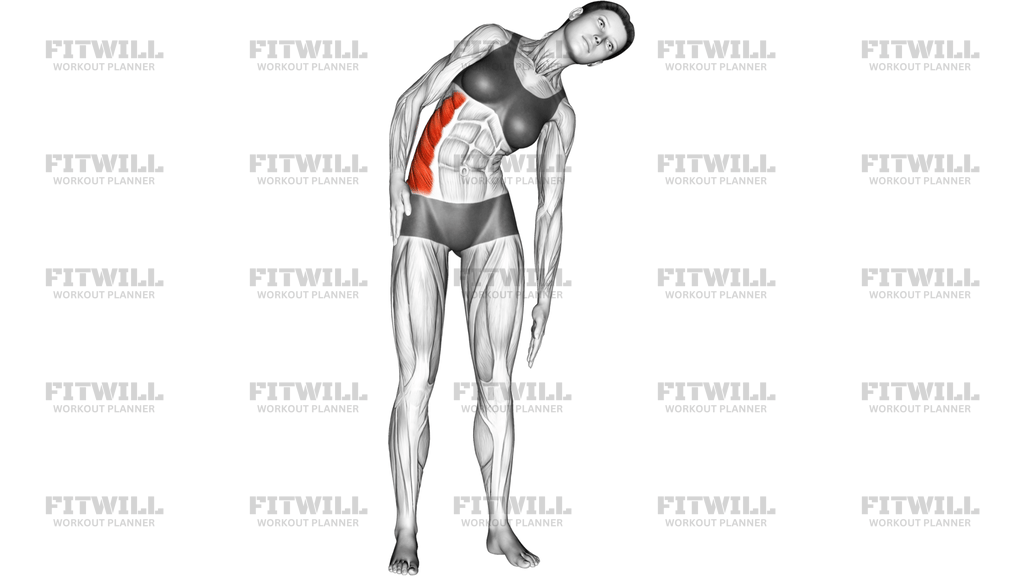
Standing Lateral Side Stretch is a standing side-bending mobility drill that lengthens the muscles along the side of the torso while you keep the pelvis steady and the spine long. In the image, the body is stacked upright through the legs and then gently arced to one side, which makes this a useful way to open the obliques, intercostals, quadratus lumborum, and lat area without turning it into a twist.
Because the stretch is driven by body position rather than load, the quality of the setup matters more than the depth of the bend. A good rep starts with the feet planted, ribs down, and the neck relaxed so the side body can lengthen instead of the low back collapsing. The goal is a smooth line from the standing leg through the lifted side, not a dramatic lean that shifts the hips or jams the shoulder.
This exercise is commonly used in warm-ups, cooldowns, and recovery sessions when you want to restore lateral trunk motion or reduce the feeling of tightness through the waist and ribcage. It can also help lifters who spend a lot of time braced in forward-flexed positions by giving the trunk a gentle side-line stretch and a chance to breathe into the lengthened side.
Execution should feel controlled and even. Reach overhead, or slide the hand down the outside of the thigh as you bend, and keep the chest open while the torso arcs to the side. The stretch should build gradually along the ribcage and waist, then ease off just as gradually on the way back to standing. If the movement turns into a hip shift, a backward lean, or a sharp pull in the low back, the range is too aggressive.
Use Standing Lateral Side Stretch whenever you need a simple standing mobility option that does not require equipment or floor work. It works well between heavier training sets, after rowing or pressing volume, or as part of a daily mobility routine. Focus on calm breathing, a tall spine, and a pain-free range so the side body opens without losing balance or spinal control.
Fitwill
Log Workouts, Track Progress & Build Strength.
Achieve more with Fitwill: explore over 9600 exercises with images and videos, access built-in and custom workouts, perfect for both gym and home sessions, and see real results.
Start your journey. Download today!




Instructions
- Stand tall with your feet about hip-width apart and your weight evenly spread through both legs.
- Keep the pelvis level, soften the knees, and let one arm reach overhead or slide down the outside of the thigh.
- Brace lightly through the abdomen so the ribs stay stacked over the hips before you move.
- Exhale and bend the torso to one side, letting the opposite side of the waist and ribcage lengthen.
- Keep the chest facing forward and avoid rotating the shoulders as you arc sideways.
- Pause in the end range for a smooth breath while keeping the stretch comfortable, not sharp.
- Return to standing slowly by bringing the ribs back over the pelvis rather than snapping upright.
- Repeat on the other side and match the range so both sides are stretched evenly.
Tips & Tricks
- Think of lengthening the side waist first and bending second.
- Keep both feet rooted so the hips do not drift sideways as you reach.
- A small bend is usually enough; forcing a bigger arc often turns the movement into a low-back pinch.
- Let the shoulder on the stretched side stay relaxed instead of shrugging toward the ear.
- If you want a stronger stretch, increase the reach overhead before you increase the bend.
- Keep the chest pointed forward so the exercise stays a true side bend and not a twist.
- Breathe into the expanded side ribs to make the stretch feel smoother and less guarded.
- Come out of the position slowly to avoid yanking the trunk back to center.
Frequently Asked Questions
What does Standing Lateral Side Stretch target most?
It primarily stretches the side body, especially the obliques, intercostals, quadratus lumborum, and the lat area on the lengthened side.
Is this more of a stretch or a strengthening exercise?
It is mainly a mobility and recovery stretch. The work comes from controlled positioning and breathing, not from loading the movement.
Should my hips move when I bend to the side?
No. Keep the pelvis level and let the ribcage travel sideways over a stable base instead of shifting the hips out of line.
Do I need to reach overhead with the arm?
An overhead reach usually helps create more length through the side body, but a hand sliding down the thigh can work well if that feels more stable.
Can beginners do Standing Lateral Side Stretch?
Yes. Beginners should use a small range, keep the movement slow, and stop before the low back starts to feel compressed.
What is the most common form mistake?
People usually twist the torso or lean backward instead of moving straight into a clean side bend.
When is this exercise most useful?
It fits well in warm-ups, cooldowns, between heavy sets, or after training that leaves the ribcage and waist feeling tight.
Should I feel a strong pull in my lower back?
You should feel a lengthening stretch along the side waist and ribs, not a sharp pull or pinch in the low back.