Resistance Band Glute Bridge
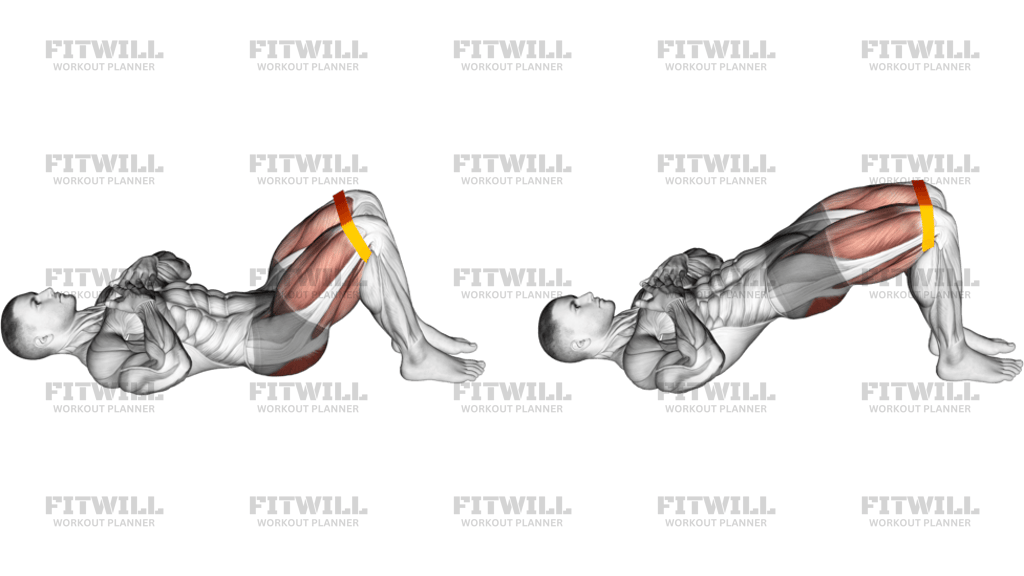
Resistance Band Glute Bridge is a floor-based hip extension exercise that uses a band above the knees to train the glutes through a short but demanding range of motion. The band adds outward pressure so the hips have to extend while the thighs stay aligned, which makes the movement useful for glute activation, posterior-chain work, and warm-up sets before heavier lower-body training.
The setup matters because the bridge only works well when the feet, knees, and pelvis are organized before the first rep. Lie on your back with the knees bent, feet flat, and the band looped just above the knees. Keep the heels close enough that the shins can stay near vertical at the top. If the feet are too far away, the hamstrings take over and the lower back is more likely to arch.
As you bridge, press the knees gently out into the band, brace the ribs down, and lift the hips by driving through the heels. The goal is a straight line from shoulders to knees without overextending the spine. A brief squeeze at the top should come from the glutes, not from arching the low back. Lower under control until the hips are close to the floor, then repeat with the same tension and tempo.
This exercise fits well in activation blocks, accessory work, rehab-style sessions, or any program that needs glute-focused volume without loading the spine heavily. It is also a practical choice when you want a simple home-friendly movement that teaches pelvic control and knee tracking. Keep the range pain-free, keep the band tension even, and stop the set when the hips stop rising smoothly or the knees collapse inward.
[ Workout Log & Planner ]
Put your next workout in Fitwill
Keep your plan and training log ready when you are.


Instructions
- Lie on your back with the resistance band looped just above the knees, bend your knees, and place both feet flat on the floor about hip-width apart.
- Walk the feet in or out until the shins are close to vertical when the hips are fully raised.
- Rest the arms on the floor, keep the chin slightly tucked, and brace the ribs down before you start.
- Press the knees gently outward into the band so the thighs stay in line with the feet.
- Exhale and drive through the heels to lift the hips off the floor.
- Raise the hips until the body forms a straight line from the shoulders to the knees without arching the low back.
- Squeeze the glutes briefly at the top while keeping the band tension even.
- Lower the hips under control until they are just above the floor, then reset and repeat.
Tips & Tricks
- Keep the band just above the knees; placing it lower makes the knees harder to control and places more stress on the setup.
- Think about spreading the floor with the feet so the knees stay gently open through the whole rep.
- The top position should come from hip extension, not from pushing the ribs up and arching the lower back.
- If you feel the hamstrings cramping, bring the heels a little closer so the shins are more vertical at the top.
- Keep pressure through the heels rather than rolling onto the toes, which shifts work away from the glutes.
- Pause for a second at the top only if you can keep the pelvis level and the band tension steady.
- Lower slowly until the hips nearly touch down so every rep starts from the same range and not a bounced rebound.
- Use a band tension that challenges the knees to stay out without forcing the lower back to compensate.
Frequently Asked Questions
What muscle does Resistance Band Glute Bridge target most?
The glutes do most of the work, especially the gluteus maximus during hip extension.
Can beginners perform this exercise?
Yes. It is beginner-friendly as long as the band is light enough to keep the knees tracking well and the lower back relaxed.
Where should the band sit on my legs?
Place it just above the knees so it can cue outward tension without digging into the joint.
Should my knees push outward during the bridge?
Yes, gently. Keep tension on the band so the knees do not cave inward as the hips rise.
How high should I lift my hips?
Lift until the torso and thighs make a straight line. Going higher usually turns the rep into a low-back arch.
Why do my hamstrings take over?
That usually happens when the feet are too far from the hips or when you push through the toes instead of the heels.
How is this different from a hip thrust?
A glute bridge is performed on the floor, so it uses a shorter range and is usually easier to control than a bench hip thrust.
What is the best way to progress it?
Use a stronger band, add a pause at the top, or increase reps while keeping the knees steady and the pelvis controlled.