Swimming All Fours
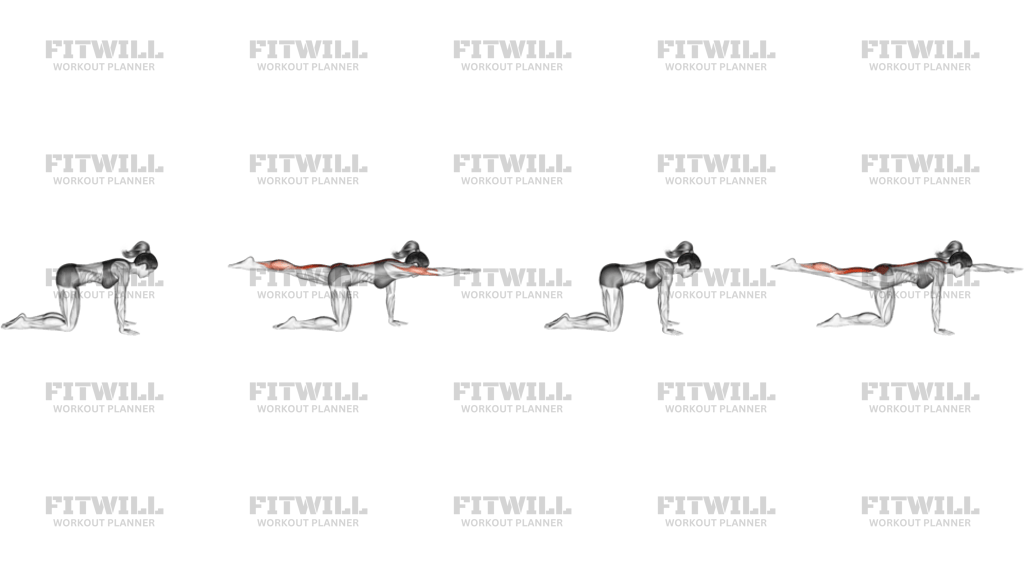
Swimming All Fours is a quadruped pilates exercise done on the floor with body weight and a strong focus on control. From hands and knees, you alternate reaching one arm and the opposite leg away from the body so the torso stays long, the hips stay square, and the trunk does not twist to chase the range. It is a simple-looking drill, but the quality of the position matters more than how far you can extend.
The main training value comes from the way Swimming All Fours challenges the deep core, spinal stabilizers, glutes, and shoulder girdle at the same time. One side of the body has to support you while the other side reaches, so each rep asks for balance between stability and movement. That makes the exercise useful when you want cleaner trunk control, better cross-body coordination, and a more organized pattern before more demanding crawling, locomotion, or core work.
The setup is important because a sloppy base changes the whole exercise. Hands should stay under the shoulders, knees under the hips, and weight spread evenly through the palms and kneecaps. The neck stays long, the ribs stay knit down, and the pelvis stays level as you reach. If the low back arches or the chest sinks, shorten the reach and make the rep smaller instead of trying to force a bigger line.
Each repetition should feel like a long reach rather than a kick or a throw. Extend the working arm and leg until they make a straight line with the torso, then hold long enough to feel the support side working without losing alignment. The return should be just as controlled as the reach, with no rocking through the shoulders or hips. Breathing should stay calm and steady so the trunk keeps supporting the movement instead of bracing so hard that the ribs flare.
Swimming All Fours fits well in a warm-up, pilates block, rehab-style core session, or any program that needs low-load stability work. It is usually appropriate for beginners because the movement is scaleable, but the standard is strict: the fewer compensations you use, the more useful the exercise becomes. Treat every rep as a balance drill for the spine and pelvis, not as a test of how high the arm and leg can lift.
[ Workout Log & Planner ]
Put your next workout in Fitwill
Keep your plan and training log ready when you are.


Instructions
- Kneel on a mat on hands and knees with your hands under your shoulders and your knees under your hips.
- Spread your fingers, press the floor away, and keep your weight even between both palms and both knees.
- Set a long neck, draw your ribs down, and keep your pelvis level before you move.
- Reach one arm straight forward as you extend the opposite leg straight back behind you.
- Keep both hips facing the floor and stop the reach before your low back starts to arch.
- Hold the extended position briefly, reaching through the fingertips and the heel to make the body feel long.
- Lower the hand and knee back under control without letting the torso sway or shift sideways.
- Switch sides and repeat the same reach on the opposite arm and leg.
- Breathe smoothly through each rep and reset your base if you start losing balance or alignment.
Tips & Tricks
- Keep the reaching arm in line with your ear, not out to the side, so the torso does not rotate to help the rep.
- Think about sliding the back heel away instead of lifting it high; a lower leg line usually keeps the lumbar spine calmer.
- If your shoulders shift over the supporting hand, widen your base slightly and press both palms into the mat before the next rep.
- A small pause in the fully extended position is better than a bigger but unstable reach.
- Keep the kneeling knee light on the floor; if you rock back hard into the knee, you are probably using momentum.
- Exhale as the arm and leg extend if your ribs tend to flare during the reach.
- Use a shorter range if you feel the low back taking over before the glute and core do.
- Move slowly enough that the support side stays quiet and the pelvis does not tilt toward the lifted leg.
Frequently Asked Questions
What does Swimming All Fours train most?
It mainly trains trunk stability, glute control, and shoulder control while the opposite arm and leg reach away from the floor.
Can beginners perform this exercise?
Yes. Beginners usually do best with a shorter reach and a brief hold, as long as the hands stay under the shoulders and the knees stay under the hips.
Should my hips stay square during Swimming All Fours?
Yes. Try to keep both hip bones facing the floor instead of letting the lifted leg open the pelvis or swing the torso.
How high should the arm and leg lift?
Only as high as you can keep a long spine and steady shoulders. A straight, controlled line is better than a big lift that arches the low back.
Is Swimming All Fours the same as a bird dog?
It is very similar. This version emphasizes a slower, more pilates-style reach and body-lengthening quality rather than a fast alternating drill.
What should my hands and knees be doing?
Your hands should stay planted under your shoulders and your knees under your hips so the base stays stable while the opposite limbs move.
Why does my low back want to arch during this exercise?
Usually the reach is too large or the ribs are flaring. Shorten the arm and leg line and keep the exhale steady as you extend.
Can I hold the extension or should I keep moving?
Both can work. A short hold builds more control, while a smooth alternating rhythm is useful once you can keep the torso still.