Potty Squat With Support
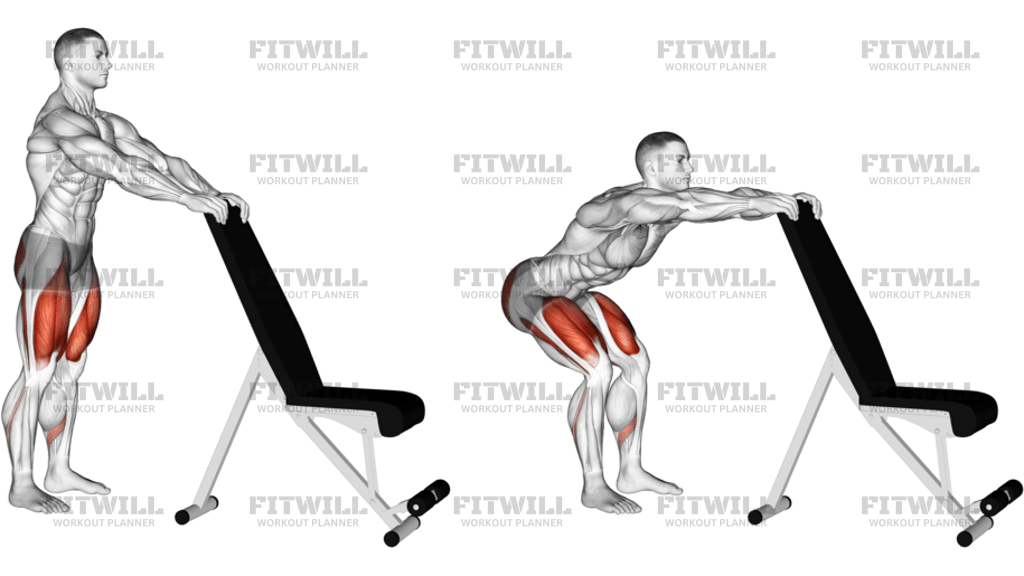
Potty Squat With Support is a bodyweight supported squat performed while holding a stable bench or chair in front of you. The hands give you a balance reference, but the legs still do the work. This makes the movement useful for building squat pattern confidence, hip mobility, and lower-body control without demanding the same amount of balance as a free squat.
The main training emphasis is on the glutes, with the quads, hamstrings, adductors, and core helping you keep the descent organized and the stand-up smooth. In anatomy terms, the primary work comes from the Gluteus maximus, with support from the Quadriceps, Biceps femoris, Rectus abdominis, and Erector spinae. Because the hands are on the support, it is easy to let the upper body do too much, so the best repetitions come from keeping the grip light and the torso controlled.
Setup matters here. Stand with your feet about shoulder-width apart, toes slightly turned out, and hold the top of the bench or chair with straight arms. Keep your weight over the midfoot and heels before you start the descent. A steady setup lets you sit the hips back and down instead of dropping forward onto the toes or collapsing into the bottom position.
Each repetition should look like a smooth squat to a supported bottom position, then a controlled stand back up. Lower until your thighs are near parallel or as deep as you can go without heel lift, knee collapse, or a tucked pelvis. Use the support only to steady yourself, not to pull yourself upright. Drive through the floor on the way up and finish by standing tall with the glutes engaged.
This variation is a good choice for warmups, beginner squat practice, mobility work, or accessory lower-body training when you want a clean pattern with less balance demand. It also works well as a regression when a full squat feels unstable. Keep the movement pain-free, shorten the range if your knees or back complain, and treat the support as a guide rail rather than a crutch.
Fitwill
Log Workouts, Track Progress & Build Strength.
Achieve more with Fitwill: explore over 9600 exercises with images and videos, access built-in and custom workouts, perfect for both gym and home sessions, and see real results.
Start your journey. Download today!




Instructions
- Stand facing a sturdy bench or chair and place your feet about shoulder-width apart, with your toes turned out slightly.
- Hold the top edge or backrest with both hands, keep your arms straight, and stack your shoulders over your hips.
- Set your weight over the midfoot and heels before you start the descent.
- Sit your hips back and bend your knees at the same time, keeping your chest long and your spine neutral.
- Lower under control until your thighs are near parallel or as deep as you can go without your heels lifting.
- Let the support help your balance, but do not hang your bodyweight on your arms.
- Drive through your heels and midfoot to stand back up, finishing with the glutes squeezed and the knees tracking over the toes.
- Inhale on the way down, exhale as you stand, and repeat for the planned reps.
Tips & Tricks
- Use the support as a balance aid, not as a way to pull yourself out of the squat.
- If your knees drift inward, turn the toes out a little more and track the knees in line with the second or third toe.
- Keep your heels heavy; if they pop up, shorten the depth or widen your stance slightly.
- A light forward torso angle is normal here and usually helps the hips sit back instead of dumping you onto the toes.
- Stop the descent before your pelvis tucks hard under at the bottom.
- Think about sitting between your heels rather than straight down onto your toes.
- If the top of the bench is too high to hold comfortably, use a more suitable sturdy support at about waist to chest height.
- Move slowly through the first few reps so you can find the depth where your knees, hips, and balance all feel organized.
Frequently Asked Questions
What muscles do Potty Squat With Support work?
The main emphasis is on the glutes, with the quads, hamstrings, adductors, and core helping control the squat and stand-up.
Why do I hold the bench or chair in this exercise?
The support gives you balance and a reference point for depth, but your legs should still control the squat.
How deep should I lower into the squat?
Go as deep as you can while keeping your heels down, knees tracking over the toes, and your pelvis from tucking hard under.
Should I lean forward while doing this squat?
A slight forward lean is normal because it helps the hips move back, but the spine should stay long and not round.
Can beginners use Potty Squat With Support?
Yes. It is a good beginner squat pattern because the hands-on support reduces balance demands and makes the descent easier to control.
What is the most common mistake with the support?
People often pull hard on the bench or chair and let the arms do the work. The hands should only steady you.
Why do my knees cave inward at the bottom?
That usually means your stance is too narrow, your toes are too straight, or you are dropping faster than your hips can control.
Can I use a chair instead of a bench?
Yes, as long as it is stable and does not slide. Pick a support that lets you hold on without shrugging your shoulders.
Is this exercise more for strength or mobility?
It can do both. Use slower, controlled reps for squat strength and confidence, or lighter practice reps for hip and ankle mobility.